From missed exits and impossible turns to unnecessary detours, even sophisticated navigation apps can make frustrating mistakes. Here’s why they happen—and what drivers can do about them.
You’re driving through an unfamiliar neighborhood when your navigation app tells you to turn right. You follow the instructions, only to discover that the street is closed. A few minutes later, the app sends you around the block and brings you back to the same intersection.
Or perhaps you’ve experienced something even stranger: your phone insists you’re driving on a nearby street when you’re actually traveling along a highway.
Millions of drivers rely on Google Maps, Waze, Apple Maps, and other navigation services every day. These applications combine satellite positioning, digital maps, traffic information, and sophisticated algorithms to guide us from one destination to another.
Yet they still make mistakes, sometimes with consequences that go beyond inconvenience.
Understanding why requires recognizing an important distinction: GPS determines your location. Navigation software decides where you should go. And either part of that process can fail.
The Satellites Don’t Know Where You’re Going
The Global Positioning System, or GPS, was developed by the United States government. It uses signals transmitted by satellites orbiting Earth to help receivers calculate their positions.
Your smartphone measures the timing of signals from multiple satellites to estimate where you are. Modern phones may also use other satellite navigation systems, cellular networks, Wi-Fi, and motion sensors to improve positioning.
Under favorable conditions, GPS-enabled smartphones are typically accurate within approximately 16 feet (4.9 meters), according to the U.S. government’s GPS information service. But accuracy deteriorates when satellite signals are obstructed or distorted.
Tall buildings can block signals or reflect them toward your phone. Bridges, tunnels, parking garages, and dense tree cover can create similar problems.
This explains why your location indicator sometimes jumps between streets or appears to move in the wrong direction.
The GPS system may be functioning normally. Your phone simply isn’t receiving sufficiently reliable information.
When the Map Is Wrong
Sometimes the satellite positioning is accurate, but the digital map contains incorrect information. A street may have been converted to one-way traffic. A road may be temporarily closed for construction. A new intersection may not yet appear in the mapping database.
Navigation applications depend on information gathered from government agencies, commercial mapping providers, businesses, and users who report changes.
Updating this information across millions of roads is a continuous challenge.
Even an apparently minor error can create a major problem for a driver. An incorrectly marked turn restriction might send someone toward an illegal maneuver. A misplaced address can direct a delivery driver to the wrong side of a building. An outdated road connection may cause the app to recommend a route that no longer exists.
In these cases, the problem isn’t the satellite system. It’s the information the navigation application uses to interpret the world.
Why Does the App Choose Such Strange Routes?
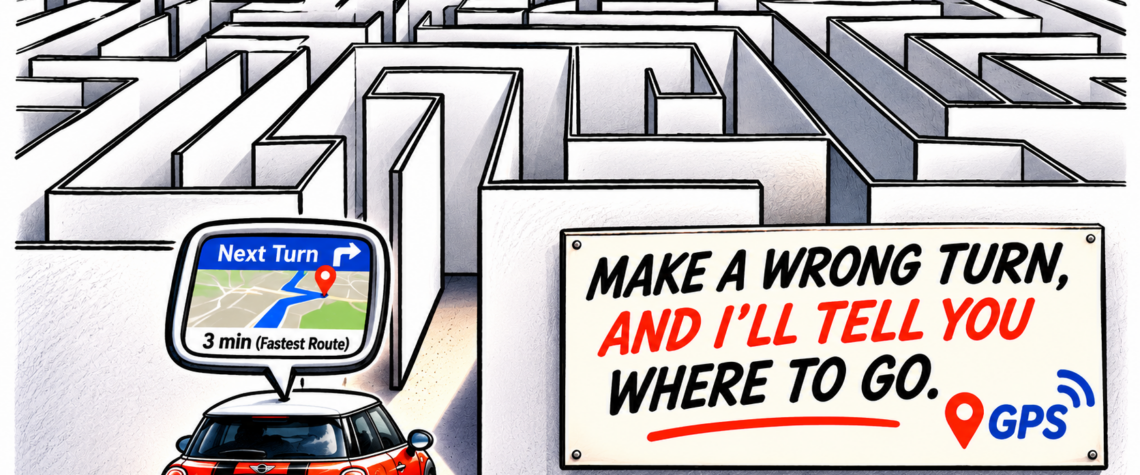
Navigation software doesn’t necessarily choose the simplest or most comfortable route.
It generally attempts to optimize a journey according to factors such as estimated travel time, distance, traffic conditions, road restrictions, and user preferences.
That can produce surprising recommendations. A route that saves two minutes might involve several difficult turns. A shortcut through residential streets may look efficient to the software but feel unnecessarily complicated to the driver.
Traffic predictions can also change suddenly. An accident, road closure, or unexpected congestion may cause the application to recalculate the journey.
Sometimes the new route is genuinely better. Other times, the predicted advantage disappears before the driver reaches it.
Google explains that its Maps service uses historical and current location information, along with data from external partners, to estimate traffic conditions and travel times.
Those estimates are useful, but they remain predictions rather than guarantees.
Why Doesn’t the App Learn From Millions of Drivers?
It seems reasonable to expect that a navigation application used by millions of people would eventually stop making the same mistakes.
But collecting enormous quantities of data doesn’t automatically eliminate errors.
Drivers may travel through a street despite a temporary restriction. Traffic patterns may change from one hour to another. A road closure reported by one person may be difficult to verify immediately.
Some errors involve incomplete mapping information rather than traffic predictions. Others result from the limitations of satellite reception.
Navigation systems must continuously reconcile information that may be incomplete, contradictory, or outdated.
Even when an algorithm recognizes a pattern, that doesn’t necessarily mean it understands the circumstances behind it.
Can Artificial Intelligence Solve the Problem?
Artificial intelligence and machine learning can help navigation services analyze traffic patterns, estimate arrival times, identify unusual congestion, and predict which routes may be faster.
They can also assist in interpreting large amounts of mapping and road-condition data. But AI cannot guarantee accurate directions when the underlying information is wrong.
A sophisticated prediction based on an outdated map may still produce an incorrect recommendation.
Likewise, an algorithm cannot reliably determine a vehicle’s exact location when satellite reception is severely disrupted.
The problem illustrates a broader limitation of intelligent systems: better predictions do not eliminate uncertainty.
When GPS Signals Are Deliberately Disrupted
Most everyday navigation mistakes result from ordinary technical limitations, outdated maps, or routing decisions. However, satellite navigation can also be affected by deliberate interference.
Jamming involves transmitting signals that interfere with a receiver’s ability to detect legitimate satellite transmissions. Spoofing is different. It involves transmitting misleading signals that can cause a receiver to calculate an incorrect position or time.
These threats are particularly important in aviation, maritime navigation, and other activities that depend on precise positioning.
The Federal Aviation Administration has published guidance addressing both forms of interference.
For ordinary drivers, however, an incorrect turn or misplaced location indicator is far more likely to result from common reception or mapping problems than from a deliberate attack.
Seven Ways to Avoid Navigation Mistakes
1. Review the route before leaving. Look at the general direction of travel, major highways, and destination area rather than relying entirely on turn-by-turn instructions.
2. Check alternative routes. The fastest route isn’t always the easiest. A slightly longer journey may involve fewer complicated turns or less stressful driving.
3. Download offline maps when available. Offline maps can help when cellular service disappears, although live traffic information and some navigation features may be unavailable.
4. Keep your navigation app and phone updated. Software updates can correct bugs and improve compatibility with location services.
5. Make sure location permissions are enabled. Check that your navigation application has the location access it needs, including precise location where supported.
6. Report incorrect roads and directions. Mapping providers offer ways to submit corrections. Google Maps, for example, allows users in supported regions to report incorrect route steps through its desktop interface.
7. Trust road signs and actual conditions over the screen. Never make an illegal or dangerous turn simply because an application instructs you to do so. If you miss an exit, continue safely and allow the system to recalculate.
The Driver Still Has the Final Word
Navigation technology has transformed everyday travel. It helps drivers avoid congestion, find unfamiliar destinations, and navigate cities that would once have required detailed maps and considerable preparation.
Its occasional failures don’t erase those achievements. But the technology has also encouraged a new habit: following instructions without questioning them. A navigation application can process enormous amounts of information, yet it cannot always recognize what a driver sees directly through the windshield.
The most reliable approach is to treat digital navigation as an exceptionally useful assistant—not an unquestionable authority. After all, the app may know where it thinks you are. You’re the one who can see the road ahead.
…………
This article is supported by official information on GPS accuracy, map errors, route calculation, and interference.