An open-source photo editor built with artificial intelligence is challenging assumptions about the cost of creating software. But faster development also raises questions about copyright, quality, jobs, and the future of commercial applications.
For decades, developing sophisticated software required large teams of programmers, years of engineering work, and substantial financial investment. Applications such as Adobe Photoshop became industry standards not simply because of their features, but because of the enormous resources needed to build, improve, and maintain them.
Now artificial intelligence is beginning to challenge that economic model.
Brandon Thomas, a software developer and founder of ArtCraft, says he created the first working version of PhotoCraft, an open-source application designed to resemble Photoshop, in approximately 24 hours.
Instead of writing the program line by line, Thomas used an AI coding model to generate much of the software from his instructions.
The result was not a complete replacement for Photoshop. But it was functional enough to attract attention from developers, technology journalists, and users interested in alternatives to expensive commercial applications.
The experiment raises a question with implications far beyond photo editing: What happens to the software industry when the cost of creating competing applications falls dramatically?
From Writing Code to Directing AI
Traditional software development requires programmers to translate ideas into instructions that computers can execute.
AI-assisted development changes part of that process.
Instead of manually writing every function, developers can describe what they want, ask an AI system to generate code, test the results, and request improvements.
The approach is sometimes called vibe coding, although the term is often used loosely to describe different levels of AI assistance.
Thomas is an experienced programmer, not someone who simply asked a chatbot to create Photoshop.
According to his account to PCMag, he designed the application’s architecture, specified how its components should be organized, and directed the AI through the development process.
He also allowed the model to examine screenshots of Photoshop’s interface and use publicly available knowledge about how the application works.
Thomas said he did not give the AI access to Adobe’s source code, executable code, or underlying application.
That distinction is important because the project aims to reproduce familiar functionality without directly copying proprietary software.
PhotoCraft was written in Rust, a programming language used to build applications where performance and reliability matter.
The first working version reportedly took about a day. Additional development, testing, and improvements have continued since then.
A Familiar Interface, but Not Yet a Full Replacement
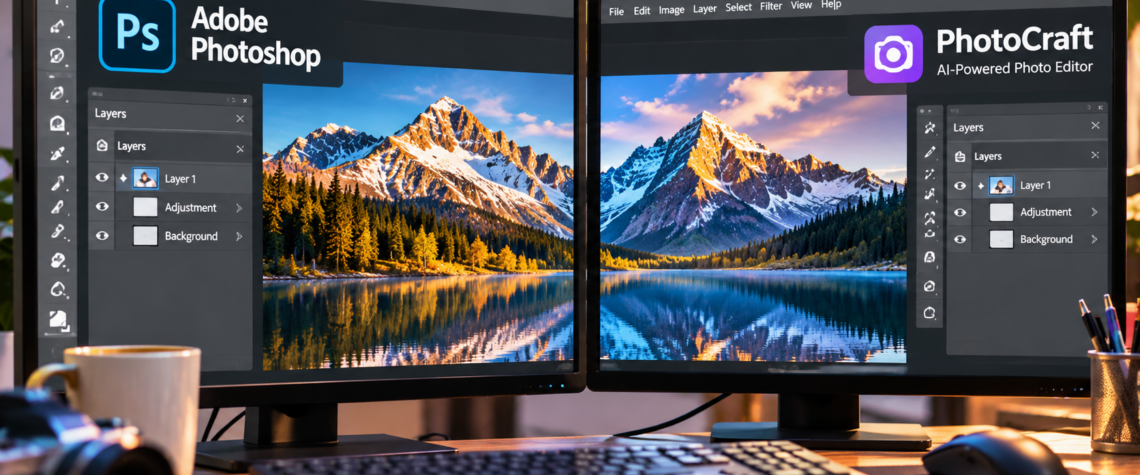
PhotoCraft resembles Photoshop in ways that may appeal to experienced users.
Its menus, panels, keyboard shortcuts, and editing tools follow familiar patterns. The application supports features such as layers, masks, and image adjustments.
In a hands-on evaluation, PCMag’s Jim Fisher found PhotoCraft and a related Lightroom-style application, LightCraft, surprisingly capable for relatively new projects.
However, the testing also revealed limitations in advanced image processing and professional workflows.
The developers themselves have acknowledged that PhotoCraft remains an early-stage application rather than a complete replacement for Photoshop.
This distinction matters because software quality cannot be measured simply by the number of visible features.
Professional applications must handle complex files, unexpected user actions, large workloads, security vulnerabilities, and compatibility problems.
They also need documentation, customer support, accessibility features, updates, and reliable performance over time.
Creating a convincing first version in one day is impressive. Maintaining a dependable product for millions of users is an entirely different challenge.
Is Copying Software Features Illegal?
PhotoCraft also raises questions about intellectual property.
Software companies own copyright in original code and certain creative elements of their products. But copyright generally does not grant exclusive ownership of every function or idea implemented by a program.
A photo editor, for example, may offer layers, brushes, filters, and cropping tools without necessarily infringing another company’s copyright.
The legal situation becomes more complicated when a competing product closely reproduces a distinctive interface, protected graphics, branding, or other expressive elements.
Patent rights, trademark law, licensing agreements, and unfair-competition rules may also be relevant.
In interviews with PCMag, intellectual-property attorney Thomas Dunlap explained that reverse engineering can be lawful in the United States, but that does not automatically protect every form of imitation.
The circumstances matter.
An independently written program that performs similar tasks is not necessarily an illegal copy. Conversely, generating code with AI does not make infringement impossible.
The central legal questions concern what was copied, how it was obtained, which protections apply, and whether the new product violates those rights.
There is no established basis for declaring PhotoCraft piracy merely because it resembles Photoshop.
Nor should the use of AI be treated as proof that the application is legally original.
The Economic Threat to Traditional Software
The larger significance of PhotoCraft may lie in economics rather than copyright.
Software companies traditionally recover development costs through licenses, subscriptions, enterprise contracts, and related services.
If AI allows smaller teams to build sophisticated alternatives more quickly, competition could increase.
Consumers might gain access to more free or inexpensive applications.
Small businesses could commission software tailored to their needs rather than paying for expensive products containing features they rarely use.
Independent developers might enter markets previously dominated by large companies.
For established software businesses, however, lower development costs could create pressure on subscription prices and profit margins.
That does not mean companies such as Adobe will suddenly become obsolete.
Established applications benefit from trusted brands, professional ecosystems, integrations, training resources, and years of accumulated reliability.
For many organizations, switching software involves more than comparing features. It can require retraining employees, converting files, changing workflows, and accepting new operational risks.
AI may make software easier to create without making established customer relationships equally easy to replace.
What Happens to Programmers?
The possibility of creating complex applications with AI has intensified concerns about the future of programming jobs.
If a model can generate thousands of lines of code in minutes, companies may eventually need fewer people to perform certain repetitive development tasks.
But programming involves much more than producing code.
Engineers must understand business requirements, design systems, identify security problems, evaluate trade-offs, and maintain applications after deployment.
AI-generated code still requires testing and oversight.
The PhotoCraft project illustrates both sides of this transformation.
Thomas was able to accelerate development substantially. Yet the project also attracted contributors who help identify problems, improve features, and maintain the software.
Rather than eliminating human involvement, AI changed the kind of work humans performed.
Whether this ultimately reduces employment, creates new opportunities, or changes the distribution of programming jobs remains uncertain.
What seems increasingly likely is that developers will need to become skilled at evaluating and directing AI-generated work, not merely producing code themselves.
The Hidden Cost of AI-Generated Software
Speed can create problems of its own.
In November 2026, Software Improvement Group, a company specializing in software quality analysis, examined seven AI-built applications from the ArtCraft suite.
Its analysis found that the programs performed reasonably on some security measures but received low scores for maintainability and architecture.
PhotoCraft received a particularly weak modularity assessment, suggesting that changes to one part of the program could be difficult to manage without affecting other components.
These findings do not establish that the applications are unusable or inherently unsafe.
They highlight a practical problem: AI can generate large amounts of functioning code faster than developers may be able to understand, test, and maintain it.
A program that appears to work today may become expensive to improve tomorrow.
For consumers, the danger is assuming that an application is reliable simply because it looks professional or performs well during a short demonstration.
For businesses, the danger is adopting AI-generated software without sufficient security reviews, documentation, and long-term support.
The cost of building software may be falling, but the cost of maintaining trustworthy software has not disappeared.
What Should Consumers Do?
AI-generated alternatives could provide substantial savings, particularly for people who cannot justify expensive software subscriptions.
But users should approach new applications carefully.
Before installing a program, verify that it comes from the project’s official distribution channel or a trustworthy repository.
Check whether the software is actively maintained, whether known problems are documented, and whether other users have reported serious failures.
For applications that handle important files, test compatibility using copies rather than original documents.
Professional photographers, designers, and businesses should be especially cautious about relying on early-stage software for critical projects.
Open-source licensing can provide useful transparency and flexibility, but it does not guarantee security or quality.
And a program developed with AI should be judged by the same standards as any other software: Does it work reliably? Is it secure? Can it be maintained? Does it meet the user’s needs?
A Different Future for Software
PhotoCraft may not replace Photoshop anytime soon.
But its significance does not depend on achieving that goal.
The project demonstrates how artificial intelligence can compress the early stages of software development and make ambitious applications possible with fewer initial resources.
That could expand competition, lower costs, and give independent developers opportunities that once seemed unattainable.
It could also produce a flood of poorly maintained applications and force the industry to reconsider how it evaluates software quality and intellectual property.
For established technology companies, the challenge will be demonstrating that their products offer value beyond features that competitors can increasingly reproduce.
For programmers, the challenge will be adapting to tools that automate more of the work they once performed manually.
And for consumers, the opportunity will be greater choice—provided they can distinguish genuinely useful alternatives from impressive but unfinished experiments.
Artificial intelligence may make it possible to build software in a day.
The harder question is whether that software will still be worth using years later.