The coffee giant is exploring personalized menus, automatic payments, and AI-assisted ordering. The promise is convenience, but the technology raises new questions about customer data, privacy, and the growing influence of algorithms on everyday purchases.
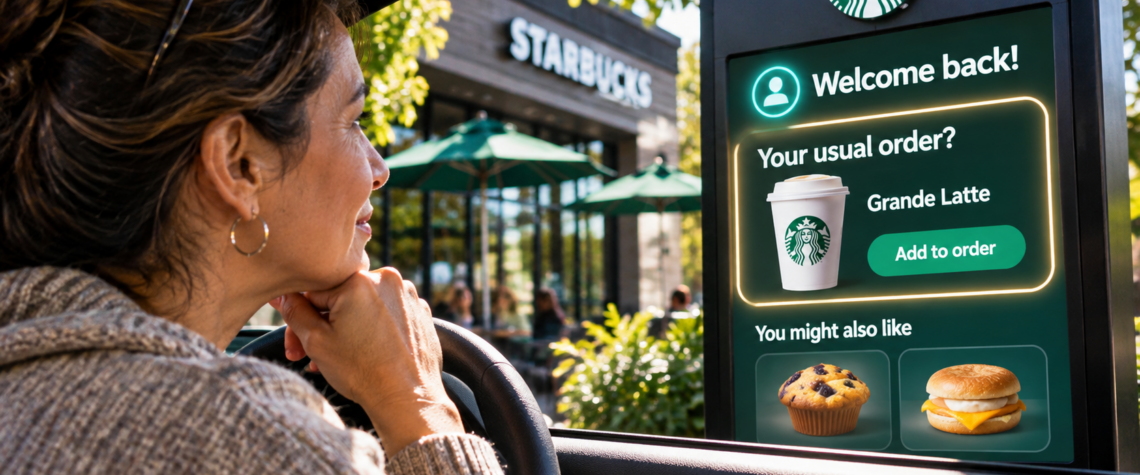
Imagine pulling into a Starbucks drive-thru and discovering that the restaurant already knows who you are, what you usually order, and how you prefer to pay.
Before you say a word, a digital menu displays your favorite coffee. The barista greets you by name and asks whether you would like your usual order. Moments later, your payment is complete.
For customers accustomed to waiting in line, the experience might sound appealing.
But it also raises a question: How much information should a coffee shop know about its customers?
Starbucks is exploring technology that could make this scenario possible. During the company’s October 29 earnings conference call, CEO Brian Niccol described plans to recognize participating customers as they arrive, display personalized menus, and simplify payment.
The announcement quickly generated speculation that facial recognition technology might be coming to Starbucks.
But the company’s subsequent explanation points in a different direction.
Starbucks says the proposed experience would operate through its mobile application, with customers choosing whether to participate.
The distinction matters. Recognizing someone through a voluntarily enrolled smartphone application is not the same as identifying that person’s face with a camera.
Nevertheless, the technology illustrates how artificial intelligence is transforming the relationship between retailers and consumers.
A Coffee Shop That Remembers Your Preferences
Starbucks has spent years developing its mobile ordering and loyalty programs. Its application allows customers to customize beverages, place orders, make payments, and earn rewards.
According to a November 11 company announcement, Starbucks Rewards had reached 36 million active U.S. members over the preceding 90 days.
That extensive digital relationship gives Starbucks opportunities to make its services more personalized.
The company is developing features that could recommend products based on customers’ previous purchases and stated preferences. It also wants to simplify ordering through conversational AI and improve how customers discover food and beverages.
In the drive-thru, the experience could become particularly noticeable.
A customer who chooses to participate might be recognized upon arrival, shown a familiar order, and offered a faster way to pay.
Starbucks has not announced a launch date or identified specific stores for the personalized arrival experience.
The company describes the initiative as exploratory, meaning its final design and availability remain uncertain.
What About Facial Recognition?
Some early headlines suggested that Starbucks was preparing to identify customers by scanning their faces.
That interpretation went beyond what Niccol actually announced.
In an interview following the earnings call, the CEO described an experience in which the Starbucks application would recognize a customer arriving at the drive-thru.
On November 11, Starbucks provided additional clarification. The company said customers would enroll through its app and that recognition would depend on information and preferences they chose to share.
The announcement did not describe facial recognition as part of the proposed system.
Other technologies could potentially support app-based recognition, including location services or short-range wireless signals. However, Starbucks has not publicly specified the technical method it intends to use.
For consumers, this distinction is important because different identification technologies create different privacy risks.
A loyalty account or application can generally be disabled or disconnected. Biometric identifiers, such as facial characteristics, are much harder to change if compromised.
The broader lesson is that consumers should look beyond the word recognition and ask precisely how a company identifies them.
When Convenience Depends on Personal Data
Personalized services depend on information.
To recommend a familiar beverage, a retailer may use previous purchases. To suggest a new product, it may analyze preferences, ordering patterns, or other information associated with an account.
The more a company learns about a customer’s habits, the more precisely it may be able to tailor recommendations.
That can be useful.
Someone who regularly orders a particular drink may appreciate having it appear immediately on the screen. A customer with dietary preferences might welcome suggestions that make choosing easier.
But personalization can also influence purchasing decisions.
A recommendation is not simply a neutral reflection of what someone likes. It is a selection made by a system designed according to the retailer’s objectives.
Those objectives may include improving customer satisfaction, increasing sales, encouraging repeat visits, or promoting particular products.
None of this means Starbucks has announced a system that secretly changes prices or manipulates individual customers.
It means that consumers should understand the difference between a service that remembers their preferences and one that uses those preferences to shape what they see.
The Difference Between Recommendations and Personalized Prices
One concern surrounding AI-powered retail is the possibility of individualized pricing.
Dynamic pricing allows businesses to adjust prices according to factors such as demand, inventory, or market conditions.
Personalized pricing goes further by potentially offering different prices to different customers based on information about them.
These practices are not identical.
Starbucks has discussed personalized menus and recommendations, but its announced drive-thru initiative does not establish that the company plans to charge different customers different prices based on their personal profiles.
Still, the distinction deserves attention as retailers increasingly experiment with AI.
A menu that recommends a customer’s favorite beverage may be convenient. A system that uses personal information to estimate how much that customer is willing to pay would raise a different set of questions.
Transparency about how recommendations and prices are determined will become increasingly important.
Artificial Intelligence Behind the Counter
Starbucks is also planning to use AI in ways customers may not immediately notice.
Beginning in fiscal 2027, the company intends to test background AI models that help baristas enter drive-thru orders more accurately.
The goal is to reduce mistakes and improve service speed while allowing employees to concentrate on customer interactions.
Starbucks is also exploring conversational ordering, which could eventually allow customers to communicate with an AI system rather than navigate a conventional menu.
These developments reflect a broader movement toward automated retail experiences.
Artificial intelligence is increasingly being used to interpret customer requests, predict preferences, organize transactions, and assist employees.
The potential benefits include shorter waits, fewer ordering errors, and more convenient service.
The challenge is ensuring that automation remains understandable and that customers retain meaningful choices.
What Should Starbucks Customers Know?
For now, the proposed recognition system remains an initiative under development, not a service that customers should assume is already operating at their local Starbucks.
Nevertheless, consumers can take practical steps to understand how personalization affects their privacy.
Start by reviewing the permissions granted to retail applications, particularly access to location information. A shopping or restaurant app may offer useful features without requiring every available permission.
Customers should also examine privacy settings and determine whether they can control personalized recommendations or optional data sharing.
Loyalty programs deserve similar attention. Rewards and convenience can provide genuine value, but customers should understand what information they exchange for those benefits.
When new AI-powered services become available, consumers should ask whether participation is optional, how their identity is established, what information is retained, and whether they can withdraw consent.
They should also remember that a personalized recommendation is still a commercial recommendation.
The product displayed first is not necessarily the best choice or the best value.
The Future of Shopping May Know Us Better Than We Expect
Starbucks is not simply experimenting with a faster way to order coffee.
It is exploring a future in which retailers can recognize participating customers, anticipate preferences, and reduce the number of decisions required to complete a purchase.
For many people, that convenience will be welcome.
But the same technologies raise questions about how personal information is collected, how algorithms influence choices, and how much control consumers retain over their shopping experiences.
Starbucks says customer choice, transparency, and data protection will guide its development of personalized services.
Those commitments will ultimately need to be evaluated against the features the company actually introduces.
A coffee shop that remembers your favorite drink may make your morning easier.
The more important question is whether you remain in control of what else it remembers about you.