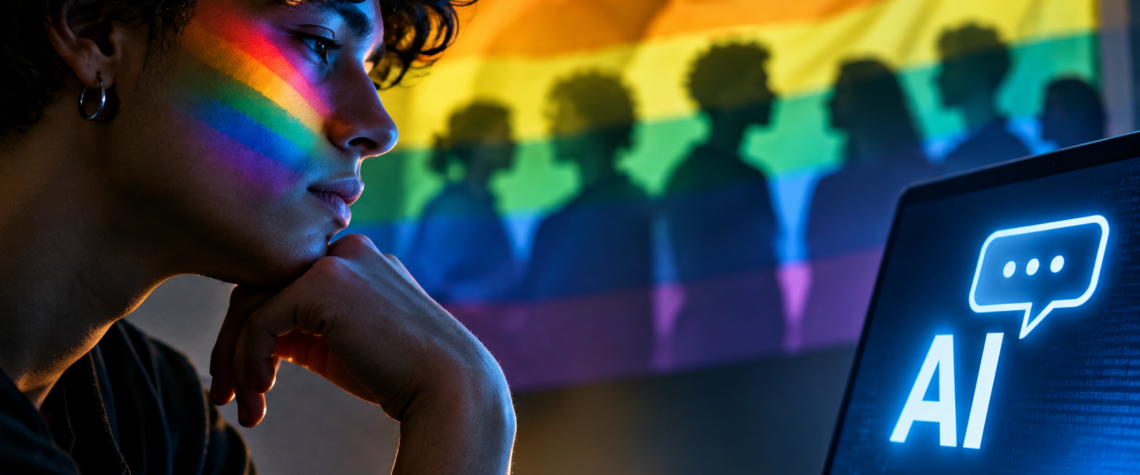
Artificial intelligence can offer a private space to explore personal questions. But research reveals troubling weaknesses in how AI systems understand identity, protect sensitive information, and respond to LGBTQ+ experiences.
Imagine someone asking an artificial intelligence chatbot a question they have never dared to ask another person. Perhaps they are uncertain about their sexual orientation, struggling with their gender identity, or preparing to tell their family something deeply personal.
The chatbot responds immediately. It does not appear surprised, impatient, or judgmental. It offers explanations, encouragement, and suggestions. For someone afraid of rejection, the experience may feel reassuring.
But what happens when the machine misunderstands the question, reproduces a stereotype, or stores information the person intended to keep private?
These concerns are becoming increasingly important as artificial intelligence moves into everyday conversations about relationships, identity, health, and emotional well-being.
Recent research suggests that while AI can provide useful information and a sense of support, it can also reproduce biases, mishandle sensitive subjects, and create privacy risks that users may not fully understand.
When the Machine Doesn’t Understand
Artificial intelligence systems learn patterns from enormous collections of human-produced information. Those collections reflect society’s knowledge, but they can also contain its prejudices, omissions, and stereotypes.
Researchers have found that these problems can influence how language models represent sexual orientation and gender identity.
A study published in November 2025 in the proceedings of the Association for Computational Linguistics examined stereotypes involving sexual and gender minorities. Researchers Ruby Ostrow and Adam Lopez found that large language models could reproduce stereotyped representations of these groups, including in creative writing.
The implications extend beyond offensive language. An AI system that relies on distorted assumptions may produce misleading explanations, inappropriate recommendations, or inaccurate portrayals of people’s experiences.
A separate 2025 study examined how language models respond to LGBTQ+ expressions and slang. It found differences in the emotional tone of responses, suggesting that even systems designed to avoid explicit discrimination can handle minority language unevenly.
These findings do not mean that every AI response involving LGBTQ+ people is biased. They demonstrate that respectful behavior cannot be assumed simply because a chatbot has been programmed to avoid offensive statements.
The Privacy Problem: Who Knows What You Told the Chatbot?
For many users, privacy may be an even greater concern than biased responses.
Conversations about sexual orientation, gender identity, relationships, or personal difficulties can reveal information that someone has chosen not to share with employers, relatives, or friends.
Unlike a confidential conversation with a licensed professional, an ordinary chatbot interaction is governed by the provider’s data policies and applicable privacy laws.
In October 2025, researchers at Stanford University reported concerns about the privacy practices of major AI developers. Their examination of company policies found that user conversations could be retained or used to improve AI systems, depending on the provider and its settings.
The researchers also identified difficulties in understanding how personal information is collected, processed, and retained.
For LGBTQ+ users, these issues can carry particular consequences. Disclosure of someone’s identity without consent may expose them to discrimination, harassment, or personal conflict.
The risk is not that every chatbot conversation will become public. It is that users may disclose highly sensitive information without understanding how it will be handled.
Privacy protections vary across services, and some providers offer controls to limit data use. But users should not assume that every AI conversation is confidential.
When Safety Filters Become a Form of Exclusion
Artificial intelligence companies use automated safeguards to prevent harmful or inappropriate content. These systems serve important purposes, including reducing harassment, exploitation, and dangerous advice.
However, poorly designed filters can also suppress legitimate discussions.
A 2024 article in Nature Computational Science examined evidence that AI safety systems have disproportionately excluded LGBTQ+ material from datasets and online content.
An educational discussion about sexual health, for example, may contain language that resembles material an automated system has been trained to restrict. Without sufficient context, the system may reject or limit information that is entirely legitimate.
This creates a difficult challenge for technology companies.
Safety systems must protect users from abuse without treating discussions of LGBTQ+ identities as inherently inappropriate.
The distinction matters for educational resources, health information, personal testimony, and online communities.
GLAAD’s 2026 report, Build for Everyone: A Framework for LGBTQ Representation and Safety in AI, identifies representation, privacy, content moderation, and accountability as important areas for improvement.
The organization’s recommendations emphasize the need for AI systems that recognize diverse experiences while protecting users from harassment and discriminatory treatment.
Can AI Offer Emotional Support?
Despite these concerns, artificial intelligence may provide meaningful benefits.
Researchers at Harvard University and collaborating institutions examined how people, including LGBTQ+ participants, used AI chatbots for mental health-related conversations.
The study involved 31 participants, 18 of whom identified as LGBTQ+.
Some participants described chatbots as accessible spaces for exploring their identities or rehearsing difficult conversations, including telling friends or family members about their sexual orientation.
But the researchers also found significant limitations.
Chatbots sometimes responded with generic expressions of sympathy rather than understanding the circumstances behind a user’s problem. In other cases, their recommendations failed to consider practical consequences.
One participant described receiving advice to leave a job after experiencing workplace homophobia, without sufficient attention to the financial implications.
The findings illustrate a fundamental limitation: a chatbot may generate supportive language without fully understanding the social, emotional, and economic realities surrounding a person’s situation.
AI can help people organize their thoughts, obtain information, or prepare for conversations. It should not be treated as a substitute for qualified professional assistance when serious mental health concerns are involved.
Bias Can Have Consequences Beyond Conversation
The stakes become even higher when AI systems are used in healthcare.
A study published in PLOS Digital Health in September 2025 evaluated four large language models using clinical scenarios developed with medical and LGBTQIA+ health expertise.
Researchers found inappropriate responses in both scenarios that mentioned LGBTQIA+ identities and those that did not. The problems included inaccurate information, safety concerns, and bias.
The study also identified differences in the severity and character of some biased responses involving LGBTQIA+ patients.
The findings suggest that adding an AI system to healthcare does not automatically eliminate inequalities already present in medical practice.
For developers, the challenge is to evaluate systems using realistic situations involving diverse patients, rather than relying exclusively on general performance tests.
For healthcare professionals, the lesson is that AI-generated recommendations require appropriate verification and human oversight.
What Can Users Do to Protect Themselves?
People do not need to avoid artificial intelligence entirely to reduce these risks.
They can take several practical precautions.
Before sharing sensitive information, users should review the chatbot’s privacy settings and determine whether conversations may be retained or used for model improvement.
They should avoid providing unnecessary identifying details, such as full names, addresses, workplaces, or information about other people, when asking personal questions.
For medical or mental health concerns, AI-generated information should be checked against reliable sources and discussed with qualified professionals when appropriate.
Users should also recognize that a reassuring answer is not necessarily an accurate one.
Finally, when a chatbot produces a stereotyped, discriminatory, or inappropriate response, reporting the problem can help developers identify weaknesses that standard testing may have missed.
The Larger Question: Can AI Understand Human Diversity?
The relationship between artificial intelligence and LGBTQ+ communities raises a question that extends far beyond any single group.
Can technology built from patterns in human behavior recognize the complexity of individual lives without reducing people to categories and stereotypes?
Researchers and advocacy organizations increasingly argue that better AI requires more than filtering offensive words. It requires representative evaluation data, privacy safeguards, transparent policies, and meaningful participation by the communities affected.
Artificial intelligence may never understand personal identity in the way another human being can. But it can be designed to respond with greater accuracy, fairness, and respect.
For someone asking a deeply personal question, that difference matters.
The real test of responsible AI is not simply whether a chatbot sounds understanding. It is whether the technology deserves the trust that its answers can inspire.
…………………
SOURCES: