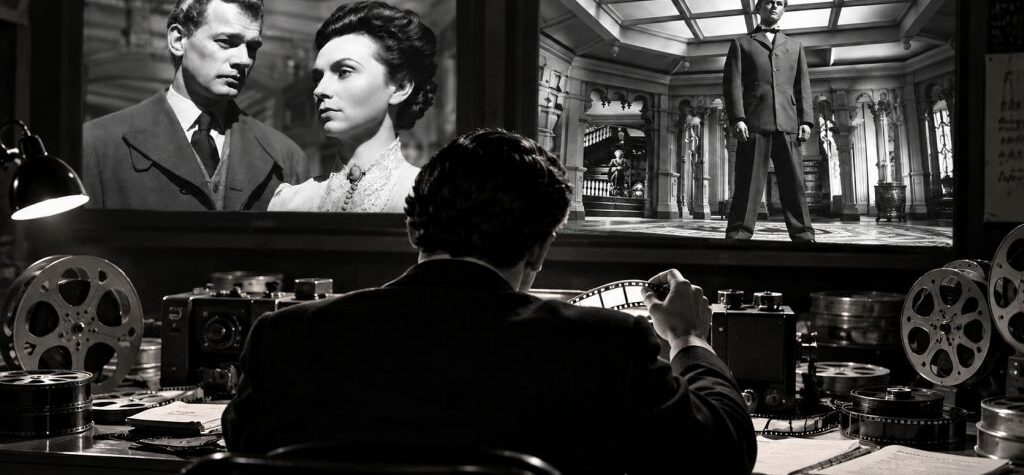
More than eight decades after Hollywood dismantled The Magnificent Ambersons, producer Edward Saatchi is using artificial intelligence to reconstruct its missing scenes. But can technology recover an artist’s vision—or only imagine what it might have been?
In 1942, while Orson Welles was working in South America, Hollywood executives took control of his second feature film, The Magnificent Ambersons. They shortened it, changed its ending and ultimately destroyed much of the footage they had removed. What survived was a celebrated film shadowed by the possibility of an even greater one. More than eighty years later, British producer and technology entrepreneur Edward Saatchi is attempting something that generations of film historians could only imagine: reconstructing the missing material using artificial intelligence.
The project is an ambitious experiment in filmmaking, historical reconstruction and digital performance. It also raises a question that reaches far beyond cinema: Can artificial intelligence restore a work of art when the original no longer exists?
The Masterpiece Hollywood Dismantled
Following the extraordinary success of Citizen Kane in 1941, Welles adapted Booth Tarkington’s novel The Magnificent Ambersons, a portrait of a wealthy Midwestern family confronting the social and economic changes brought by industrialization.
The film explored the decline of inherited privilege, the arrival of the automobile and the destructive consequences of pride. Its atmosphere was elegiac, its characters deeply flawed and its ending far from reassuring. But RKO Pictures, concerned about unfavorable preview reactions and the film’s commercial prospects, drastically altered Welles’s work. Approximately 43 minutes were removed from a version running about 131 minutes, and a more comforting ending was substituted.
The deleted footage was subsequently destroyed. Unlike many other films whose original versions have eventually resurfaced, The Magnificent Ambersons remains a celebrated example of cinema history’s irreversible losses. What survives is not necessarily the film Welles would ultimately have released, but a version profoundly altered without his control.
Rebuilding the Missing Images
Saatchi, co-founder of Fable Studio and associated with its AI filmmaking platform Showrunner, announced the reconstruction project in 2025. His team is working with filmmaker Brian Rose, who spent years researching the lost sequences and developing an animated reconstruction using surviving scripts, production documents, still photographs and other historical evidence.
The new effort combines that research with generative AI and performances by contemporary actors. The objective is to produce moving images resembling the original cast and visual style, bringing scenes back to the screen that have existed for decades primarily in written descriptions and surviving production records. By May 2026, the team was working on a substantially shortened railway-station scene involving George Minafer and his uncle Jack Amberson. Early tests had also been developed for the film’s lost boarding-house ending. These are not recovered original frames. They are newly created images guided by historical evidence.That distinction is essential.
Restoration or Reinvention?

Traditional film restoration works with surviving material. Technicians may repair damaged images, stabilize footage, correct color or reconstruct a soundtrack. Their objective is generally to preserve what was actually recorded.
The Saatchi project confronts a fundamentally different problem: the images it seeks to restore no longer exist. AI can approximate actors’ appearances, reconstruct sets and generate performances consistent with the available documentation. But it cannot know with certainty how Welles would have edited every shot, directed every gesture or refined the finished film.
Indeed, scholars have questioned whether the surviving longer cut should be regarded as Welles’s definitive artistic intention. A working version is not necessarily a final version. The result may therefore be historically informed and visually persuasive without being an authentic restoration. That does not automatically make the experiment worthless. It does, however, require an honest description of what audiences are seeing.
A Controversy Beyond the Screen
The project has also encountered questions involving copyright, artistic ownership and the digital recreation of deceased performers. Saatchi initially described the reconstruction as a noncommercial research undertaking. The rights to the original film and the concerns of Welles’s family remain important considerations for any wider distribution.
Beatrice Welles, the director’s daughter, has expressed skepticism about whether anyone or anything could reproduce her father’s thinking, while also acknowledging the care and respect with which the filmmakers appear to be approaching the work.
The disagreement reflects a broader debate now confronting the creative industries. When artificial intelligence reproduces an actor’s face, imitates a director’s visual language or generates scenes that were never filmed, who determines whether the result is preservation, interpretation or appropriation? The technology may eventually make such reconstructions easier. That will not necessarily make the ethical questions simpler.
There is an intriguing parallel between the subject of The Magnificent Ambersons and the technology now being used to reconstruct it. In Welles’s film, the automobile represents a disruptive invention that transforms society while threatening the established world of the Amberson family. Today, artif