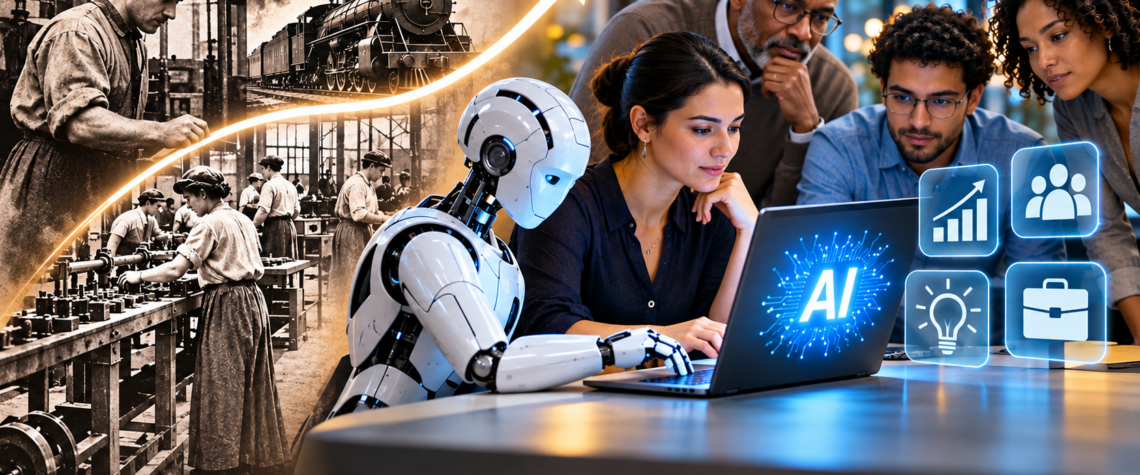
Past industrial revolutions transformed the world of work. Artificial intelligence may do the same—but its greatest promise could lie in empowering workers rather than replacing them.
Every major technological revolution has brought with it a familiar fear: machines will take our jobs.
When mechanized looms transformed textile production, workers feared for their livelihoods. When factories introduced assembly lines, entire occupations changed. When computers entered offices, many predicted that automation would make large numbers of employees unnecessary.
Those fears were not imaginary. Technological progress has repeatedly eliminated jobs, disrupted communities, and forced workers to adapt. Yet over the long term, industrial economies also developed new industries, professions, and opportunities that earlier generations could scarcely have imagined.
Today, artificial intelligence has revived the debate with extraordinary intensity. Some predict massive unemployment as machines learn to perform tasks once reserved for human intelligence. Others envision a new era of productivity, entrepreneurship, and economic expansion.
Both scenarios are possible. Neither is inevitable.
The most important question may not be how many workers artificial intelligence will replace, but how many workers it could empower.
What History Really Tells Us
The Industrial Revolution fundamentally altered the relationship between people and work. Agricultural employment declined as mechanization spread, while manufacturing, transportation, commerce, and eventually services created new opportunities.
Electricity transformed industrial production. The automobile created demand for mechanics, road construction, transportation services, and countless related businesses. Computers eliminated many routine clerical tasks but also helped create software development, digital communications, and entirely new industries.
These examples suggest that technological progress can generate employment beyond the occupations it displaces.
But history offers no guarantee that every technological revolution will produce more jobs than it destroys, especially within a particular country, industry, or generation.
The transition from one economic system to another can take decades. Workers displaced by automation do not necessarily possess the skills required for emerging occupations. New opportunities may arise in different locations, demand different qualifications, or offer lower wages.
A society can become wealthier while some of its workers become economically less secure.
That distinction is essential to understanding the artificial intelligence revolution.
Why AI May Be Different
Earlier waves of automation largely transformed physical labor and repetitive industrial processes. Computers subsequently automated many administrative and information-processing tasks.
Artificial intelligence is expanding automation into activities that require language, analysis, judgment, and creativity.
AI systems can draft documents, analyze financial information, generate computer code, summarize research, assist with medical documentation, and perform aspects of customer service.
This does not mean that every occupation involving those activities will disappear.
A job is rarely a single task. Teachers do more than prepare lessons. Journalists do more than write sentences. Doctors do more than interpret medical information. Lawyers do more than review documents.
Professional responsibility, interpersonal relationships, experience, and judgment remain central to many occupations.
The International Labour Organization’s 2025 research on generative AI emphasizes the importance of examining the individual tasks within occupations rather than assuming that exposure to AI automatically means the elimination of entire jobs.
The distinction between replacing a task and replacing a worker could determine much of AI’s eventual impact on employment.
Economists Are Far From Agreement
Even among leading economists, there is considerable uncertainty about the scale of AI’s economic benefits.
Daron Acemoglu, the Massachusetts Institute of Technology economist who received the 2024 Nobel Memorial Prize in Economic Sciences, has challenged some of the industry’s most optimistic productivity forecasts.
In his research, The Simple Macroeconomics of AI, Acemoglu estimated that AI could increase total factor productivity by approximately 0.5% to 0.6% over a decade under the assumptions of his model—an economically meaningful contribution, but far below some of the transformative gains predicted elsewhere.
He has also warned that AI could widen the economic gap between owners of technology and workers if companies primarily deploy it to reduce labor costs rather than develop new capabilities.
Other forecasts are more optimistic.
The World Economic Forum’s Future of Jobs Report 2025 projected that broad economic and technological changes could create 170 million jobs globally by 2030 while displacing 92 million, producing a net increase of 78 million positions.
Those figures, however, reflect employers’ expectations across several economic trends, not a prediction of AI’s effects alone. They are projections, not observed outcomes.
Taken together, these perspectives reveal an important reality: No one can yet calculate with confidence the final balance between the jobs artificial intelligence will create and those it will eliminate.
What If We Put AI in the Hands of Workers?
Much of the public debate treats artificial intelligence as a technology controlled by corporations and deployed upon workers.
But there is another possibility: AI as a tool that workers themselves can use to expand their knowledge, productivity, and independence.
Consider a small-business owner who previously could not afford a marketing department, professional translator, or sophisticated market research. AI tools can now help that entrepreneur prepare promotional materials, communicate with international customers, and analyze business opportunities.
An independent journalist can use AI to organize research, compare documents, transcribe interviews, and investigate unfamiliar subjects—while retaining responsibility for accuracy and editorial judgment.
A teacher can prepare differentiated learning materials. A technician can consult interactive explanations of unfamiliar equipment. A professional returning to the workforce can practice new skills with an AI tutor.
These applications do not eliminate the need for human expertise. They can make expertise more accessible and help individuals accomplish work that previously required larger organizations or more expensive resources.
The real question is not simply whether artificial intelligence will replace workers, but whether workers will have the opportunity to use artificial intelligence to expand their own capabilities.
This is a fundamentally different way of thinking about technological progress.
Instead of asking only what machines can do without people, we should also ask what people can accomplish with better machines.
The Opportunity Is Not Equally Distributed
There is, however, a serious obstacle to this optimistic possibility.
Access to AI tools is not the same as the ability to benefit from them.
Workers need reliable internet access, digital literacy, affordable technology, time to learn, and opportunities to apply new skills.
A highly educated professional working for a technology company may receive advanced AI training as part of the job. A retail employee, warehouse worker, or independent contractor may receive no comparable support.
Small businesses may struggle to evaluate competing products, protect customer information, or determine whether AI investments are worthwhile.
There is also the question of who captures the economic gains.
If AI allows a company to produce more with fewer employees, shareholders may benefit even when displaced workers do not. If the same technology helps employees improve services, develop products, and enter new markets, the benefits may be distributed more widely.
Neither outcome is automatic. Both depend on business strategies, competition, labor institutions, education, and public policy.
From Protecting Jobs to Creating Opportunities
Governments and employers face a difficult challenge.
Protecting workers from sudden economic disruption is essential. But attempting to preserve every existing task indefinitely would ignore the opportunities created by innovation.
A more productive strategy would combine worker protections with broad access to new capabilities.
Employers can invest in training employees to work alongside AI rather than assuming automation must lead to layoffs. Schools and universities can teach students how to question, verify, and improve AI-generated information instead of merely accepting its answers.
Public institutions can support affordable training, career transitions, and opportunities for small businesses to adopt useful technologies.
Workers, meanwhile, can begin experimenting with AI in ways that strengthen their professional knowledge.
The objective should not be to turn everyone into a computer programmer or AI engineer. It should be to help people understand how these tools can improve the work they already know how to do.
That approach recognizes an essential principle: Technological development becomes social progress only when people can participate in its benefits.
The Future of Work Is a Choice
Artificial intelligence will undoubtedly transform employment. Some occupations will shrink, others will change substantially, and new forms of work will emerge.
But predictions of inevitable mass unemployment are no more reliable than promises of unlimited prosperity.
History teaches us that technological revolutions create both opportunities and disruptions. It does not tell us who will benefit, how quickly workers will adapt, or whether the gains will be shared fairly.
Those outcomes are shaped by decisions made by businesses, governments, educational institutions, and workers themselves.
Perhaps the most important lesson of earlier industrial revolutions is not that machines ultimately created more jobs than they destroyed. It is that societies had to learn how to turn technological advances into broader economic opportunities.
Artificial intelligence gives us another chance to confront that challenge.
The future of work should not be defined only by what artificial intelligence can do instead of us, but by what we can accomplish because we have it.