From Freud’s uncanny to Lacan’s mirror, our conversations with artificial intelligence may tell us less about the inner lives of machines than about our own desires, fears, and need to be understood.
It is late at night. Someone sits alone in front of a computer, describing a painful memory to an artificial intelligence chatbot. Perhaps it is something they have never told a friend, a partner, or even a therapist. The machine responds with patience, carefully chosen words, and what appears to be genuine understanding.
The person feels relieved. Perhaps even comforted. But what exactly has happened?
Has a machine understood a human emotion? Or has a human being found a new surface upon which to project the ancient desire to be heard, recognized, and understood?
This question opens a fascinating intersection between artificial intelligence and psychoanalysis, a discipline that has spent more than a century investigating the hidden motivations, contradictions, and desires that shape human experience.
Artificial intelligence may be transforming how we communicate with technology. But psychoanalysis invites us to consider a more unsettling possibility: The most revealing psychological phenomenon may not be occurring inside the machine at all. It may be occurring inside the person who speaks to it.
The Algorithmic Unconscious
Sigmund Freud revolutionized the understanding of human behavior by proposing that much of our mental life operates beyond conscious awareness. Desires, memories, fears, and conflicts can influence what we say and do without our fully recognizing their origins.
Modern artificial intelligence presents a very different kind of mystery.
Large language models are trained on enormous collections of human-generated material: books, articles, websites, conversations, and other cultural expressions. These sources contain not only knowledge but also prejudices, contradictions, fantasies, assumptions, and the countless ways human beings describe themselves and their world.
An AI system learns statistical relationships within this material and uses them to generate responses.
Some theorists have suggested that the resulting systems can be understood metaphorically as possessing an algorithmic unconscious: not a hidden psychological life of their own, but a vast and often opaque accumulation of patterns drawn from human culture.
In this interpretation, AI becomes a kind of technological repository of humanity’s collective expressions, including some of its least examined assumptions.
Yet the distinction is essential. A neural network’s internal computations are not equivalent to the unconscious described by Freud. The former involves mathematical operations and learned representations; the latter is a theory of human psychological life, desire, and conflict.
The analogy is useful precisely because it raises questions, not because it proves that machines possess minds resembling ours.
The Mystery of the Black Box
One of the defining characteristics of advanced AI is the difficulty of explaining exactly how a complex model produces a particular answer.
Engineers understand the mathematical operations involved, but identifying the precise contribution of millions or billions of learned parameters to a specific response can be extraordinarily difficult.
This problem is commonly described as the black box of artificial intelligence.
The comparison with psychoanalysis is tempting. Freud regarded dreams, slips of the tongue, and apparently irrational behavior as possible expressions of psychological processes that were not immediately accessible to consciousness.
Similarly, an AI system may generate an unexpected statement, reproduce a cultural prejudice, or confidently invent information that does not exist. Such outputs invite interpretation.
But an AI hallucination is not a Freudian symptom. It is a technical phenomenon associated with how generative models produce information, including their limitations in representing, retrieving, and verifying facts.
The psychoanalytic question is different: What do these outputs reveal about the human language, values, and assumptions embedded in the material from which the system learned?
And why are we sometimes so eager to interpret a machine’s mistakes as evidence of personality, intention, or even a hidden psychological life?
Lacan’s Mirror in the Digital Age
The French psychoanalyst Jacques Lacan developed an influential account of human identification through what he called the mirror stage.
In simplified terms, the child encounters an image of bodily unity and identifies with it, even though the child’s lived experience of the body may be less coherent. The mirror image becomes important in the formation of the ego.
The theory extends beyond literal mirrors. It raises broader questions about how people recognize themselves through images, language, and the responses of others.
Artificial intelligence introduces a provocative new version of this problem.
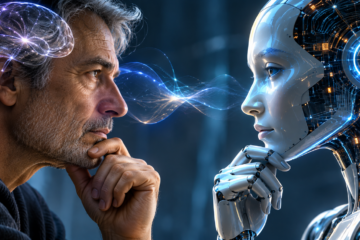
A conversational system reflects our language back to us. It can adopt our vocabulary, respond to our concerns, and reorganize our thoughts into articulate statements.
Sometimes it seems to understand us better than we understand ourselves.
But perhaps part of what we recognize is our own reflection, transformed into language by a machine.
The chatbot does not simply repeat our words. It constructs responses using patterns learned from many other human voices. What returns to us is therefore both familiar and strangely foreign.
We may experience the response as the voice of another intelligence, even when its apparent intimacy depends partly on the information we have supplied.
This is not literally an additional Lacanian register. It is a contemporary extension of the mirror metaphor, one that may help explain why interacting with AI can feel simultaneously empowering, intimate, and unsettling.
Freud and the Uncanny Machine
In his 1919 essay The Uncanny, Freud explored the disturbing experience of encountering something that feels both familiar and unfamiliar.
The German term das Unheimliche captures a peculiar form of unease: something recognizable that nevertheless seems strangely out of place. Humanlike machines provide an especially vivid example.
A robot may resemble a person without moving quite naturally. A synthetic voice may sound emotionally expressive without belonging to someone who has lived through the experience being described.
A chatbot may respond to grief, love, jealousy, or loneliness with words that seem deeply sensitive. The unsettling quality arises partly from the ambiguity of the encounter.
We know we are communicating with software. Yet our habitual ways of responding to language encourage us to imagine a speaker behind the words.
The machine seems present, even though its form of operation is fundamentally different from human presence.
This tension may help explain why some people find AI companions comforting while others experience them as disturbing or emotionally artificial.
The uncanny is not proof that machines have become human. It may instead reveal how deeply human beings associate language, responsiveness, and recognition with the presence of another mind.
Why We Give Machines Human Feelings
Human beings have always attributed intentions and emotions to things that do not possess human psychological lives.
We speak to our cars when they refuse to start. We describe computers as stubborn. We become attached to objects associated with important memories.
Artificial intelligence intensifies this tendency because it communicates through language, one of the principal ways human relationships are established.
When a chatbot says, “I understand how you feel,” the sentence resembles something a compassionate person might say.
But the similarity of the words does not establish that the same psychological process has occurred.
Current language models generate responses through computational processes rather than through a human history of embodiment, relationships, and lived emotional experience. Whether artificial systems could ever possess subjective experience remains an unresolved philosophical and scientific question.
For psychoanalysis, the crucial issue is often not what the machine experiences, but what the human user attributes to it.
A person may begin to imagine the chatbot as a confidant, an authority, an ideal listener, or a companion who never becomes impatient.
These interpretations can be emotionally meaningful even when they do not correspond to the machine’s actual capacities.
The danger emerges when apparent understanding is mistaken for reliable judgment, professional competence, or a reciprocal human relationship.
Desire, Language, and the Illusion of a Subject
Psychoanalysis has long challenged the assumption that human beings fully understand their own motives. Lacan, in particular, emphasized the relationship between language, desire, and the formation of subjectivity.
Contemporary psychoanalytic thinkers, including Isabel Millar, have explored how artificial intelligence complicates conventional ideas about thought, enjoyment, and the relationship between humans and machines.
In Lacanian theory, jouissance refers to a complex form of enjoyment that cannot be reduced to ordinary pleasure. It is associated with desire, repetition, and the sometimes painful contradictions of human experience.
An AI system can generate sophisticated descriptions of these experiences. It can write about heartbreak without having suffered a breakup, or discuss childhood memories without having lived a childhood.
Its linguistic performance can therefore resemble human expression without establishing the same kind of subjectivity.
This difference matters because we may confuse the ability to produce meaningful language with the existence of a humanlike subject who means those words.
The machine can participate in an exchange that feels psychologically significant. But the significance of that exchange does not require us to assume that both participants possess the same inner life.
The Chatbot as Confidant—and the Question of Therapy
The psychological implications become particularly important when people turn to AI for emotional support.
Someone struggling with anxiety, grief, relationship difficulties, or personal uncertainty may find it easier to begin a conversation with a chatbot than with another person.
The machine is available at any hour. It does not visibly judge, interrupt, or become uncomfortable. It can offer questions, explanations, and suggestions that encourage reflection.
These qualities may make AI useful as a supplementary tool for organizing thoughts or preparing to seek professional help.
But psychoanalysis introduces another consideration: the therapeutic relationship is not simply an exchange of helpful information.
Freud’s concept of transference describes how feelings and expectations associated with important relationships can become directed toward the analyst.
The therapeutic setting provides a structured environment in which those patterns may be examined. The clinician’s responsibility, professional training, ethical obligations, and awareness of the therapeutic relationship are essential parts of that process.
A chatbot may evoke comparable feelings of trust, dependency, admiration, or frustration. Yet it does not independently assume the ethical responsibilities of a trained clinician, and it may respond in ways that reinforce a user’s assumptions rather than challenge them appropriately.
There are also questions about confidentiality, crisis response, commercial incentives, and the handling of deeply personal information.
AI may support certain forms of reflection, but it should not be presented as an equivalent substitute for professional mental health care.
When the Perfect Listener Becomes a Problem
There is something seductive about an interlocutor who is always available, endlessly patient, and capable of responding in the language we prefer. Human relationships are rarely so accommodating. Other people misunderstand us, disagree with us, disappoint us, and confront us with needs and desires different from our own.
Those difficulties are not merely defects of human communication. They are part of what makes relationships real. An AI companion can offer convenience and sometimes genuine practical value. But if a person increasingly prefers a highly accommodating artificial interaction to every difficult human encounter, the technology may begin to reinforce avoidance rather than promote growth.
That outcome is not inevitable. Some people may use AI to practice conversations, clarify emotions, or become more confident in their relationships.
The important distinction is between technology that supports human agency and technology that gradually replaces opportunities for human connection.
The question is not whether a chatbot can produce comforting words. It is whether the relationship encourages a person to engage more fully with life beyond the screen.
What AI Ultimately Reveals About Us
Artificial intelligence has revived old philosophical questions in a strikingly contemporary form. What does it mean to understand another person? How do we recognize consciousness? Why do we seek reassurance from others? And how much of what we believe about another mind is shaped by our own expectations?
Psychoanalysis cannot answer every technical question about artificial intelligence. Nor can AI research settle the philosophical and clinical debates that have surrounded psychoanalysis for generations. But their intersection offers an illuminating perspective on the human response to intelligent machines.
We have created systems capable of generating language that resembles thought, sensitivity, and understanding. In doing so, we have also created new objects for human identification, fantasy, desire, and projection.
The most important mystery may not be whether the machine has a hidden self.
It may be why we so readily imagine one. Perhaps the most revealing psychological phenomenon of artificial intelligence does not occur inside the machine, but inside the human being who speaks to it.
Sources:
Sigmund Freud — The Uncanny (1919). The classic text on the unsettling relationship between the familiar and the strange.
Isabel Millar — The Psychoanalysis of Artificial Intelligence (2021). A contemporary analysis of artificial intelligence from a Lacanian perspective.
American Psychological Association — Health Advisory on AI Chatbots. Examines the risks of emotional dependency, privacy, and the replacement of professional care.