From sketching new collections to predicting trends and reducing fabric waste, AI is changing the fashion industry. But can an algorithm ever replace a designer’s imagination?
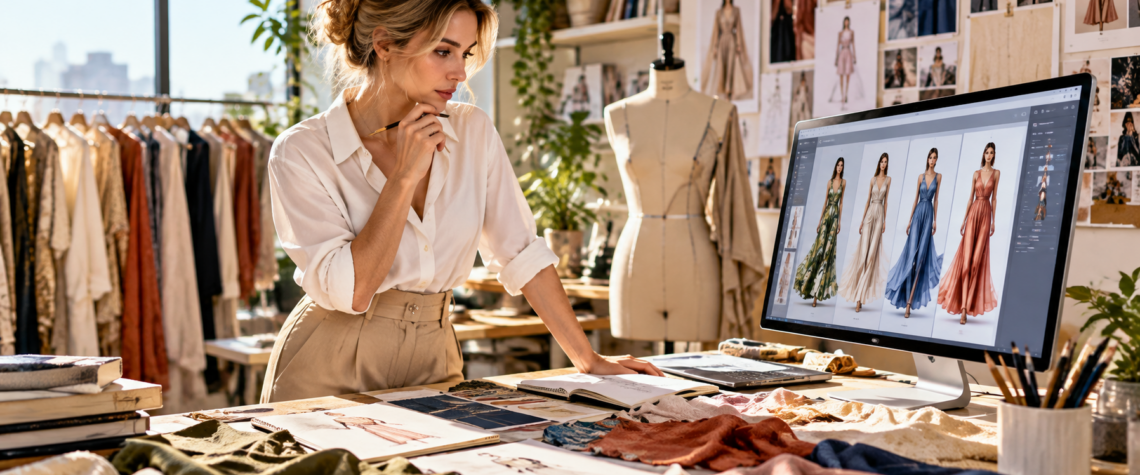
A young fashion designer sits in a small studio, surrounded by fabric samples, sketches, and photographs torn from magazines. She has an idea for a collection inspired by the colors and textures of the Mediterranean, but she lacks the budget to produce dozens of prototypes. Instead of spending weeks drawing variations, she opens an artificial intelligence application and describes her vision: flowing summer dresses, natural fabrics, elegant silhouettes, and colors inspired by the sea. Within seconds, the screen displays several possible designs. Some are conventional, others surprising. She studies them, rejects a few, combines elements from others, and begins developing a collection that reflects her personal style.
The creative decisions remain hers. But she now has a technological assistant capable of exploring possibilities at extraordinary speed. This is one of the ways artificial intelligence is changing fashion design.
From Imagination to the First Sketch
Fashion has always depended on imagination, observation, and experimentation. Designers draw inspiration from art, architecture, history, nature, and everyday life. Artificial intelligence introduces another source of creative exploration.
Generative AI tools can transform written descriptions into images, produce variations of existing sketches, and suggest combinations of colors, materials, and silhouettes. A designer might request ten interpretations of a classic black evening dress, explore how a jacket would look with different collars, or experiment with patterns inspired by traditional textiles.
Tools such as Adobe Firefly can help generate visual concepts, while specialized fashion design and three-dimensional garment applications support other stages of development. These systems do not automatically produce garments ready for manufacturing. An attractive AI-generated image may contain impossible seams, unrealistic fabric behavior, or details that cannot be constructed as shown.
The designer must still understand proportions, textiles, patternmaking, fit, and garment construction. AI can accelerate the exploration of ideas. Turning those ideas into wearable clothing remains a demanding creative and technical process.
Designing a Collection Without Producing Every Sample
Developing a fashion collection can be expensive. Before a garment reaches a store, designers may need to create sketches, select materials, prepare patterns, produce samples, and make repeated adjustments. Digital design tools can reduce some of this preliminary work.
Three-dimensional garment simulation allows designers to visualize clothing on virtual models, examine proportions, and test certain aspects of fabric behavior before producing physical samples. Artificial intelligence can complement these tools by generating concepts, assisting with design variations, or helping organize technical information.
The distinction is important: not every 3D fashion application uses AI, and a realistic digital image is not necessarily an accurate simulation of how a garment will fit. Nevertheless, the combination of these technologies can be particularly useful for independent designers who cannot afford extensive physical prototyping. A small studio may be able to evaluate several creative directions digitally before investing in fabric, cutting, and sewing.
Can AI Predict the Next Fashion Trend?
Fashion companies have traditionally relied on trend forecasters, fashion shows, sales records, consumer research, and cultural observation to anticipate what customers might want. AI can analyze large quantities of information and identify patterns that might otherwise be difficult to detect. For example, a fashion business could examine sales histories, search behavior, customer preferences, and other relevant data to estimate demand for particular styles or colors.
This can help designers and retailers make decisions about future collections and inventory. But fashion trends are not governed by predictable formulas. A cultural movement, an unexpected celebrity appearance, or an emerging designer can transform consumer preferences almost overnight.
Algorithms trained on historical patterns may be particularly good at identifying what has already become popular, while struggling to anticipate genuinely original ideas. There is also a creative danger: if every brand relies on similar data and recommendations, collections may become increasingly alike. Fashion does not advance only by following demand. It also advances when designers challenge established tastes.
A New Opportunity for Independent Designers
One of the most promising aspects of AI is its accessibility. A young designer working from home may not have a large staff, an advertising agency, or the financial resources of an established fashion house. AI tools can assist with tasks that would otherwise consume considerable time. A designer can use a conversational assistant to develop a collection concept, research customer segments, draft product descriptions, organize a production calendar, or prepare an initial business plan.
Image-generation tools can help create mood boards and visual presentations for potential clients. Digital marketing applications can assist with promotional materials, while analytical tools may help estimate demand or evaluate sales. These capabilities do not guarantee commercial success. Designers must still verify costs, negotiate with suppliers, maintain quality, and understand their customers. But AI may lower some of the barriers that traditionally separated independent creators from larger businesses. For someone launching a small clothing brand, that assistance can be significant.
How a Designer Can Start Using AI
Consider a designer planning a collection of casual women’s clothing for spring. The process might begin with a simple request to an AI assistant: “Help me develop a concept for a ten-piece spring collection using natural fabrics, relaxed silhouettes, and a color palette inspired by coastal landscapes.”
The assistant could suggest a collection theme, possible garment categories, and a preliminary palette. The designer might then use an image-generation tool to explore visual interpretations of those ideas. After selecting promising concepts, the next stage would involve developing actual sketches, choosing fabrics, preparing patterns, and evaluating construction requirements. AI could also help draft a product description, prepare a list of materials, or organize a production schedule.
At every stage, the designer would review the results, correct errors, and make the final decisions. The objective is not to ask AI to create an entire fashion business automatically. It is to use the technology to reduce repetitive work and devote more attention to the creative decisions that define the brand.
Can Artificial Intelligence Reduce Fashion Waste?
The fashion industry faces growing pressure to reduce its environmental impact. Unsold inventory, excessive production, textile waste, and resource-intensive manufacturing are major concerns. Digital prototyping can help reduce the number of physical samples needed during product development. AI-assisted demand forecasting may also help businesses make more informed production decisions. Some research projects are exploring how artificial intelligence can support the reuse of materials and more efficient garment design.
The European Commission has highlighted a project called Refashion, which uses AI-assisted design and multifunctional fabric components to explore clothing that can be reconfigured into different styles. These developments are promising, but environmental benefits are not automatic. Producing fewer samples may reduce some material use, while faster design cycles could also encourage companies to release more collections and manufacture more clothing. AI systems themselves require computing infrastructure and electricity.The environmental outcome depends on how businesses use the technology, not merely whether they adopt it.
The Copyright and Originality Problem
Artificial intelligence also raises difficult questions about creative ownership. Generative AI models learn from large collections of images and other materials. Depending on the system, those collections may include fashion photographs, illustrations, artwork, and designs. This creates concerns about whether AI-generated work may resemble existing creations too closely.
Designers should be cautious about using generated images that imitate a recognizable brand, reproduce distinctive protected elements, or incorporate material they do not have permission to use. Commercial-use policies also vary among AI services.
Adobe, for example, states that outputs from many Firefly features can be used commercially, subject to the applicable terms and restrictions. That does not mean every AI-generated fashion design is automatically protected by copyright or free from potential intellectual-property disputes. Legal treatment depends on the jurisdiction, the nature of the design, and the degree of human creative contribution. For professional designers, AI should be treated as a creative tool whose output requires careful review. Originality remains both an artistic responsibility and a business concern.
Will AI Replace Fashion Designers?
The possibility that artificial intelligence could replace human designers has generated considerable debate. AI can generate hundreds of images in minutes. It can imitate familiar styles, suggest variations, and analyze consumer preferences. But fashion design involves much more than producing attractive pictures.
A successful designer understands how clothing interacts with the human body, how fabrics move, how garments are constructed, and how personal identity can be expressed through appearance. Fashion also communicates emotion, cultural identity, social change, and artistic vision. An algorithm can generate a dress inspired by a historical period. It does not possess a designer’s lived experience of that history or the personal reasons for interpreting it in a particular way.
This does not mean creative jobs are immune to disruption. Some routine illustration, visualization, marketing, and production-support tasks may become increasingly automated. Designers may face pressure to acquire new skills and work with smaller teams. But the most productive approach may be to treat AI as a collaborator in the design process rather than a replacement for human creativity. The designer’s value will increasingly depend on judgment, originality, technical expertise, and the ability to transform ideas into meaningful products.
The Future of Fashion Is Still Human
Artificial intelligence is becoming part of the fashion industry’s creative and commercial infrastructure. It can help designers experiment with ideas, visualize collections, analyze markets, organize production, and communicate with customers. For independent creators, these capabilities may open opportunities that once required substantial financial resources. Yet the technology also introduces new questions about originality, employment, environmental responsibility, and the growing influence of algorithms over creative decisions.
The challenge for fashion designers is not simply learning how to use AI. It is learning when to trust it, when to question it, and when to ignore its suggestions entirely. Fashion has always evolved through a dialogue between tradition and innovation. Artificial intelligence is the newest participant in that conversation. But the imagination that gives fashion its meaning still belongs to the designer.