Uber’s AI-driven pricing systems calculate what passengers pay and what drivers earn separately. Independent research suggests the gap between those amounts has widened, raising questions about transparency, fairness, and who benefits from the algorithm.
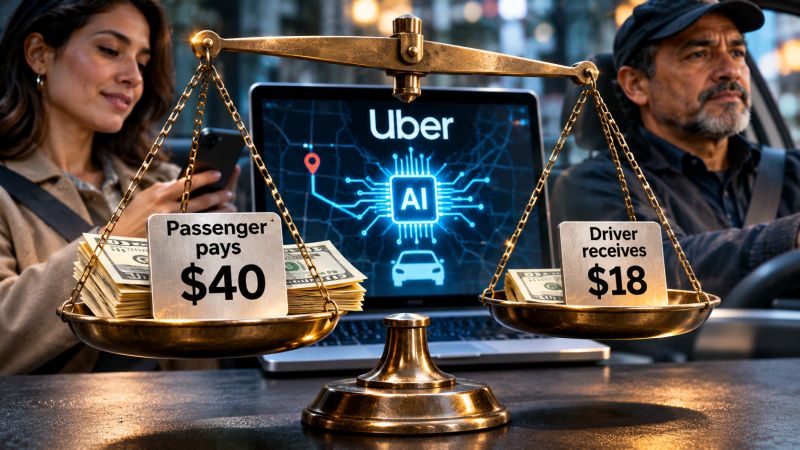
A passenger opens the Uber app, enters a destination, and agrees to pay $40 for a ride. A few minutes later, a driver receives an offer to complete that same trip for $18. The passenger assumes that most of the fare will compensate the person providing the transportation. The driver may wonder why the payment seems so low. Neither necessarily understands how the two amounts were determined. The example is hypothetical, but the underlying system is real.
Uber no longer relies on a single, fixed percentage commission to determine driver compensation in most U.S. markets. Instead, the company uses sophisticated pricing systems that calculate what passengers pay and what drivers receive separately. The difference can vary substantially from one trip to another.
For a company that has transformed urban transportation around the world, the change represents more than a new method of calculating fares. It introduces a fundamental question about the growing influence of artificial intelligence over the price of services and the compensation of the people who provide them.
Who decides how much a ride is worth? And when an algorithm makes that decision, whose interests does it serve?
Two Prices for the Same Ride
For years, Uber’s business model was relatively straightforward. Passengers paid for transportation, drivers received a substantial portion of the fare, and Uber collected a commission for connecting the two.
Although the details varied by market, the arrangement gave drivers a relatively understandable relationship between the price of a trip and their compensation That relationship has changed.
Uber began introducing upfront driver fares across most U.S. markets in 2022. Under this system, the company calculates the amount offered to a driver before the trip is accepted. Passengers also see an upfront price, but the two amounts are determined separately.
Uber acknowledges this distinction in its official pricing documentation. Passenger fares take into account factors such as estimated trip duration, distance, traffic conditions, demand, and applicable charges. Driver payments are calculated through a separate process that can consider additional circumstances, including the effort involved in reaching a passenger.
The company says this flexibility helps balance supply and demand, maintain service reliability, and compensate drivers for trips that might otherwise be unattractive. But the arrangement also means that a higher passenger fare does not necessarily produce a proportionately higher payment for the driver.
A passenger might pay more during a busy period without knowing how much of that increase reaches the person behind the wheel. Similarly, a driver might accept a trip without knowing the precise price the passenger agreed to pay. That separation is at the center of a growing debate over algorithmic pricing.
When the Platform’s Share Exceeds Half the Fare
The financial consequences have attracted the attention of academic researchers. In June 2025, researchers at the University of Oxford published a study examining more than 1.5 million trips completed by 258 Uber drivers in the United Kingdom between 2016 and 2024.
The study, conducted with the nonprofit Worker Info Exchange, compared driver compensation and platform revenues before and after Uber introduced dynamic pricing in the British market in 2023.
The findings were striking. The researchers reported that Uber’s median share of fares increased from approximately 25% to 29%. On some trips, the company’s share exceeded 50%. The researchers also found that the larger platform shares tended to occur on higher-value trips.
According to the study, inflation-adjusted driver earnings declined while passengers paid more, and drivers spent increasing amounts of unpaid time waiting for assignments.
These findings suggest that the growing sophistication of pricing algorithms has not necessarily translated into improved financial outcomes for the workers performing the trips.
However, the research examined the British market, which has its own regulatory framework and employment protections. Its findings cannot automatically be treated as representative of every U.S. city.
Uber disputed the researchers’ figures and maintained that its drivers benefit from flexibility and transparency about the offers they receive.
Nevertheless, the Oxford study provides unusually detailed independent evidence that the relationship between passenger prices, driver compensation, and platform revenue has changed.
American Drivers Are Raising Similar Questions
The controversy is not limited to Europe. In June 2026, an analysis by Len Sherman, an adjunct professor at Columbia Business School, examined approximately 50,000 Uber trips completed over several years by three experienced drivers in Dallas, Miami, and Tampa.
The analysis found that the proportion of passenger fares not paid to drivers had increased significantly, exceeding 50% in some of the markets examined.
Sherman identified a particularly important change beginning around 2022, when Uber expanded upfront pricing. Before that transition, driver compensation tended to move more closely with passenger fares. Afterward, the relationship became less direct.
The findings are consistent with concerns expressed by drivers who say that their compensation has become increasingly difficult to predict. But the research also has an important limitation: it draws on the records of only three drivers. Although those records include tens of thousands of trips, the sample cannot establish the average experience of every Uber driver nationwide.
Uber has challenged interpretations that portray the entire difference between passenger fares and driver payments as company profit. That distinction matters.
Where Does the Rest of the Money Go?
Suppose a passenger pays $40 and the driver receives $18. The difference is $22, or 55% of the passenger’s payment. It would be tempting to conclude that Uber earned $22 from the transaction. But that would be misleading.
The difference may include commercial insurance, taxes, government fees, airport charges, and other expenses associated with the trip. Uber distinguishes its service fee from certain third-party charges and says the service fee itself can vary from one trip to another.
In a 2026 response to a Consumer Reports investigation, the company argued that studies using the full difference between passenger payments and driver earnings can substantially overstate Uber’s economic share because they include insurance expenses.
Uber said that, after adjusting for insurance costs, its average U.S. revenue per trip was approximately 20%. The company also noted that insurance costs vary considerably by state and can represent a substantial portion of passenger fares.
These explanations are relevant. Commercial transportation involves real operating and liability expenses, and a responsible analysis must distinguish the money retained by the platform from costs paid to other parties.
Yet they do not resolve every concern. From the driver’s perspective, the practical question remains how much of the customer’s payment is available to compensate the person providing the vehicle, fuel, maintenance, driving time, and labor.
And from the passenger’s perspective, the question is whether the price reflects the actual cost of transportation or the maximum amount the market will bear. Those are different questions from whether Uber’s reported accounting margin is 20%, 30%, or another figure.
Is the Algorithm Negotiating Against Both Sides?
The most controversial possibility concerns how AI-driven pricing systems determine what passengers are willing to pay and what drivers are willing to accept.
In theory, a platform capable of predicting demand, driver availability, trip characteristics, and user behavior could optimize prices independently on both sides of a transaction.
A system might estimate the price at which a passenger is likely to request a ride and the compensation needed to persuade an available driver to accept it.
The difference between those two amounts would become an important factor in the platform’s economics.
Critics argue that such systems create an incentive to maximize the gap between passenger prices and driver payments. But there is an essential distinction between identifying that economic incentive and proving that Uber’s algorithms are explicitly designed to charge each passenger the highest possible price while paying each driver the lowest possible amount.
The publicly available evidence does not establish that sweeping claim. Uber says its pricing systems are designed to balance marketplace conditions, maintain reliability, and create opportunities for drivers and passengers.
Its 2026 U.S. Algorithmic Transparency Report describes the use of algorithms and AI to forecast demand, support upfront pricing, and adjust prices when the number of ride requests exceeds available drivers.
The report provides an explanation of the system’s general objectives, but it does not disclose all the proprietary calculations used to determine individual trip prices and driver offers.
That leaves an important question unanswered: how much of a driver’s individual behavior, past acceptance patterns, or predicted willingness to accept an offer influences the amount proposed for a particular trip? Without independent access to the underlying models and relevant transaction data, the full answer remains difficult to establish.
The Driver Bears Costs the Algorithm Does Not Pay
There is another dimension to the pricing debate that can easily disappear behind percentages. Drivers are not simply receiving wages for operating a company-owned vehicle. In most U.S. markets, they supply their own cars and pay for fuel or electricity, maintenance, tires, depreciation, cleaning, and other operating expenses. They also spend time traveling to pickup passengers and waiting for new requests.
A trip that pays $18 may look reasonable until those expenses and unpaid periods are considered. If completing the trip requires 40 minutes of driving, plus additional time reaching the passenger and waiting for the next assignment, the effective hourly earnings can be substantially lower than the amount displayed in the app might suggest.
The Oxford researchers found that drivers’ earnings declined in real terms when measured against the time they were available to work, rather than only the time spent transporting passengers.
This distinction is crucial. An algorithm may calculate an attractive payment for an individual trip while leaving the driver with an unpredictable and less profitable working day.
The driver’s actual income depends not only on the amount paid for each ride, but also on the frequency of assignments, distances traveled without passengers, and the costs of operating the vehicle. For consumers evaluating the fairness of the system, those expenses are part of the economic reality of every ride.
Transparency Is More Than Showing a Price
Uber emphasizes that upfront pricing gives passengers and drivers useful information before they agree to a transaction. Passengers know the price they will generally pay. Drivers know the amount they are being offered and can choose whether to accept the trip. Those are meaningful advantages over a system in which the price is entirely unknown. But knowing the final number is not the same as understanding how it was calculated.
A driver might know that a trip pays $12 without knowing why a comparable trip paid $17 the previous day. A passenger might know that a ride costs $45 without understanding why the same route cost $29 earlier.
Neither necessarily has sufficient information to determine whether the difference reflects legitimate changes in demand, insurance costs, traffic conditions, or other factors.
This is the transparency problem at the heart of algorithmic pricing. The public can observe the results, but much of the decision-making process remains inside systems controlled by the platform. Researchers can examine patterns in transaction records. Drivers can compare experiences. Regulators can request information within their legal authority. Yet the precise role of individual variables in proprietary pricing models is not fully visible to outsiders.
The result is an unusual commercial relationship: a company uses complex automated systems to determine both the price of a service and the compensation offered to the person performing it, while retaining considerable control over the information needed to evaluate those decisions.
What Should Passengers and Drivers Be Able to Know?
The debate raises several questions that extend beyond Uber. Should passengers be able to see how much of their fare reaches the driver? Should drivers receive a standardized breakdown showing the passenger payment, third-party charges, and platform service fee? Should independent researchers be allowed to audit pricing algorithms for systematic differences in compensation? And should regulators require platforms to explain whether individualized behavioral predictions influence the prices offered to consumers and workers?
None of these questions requires companies to publish every line of proprietary software. But meaningful transparency may require more than a general explanation that prices depend on supply, demand, time, and distance. It may require independently verifiable information about how pricing systems behave in practice.
The stakes are significant because algorithmic pricing is spreading beyond transportation. Digital platforms increasingly use automated systems to determine what customers pay, which workers receive assignments, and how much those workers earn.
The Uber experience may therefore offer an early glimpse of a much larger transformation in the relationship between technology, labor, and markets.
The Price of an Algorithmic Decision
For a passenger, an Uber ride is a relatively simple transaction. Enter a destination, accept a price, and arrive at the destination. For a driver, the same ride is part of a working day whose profitability depends on a stream of decisions made by software. And for Uber, each trip is one transaction within a vast marketplace that must balance customer demand, driver participation, operating expenses, and the company’s financial objectives.
Artificial intelligence can help coordinate that marketplace with remarkable efficiency. But efficiency alone does not establish fairness. A system can be highly effective at matching riders with drivers while distributing the economic benefits unevenly.
It can produce prices that customers are willing to pay without guaranteeing that drivers receive adequate compensation. And it can offer convenient, upfront information while leaving the most consequential calculations largely unexplained.
The central issue is not whether Uber should use algorithms. A transportation network operating at its scale could hardly function without sophisticated software. The question is whether the people whose money and livelihoods depend on those algorithms should have a greater right to understand how their decisions are made.
The passenger sees one price. The driver sees another. Between them lies a system that determines how the value of each ride is divided. As artificial intelligence takes on a growing role in economic life, understanding that division may become just as important as understanding the price itself.
Sources and Further Reading
- University of Oxford, New Oxford Research Reveals Uber’s Algorithmic Pricing Leaves Drivers and Passengers Worse Off, June 23, 2025.
- Binns et al., Not Even Nice Work If You Can Get It: A Longitudinal Study of Uber’s Algorithmic Pay and Pricing, ACM FAccT 2025.
- Columbia Business School, Len Sherman, research and reporting on Uber’s algorithm and driver compensation, 2025–2026.
- Uber, How Are Prices Determined?, official U.S. marketplace pricing documentation.
- Uber, What Is the Uber Service Fee?, official marketplace documentation.
- Uber, 2026 U.S. Algorithmic Transparency Report.
- Uber, Comment on Consumer Reports Study, 2026.