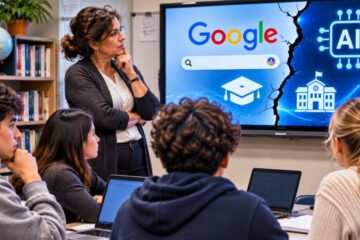
An experimental school model promises faster learning through artificial intelligence. But as the approach expands, a more profound question emerges: Are schools meant to produce efficient learners—or thoughtful citizens capable of sustaining a democratic society?
The promise is undeniably attractive: imagine a school where children complete their core academic lessons in just two hours a day, guided by artificial intelligence rather than traditional classroom instruction. The remaining hours are devoted to practical skills, creative projects, and personal development.
For parents frustrated by conventional education, the proposition sounds almost revolutionary. For technology enthusiasts, it suggests that artificial intelligence could finally deliver the personalized instruction that educators have sought for decades.
But behind the promise of greater efficiency lies a question that cannot be answered by test scores alone: What, exactly, is a school supposed to accomplish?
The controversy surrounding Alpha School, an education company founded in Texas, is not simply about whether artificial intelligence can teach children mathematics or reading. It raises fundamental questions about the purpose of education, the role of teachers, the social development of children, and the responsibilities of a democratic society toward its next generation. At stake is something considerably larger than the future of classroom technology. It is our understanding of what it means to educate a human being.
The Promise of Personalized Learning
Alpha School’s model is built around what it calls 2 Hour Learning. Instead of spending most of the school day listening to conventional lessons, students use adaptive software to work through academic subjects at their own pace. The system identifies gaps in understanding, adjusts the difficulty of exercises, and allows students to progress after demonstrating mastery.
Adults remain present, but their role is different. Rather than delivering traditional academic instruction, they serve as guides, providing motivation, emotional support, and supervision. Afternoons are generally reserved for workshops, collaborative activities, practical projects, and the development of life skills.
Alpha’s co-founder, MacKenzie Price, argues that conventional schools have failed to take advantage of technological progress. She maintains that individualized instruction can accelerate learning while freeing children from hours of repetitive classroom work.
There is a legitimate educational argument behind that ambition. Children learn at different speeds, and traditional classrooms often struggle to accommodate them. A student who has mastered a concept may become bored waiting for classmates, while another may fall behind because the teacher cannot provide enough individual attention.
Artificial intelligence could help address both problems. Properly designed and supervised, adaptive learning systems may give teachers valuable information about students’ progress and provide additional practice tailored to individual needs. The question is not whether such technology has educational value. It almost certainly does. The question is whether its advantages justify fundamentally reorganizing the school around it.
Texas Raises the Alarm
The controversy became particularly significant in Texas, where Alpha’s effort to enter the publicly funded education system encountered resistance. In 2025, the Texas State Board of Education voted 10–3 to reject an application associated with Alpha’s model to establish a charter school. Board members raised concerns about the reliance on artificial intelligence, the amount of time students would spend using screens, and the credibility of the dramatic academic improvements claimed by the organization. Yet the rejection did not end Alpha’s expansion.
A September 2026 investigation by ProPublica and The Texas Tribune found that most of Alpha’s growing network of Texas private schools had been accepted into the state’s new taxpayer-funded school voucher program. The investigation also reported that Alpha’s founders had contributed more than $2 million to Texas legislators and political action committees supporting the voucher initiative before and after its approval.
Political contributions do not, by themselves, establish wrongdoing. But the combination of public funding, rapid expansion, and unresolved questions about educational outcomes makes transparency particularly important.
A subsequent investigation, published October 1, revealed that officials at the Texas Education Agency had helped connect companies associated with Alpha to public school districts interested in testing the technology. The agency said there was no formal partnership with Alpha and that individual districts remained responsible for deciding whether to participate. The districts involved described the software as a supplement to traditional instruction, not a complete replacement for it.
That distinction is crucial. Using artificial intelligence to assist teachers is one educational proposition. Reorganizing an entire school around software-based instruction is another.
What Do the Results Actually Show?
Alpha has promoted striking academic achievements, including claims that students learn substantially faster than their peers and perform at exceptionally high levels on standardized tests. Such results would deserve serious attention if they could be consistently reproduced across different populations and independently verified. But the available evidence presents a more complicated picture.
ProPublica and The Texas Tribune examined outcomes from schools using Alpha’s educational technology and consulted researchers who questioned whether the company’s published information was sufficient to establish its broader claims. In Arizona, where an Alpha-associated charter school received approval, preliminary first-year test results reported by the news organizations fell well below the proficiency levels projected in its application. In English, the school had anticipated 65 percent proficiency, but the reported figure was 28 percent. In mathematics, the projection was 60 percent, compared with a reported 10 percent.
Those figures do not prove that the entire educational approach is ineffective. Results from a particular school can reflect student demographics, implementation problems, or other circumstances. But they do demonstrate why ambitious claims must be tested against independent evidence rather than accepted as marketing promises.
The experiences of families also deserve attention. An October 2025 investigation by WIRED documented complaints from some parents and former staff members who described academic difficulties, emotional distress, and concerns about the school’s heavy reliance on software. Alpha strongly disputed the reporting, maintaining that the accounts were inaccurate or misleading. These competing claims underscore the need for rigorous evaluations that examine not only test scores, but also students’ well-being, long-term development, and experiences in the classroom.
Education Is Not the Same as Information
The most important issue, however, extends beyond the controversy over test scores. A school is more than a place where children acquire information or improve academic performance. It is where they learn to live with others, question ideas, develop empathy, understand cultural differences, and become members of a democratic society. Education is not simply the efficient transfer of knowledge from one source to another.
A child studying history is not merely memorizing dates and events. Ideally, that child is learning to understand how societies change, why conflicts arise, how institutions develop, and what happens when people surrender their capacity for independent judgment. A literature class is not simply an exercise in reading comprehension. Through stories, students encounter unfamiliar lives, moral dilemmas, competing perspectives, and experiences beyond their own. A classroom discussion about science can teach far more than scientific facts. It can demonstrate the value of evidence, the importance of questioning assumptions, and the intellectual discipline required to change one’s mind. These experiences are difficult to reduce to a sequence of correct answers.
An algorithm may determine whether a student understands a mathematical formula. Measuring the development of empathy, civic responsibility, intellectual courage, or cultural awareness is a considerably more complex challenge. That does not mean technology cannot contribute to those goals. It means educational success cannot be defined exclusively by what software can conveniently measure.
Teachers Are More Than Information Providers
The debate also raises a fundamental question about the future of teachers. The traditional image of a teacher standing before a classroom and delivering information is certainly incomplete. But so is the suggestion that teaching consists primarily of explaining facts that a computer can now communicate more efficiently.
A good teacher recognizes uncertainty in a student’s expression, notices an emerging interest, encourages a reluctant child to participate, and understands when a mistake reveals a deeper misunderstanding. Teachers help students discover intellectual possibilities they may never have considered. They introduce young people to literature, history, music, science, and ideas that challenge their assumptions about the world. They also model something no standardized assessment can fully capture: what it means to be an educated adult engaged in a community of other human beings.
Alpha’s model does not eliminate adults from the school environment. Its guides and afternoon activities are intended to provide social interaction, motivation, and personal development. These elements deserve fair examination, rather than dismissal. But a critical question remains: Can such a structure consistently reproduce the intellectual mentorship and educational judgment provided by experienced teachers? The answer cannot be established simply by demonstrating that children complete academic exercises more quickly.
Are We Educating Citizens or Training Workers?
Perhaps the greatest danger in an excessively efficiency-driven conception of education is that it may gradually redefine what society expects from its schools. The purpose of education is not to produce human beings programmed to perform efficiently in the workforce. It is to prepare citizens capable of contributing to the intellectual, cultural, and social progress of their communities.
A democratic society depends on people who can think independently, question authority, engage with opposing ideas, appreciate cultural diversity, and participate actively in public life. It needs scientists and engineers, but it also needs historians, artists, writers, philosophers, journalists, and teachers. It needs people capable of solving practical problems and people willing to ask whether those are the right problems to solve. The preparation of future workers is a legitimate responsibility of education. It is not its ultimate purpose.
An educational system focused primarily on measurable performance risks undervaluing precisely those qualities that make a society culturally vibrant and politically free. There is an important distinction between teaching a student how to succeed within an existing system and helping that student develop the judgment to improve the system itself. Democracy requires the second. And that is why the Alpha School experiment deserves scrutiny that extends far beyond comparisons of academic test scores.
What Happens to Culture?
Every generation inherits a cultural world shaped by those who came before it. Schools help transmit that inheritance while also giving students the intellectual tools to question, reinterpret, and enrich it. Language, history, literature, the arts, civic traditions, and ethical reasoning are not peripheral subjects that can simply be fitted into whatever time remains after academic targets have been achieved. They are central to the formation of cultural identity and social understanding.
Education also exposes children to people whose backgrounds, beliefs, and experiences differ from their own. That encounter is particularly important in a diverse society such as the United States. When students discuss a novel, debate a historical decision, participate in a theatrical production, or collaborate on a community project, they learn that human experience cannot always be reduced to a single correct answer.
Artificial intelligence can enrich those encounters. It can provide access to historical documents, introduce unfamiliar languages, support creative experimentation, and help students explore perspectives beyond their immediate surroundings. But technology must broaden the human experience, not narrow it to the pursuit of measurable outcomes.
An important question for Alpha School, therefore, is how thoroughly its students engage with the humanities, the arts, civic education, and the intellectual traditions that sustain democratic life. Afternoon workshops may provide meaningful opportunities for collaboration and creativity. Whether they deliver a sufficiently rich and consistent cultural education is a question that deserves independent investigation.
An Experiment With Long-Term Consequences
Educational innovation is necessary. American schools face serious challenges, including unequal access to resources, uneven academic performance, teacher shortages, and persistent achievement gaps. Artificial intelligence may help address some of these problems. But children are not experimental subjects whose development can be evaluated solely through short-term performance indicators.
The consequences of an unsuccessful educational reform may not become apparent until years later, when students enter universities, workplaces, and public life. A generation may perform well on standardized assessments yet lack the habits of sustained attention, intellectual independence, cultural understanding, or democratic participation that society needs.
That is a potential risk, not an established outcome of Alpha School. It is precisely the kind of risk that responsible research should examine before a new educational model is adopted on a large scale. Independent longitudinal studies, transparent academic data, careful assessments of students’ emotional and social development, and meaningful participation by parents and teachers should be essential components of any expansion.
Public funding creates an additional obligation. When taxpayers help finance educational experiments, the public deserves credible evidence of their benefits and an honest accounting of their limitations. Innovation should not be exempt from scrutiny merely because it carries the promise of technological progress.
The Future of Education Must Remain Human
Alpha School may ultimately demonstrate that some elements of its approach offer substantial educational benefits. Personalized instruction, flexible learning schedules, and greater opportunities for practical activities could become valuable contributions to the future of schooling. But even if artificial intelligence allows students to master academic subjects in a fraction of the conventional time, that achievement would answer only part of the educational question.
The deeper challenge is to determine what children should do with the time, knowledge, and intellectual freedom that technology might provide. Will they become more curious, creative, compassionate, and engaged with the world around them? Will they learn to distinguish evidence from manipulation, understand their cultural inheritance, and accept responsibility for the communities in which they live? Or will education become increasingly defined by speed, performance, and the acquisition of marketable skills?
The future of education should not be measured only by how much children know, but by the kind of society they will be capable of building. Artificial intelligence may become an extraordinary educational instrument. But an instrument, however sophisticated, must never be confused with the purpose it is meant to serve. We are not educating robots for the workforce. We are educating human beings for civilization.