

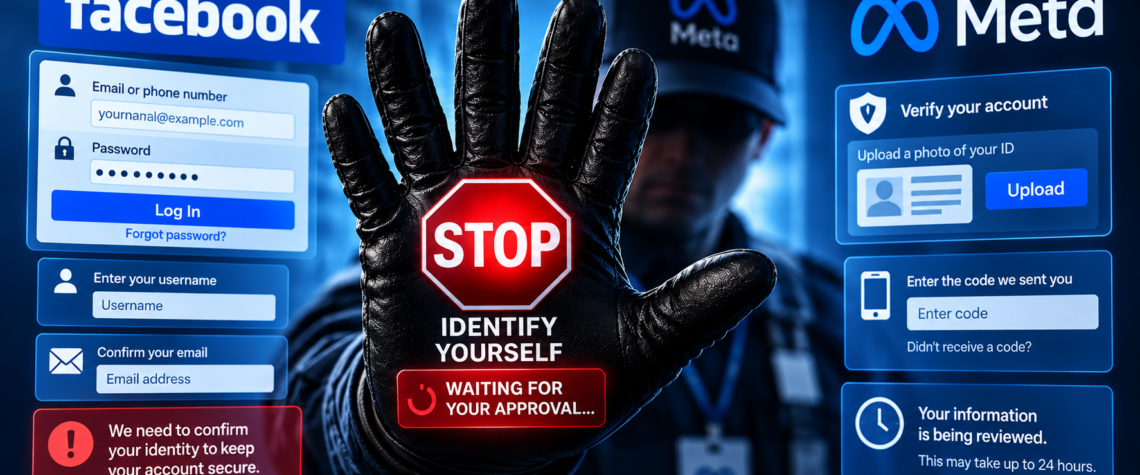
An account that hasn’t been suspended. A legitimate user who cannot get in. A verification system that repeatedly fails to provide a way back. As Meta pursues the future of artificial intelligence, an ordinary account-access problem raises extraordinary questions about technological power and human accountability.
For millions of people, Facebook is more than a social network. It is a personal archive, a communications center, a professional directory, and a record of relationships accumulated over many years. But what happens when the platform suddenly refuses to recognize the person who owns the account?
Consider my experience. I accumulated approximately 5,000 Facebook friends over the years. My account has not been suspended, and has received no notification that he violated Facebook’s community standards. Yet I repeatedly found himself unable to log in.
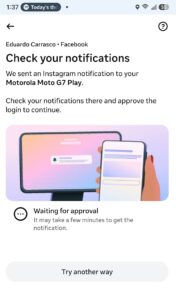
The difficulties began after a change of my mobile phone. Although my telephone number remained unchanged, Facebook’s verification process continued to rely on an older Motorola smartphone rather than my newer Samsung device. Following the platform’s instructions, completed a facial video verification using my old Motorola. Facebook confirmed receipt and indicated that a response could be expected within approximately 24 hours. That period passed without a response or restored access.
Subsequent attempts appeared to offer a way forward, but the problem returned. Facebook again prevented access from both my mobile phone and the computer. A recent verification screen instructed me to approve an Instagram notification sent to his old Motorola Moto G7 Play. The screen displayed a message indicating that the system was waiting for approval.
The question is not whether Facebook should protect its users against unauthorized access. Of course it should. The question is what happens when the protective mechanism itself becomes the obstacle—and when the problem happens more than once.
When Security Becomes a Barrier Digital security systems face a difficult challenge. They must distinguish legitimate account holders from criminals attempting to steal identities, compromise accounts, or impersonate other people. That task becomes increasingly complicated as users change phones, travel, forget passwords, or lose access to devices they once used regularly.
Automated security tools can help identify suspicious patterns and recognize familiar devices. But they also create a troubling possibility: a legitimate user may be unable to satisfy the very system designed to protect that user’s identity.
The result is a digital paradox. The platform knows enough about a person to question an unfamiliar login, but its recovery process may still fail to provide a timely route back into the account. And when the user cannot reach a human representative capable of reviewing the situation, a temporary security precaution can become an indefinite exclusion.
Meta Promises Smarter Account Recovery
Meta, Facebook’s parent company, has acknowledged the importance of improving account recovery. In December 2025, the company announced changes to Facebook and Instagram support, including improved recognition of trusted devices, more adaptive recovery procedures, and expanded identity-verification options.
In March 2026, Meta also announced the expansion of an AI-powered support assistant designed to help users resolve account problems. The company described improvements intended to make assistance more accessible and account recovery more effective.
These developments deserve recognition. Security at Facebook’s scale is an extraordinarily complex undertaking, and stronger protections against fraud benefit legitimate users. But announcing improved technology does not answer a fundamental question: What recourse does an individual have when the recovery process repeatedly fails?
A successful security system should not be judged solely by how many suspicious logins it prevents. It should also be judged by how effectively it restores access to legitimate account holders who cannot complete its verification procedures.
Five Thousand Relationships Behind a Digital Door
The Maryland journalist’s experience illustrates why account access is not a trivial inconvenience. A Facebook account with approximately 5,000 friends represents years of professional and personal connections. Some relationships may exist primarily through the platform. Others involve former colleagues, relatives, readers, and people living thousands of miles away.
When access disappears, the consequences extend beyond the inability to scroll through a news feed. Messages may go unanswered. Professional opportunities may be missed. Important personal communications may remain inaccessible.
The user has not necessarily lost ownership of the account or its contents. But the practical effect of being locked out can feel remarkably similar: a significant part of one’s digital life has become inaccessible.
This is particularly troubling for journalists, independent publishers, artists, and small businesses that have invested years building communities on social platforms.
The Problem With Automated Accountability
There is an important distinction between a platform deliberately suspending an account and a security system preventing its owner from logging in. The first involves an enforcement decision. The second may involve authentication procedures that cannot successfully establish the user’s identity. Both can leave someone unable to access an account, but they require different solutions.
A legitimate security challenge should provide understandable instructions, meaningful status updates, and a practical way to resolve failures. If users are told to submit a verification video and wait for a response, they should be able to determine whether the submission was accepted, rejected, or remains under review.
Otherwise, the process becomes a closed loop: the user cannot enter without verification, cannot determine the status of verification, and may have no clear way to reach someone who can help. Automation may reduce the cost of operating a global platform. But efficiency should not eliminate accountability.
In Whose Hands Is the Future of Artificial Intelligence?
There is a disturbing irony in this situation. Meta is among the companies investing enormous resources in artificial intelligence, developing systems intended to transform communication, business, education, and everyday life.
Yet a longtime Facebook user can remain unable to access his account after changing phones, despite following the platform’s verification procedures. In this case, the difficulty has occurred not once, but twice. The latest verification screen still directs the user toward an older device, leaving him unable to complete the login process. This raises a question that extends far beyond Facebook’s customer support:
If the companies developing increasingly powerful artificial intelligence systems cannot provide effective remedies when their existing technologies fail, how prepared are they to assume even greater responsibilities over people’s digital lives?
The issue is not whether Meta possesses the technical expertise to develop advanced AI. Clearly, it does. Nor does this individual case establish that an artificial intelligence system caused the login failure. The precise technical reason remains unknown.
The issue is whether technological sophistication is being matched by an equally serious commitment to human accountability. Artificial intelligence is increasingly influencing decisions affecting employment, financial services, healthcare, education, and access to information. Those decisions will sometimes be wrong.
When that happens, people must have meaningful opportunities to challenge decisions, correct errors, and obtain assistance. A future shaped by increasingly intelligent systems cannot depend on the assumption that those systems will always work correctly. The true test of responsible artificial intelligence is what happens when technology fails—and whether a human being still has somewhere to turn.
Who Owns Our Digital Lives?
Facebook users do not own the platform’s infrastructure. They agree to its rules and depend on its technical systems. Yet the relationships, conversations, memories, and professional histories they develop there can be deeply personal. That creates an imbalance of power.
A private company controls the gateway to a digital environment that has become an important part of public and private life. Users may invest years building a presence there, only to discover that recovering access depends on a process they cannot meaningfully question.
The issue is not unique to Facebook. Similar questions arise whenever people depend on online services for banking, employment, communications, education, or essential records. As artificial intelligence assumes a larger role in administering digital services, the need for transparent decisions and effective human review becomes more urgent.
A Question Meta Should Answer
The journalist’s experience raises several questions that deserve direct answers. What should a legitimate account holder do when the available verification methods repeatedly fail? How can users obtain meaningful assistance when their recovery attempts lead back to the same inaccessible device? And what safeguards prevent automated security procedures from excluding the very people they are intended to protect?
AI Solutions Magazine has sought comment from Meta regarding the account-access difficulties experienced by its editor. No response had been received at the time of this draft. Meta’s investments in improved account support are welcome. But their effectiveness must ultimately be measured through the experiences of people who depend on those systems.
Intelligence Must Also Mean Responsibility
No responsible person would argue that Facebook should weaken its defenses against hackers and identity thieves. But protecting accounts and protecting legitimate account holders should be complementary goals, not competing ones. Users need clear recovery procedures, reliable confirmation of submitted evidence, reasonable expectations about response times, and an accessible escalation process when automated systems fail.












[…] Related reading: AI Solutions Magazine has also examined facial recognition, biometric identification, and the privacy questions surrounding their growing use. Read our earlier report on facial recognition here — https://www.aisolutionsmag.com/locked-out-by-facebook-in-whose-hands-is-the-future-of-artificial-in… […]