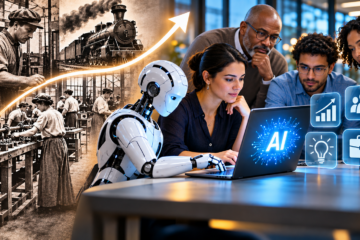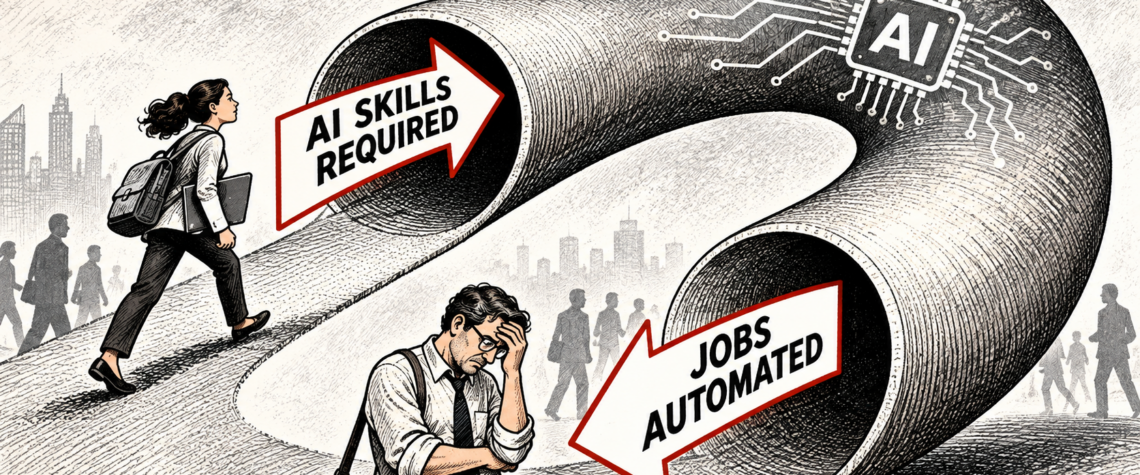
Artificial intelligence is threatening jobs once considered secure, from administrative work and translation to data processing and financial services. But replacing tasks is not the same as replacing entire professions.
For generations, a college education and a professional career were considered among the best protections against unemployment. Factory workers faced automation, machines replaced repetitive manual labor, and entire industries were transformed by technological change. Office workers, meanwhile, appeared relatively secure.
Artificial intelligence is overturning that assumption.
Unlike earlier waves of automation, generative AI can perform tasks associated with intellectual work: writing, translating, analyzing information, preparing reports, processing documents, and producing computer code. These capabilities are raising an uncomfortable question for millions of educated workers: Could the professions they spent years preparing for eventually become obsolete?
Research from Microsoft, the International Labour Organization (ILO), and Anthropic suggests that some of the occupations most exposed to AI are concentrated in offices, professional services, and information-based industries.
Exposure does not automatically mean unemployment. But as AI systems become more capable, companies may discover that fewer employees are needed to perform work previously requiring entire teams.
The Jobs Facing the Greatest Pressure
Administrative and clerical occupations are among the most vulnerable because many of their responsibilities involve repetitive information processing.
Data entry clerks, transcriptionists, administrative assistants, and employees responsible for routine documentation perform activities that AI-powered systems can increasingly automate.
Customer service is another area undergoing rapid transformation. AI chatbots can answer common questions, process requests, and assist customers around the clock. Human representatives remain essential for complicated cases, disputes, and situations requiring judgment, but companies may need fewer employees to handle routine inquiries.
Translation and language services face similar pressures. Modern AI systems can translate documents and conversations quickly, often producing results that require relatively limited editing for everyday purposes.
Professional translators and interpreters remain important in legal, medical, diplomatic, and culturally sensitive settings. Nevertheless, the market for routine translation may shrink as automated services become more reliable.
Accounting-related administrative work, bookkeeping, and certain financial reporting activities are also increasingly susceptible to automation.
The greatest risks often involve occupations where a substantial portion of the working day consists of organizing, transferring, summarizing, or processing information according to established procedures.
What Microsoft’s Research Reveals
A 2025 study by Microsoft Research examined approximately 200,000 anonymized conversations with Bing Copilot to understand how people were using generative AI to perform work-related activities.
The researchers compared those activities with occupational descriptions and developed a measure of how applicable AI capabilities were to different jobs.
Interpreters and translators, historians, writers and authors, customer service representatives, and several information-intensive occupations appeared among those with high AI applicability.
But the study did not predict that these professions would disappear. Its findings identified activities that AI could assist with or perform, not the number of workers employers would eventually eliminate.
That distinction is crucial. A technology may be capable of performing many activities associated with a profession without assuming the full range of responsibilities involved in that work.
Could Entire Professions Disappear?
History offers examples of occupations that declined dramatically or largely disappeared because of technological change. Telephone switchboard operators, typists, and certain categories of clerical workers became far less common as new systems replaced their principal functions.
AI could produce similar changes in occupations built primarily around routine digital tasks.
Some specialized positions may become unnecessary as software absorbs responsibilities previously assigned to employees. Other jobs may survive but require fewer workers, different skills, or substantially redesigned responsibilities.
The disappearance of an occupation, however, is not the same as the elimination of individual jobs.
A company may reduce its administrative staff while continuing to employ administrative professionals. A translation agency may automate routine assignments while retaining specialists for complex work.
Predicting which professions will disappear entirely remains difficult because employment depends on more than technological capability. Costs, customer expectations, regulation, professional liability, and the willingness of businesses to reorganize their operations all influence the outcome.
What the International Labour Organization Found
A 2025 ILO study estimated that approximately one in four workers worldwide held occupations with some degree of exposure to generative AI.
Only 3.3% of global employment, however, fell into the study’s highest exposure category.
Clerical occupations remained particularly vulnerable, while exposure was also increasing among certain professional and technical workers.
The organization emphasized that job transformation is likely to be more widespread than complete occupational replacement.
That conclusion should not be mistaken for reassurance that employment will remain unchanged. Even when professions survive, automation can reduce demand for workers, alter career paths, and put pressure on wages in some segments of the labor market.
The Threat to Entry-Level Careers
One of the most consequential changes may affect people beginning their professional lives.
Junior employees traditionally learn through tasks such as preparing reports, conducting preliminary research, reviewing documents, writing basic code, and organizing information.
Many of these assignments are increasingly suitable for AI assistance.
If companies automate the work traditionally performed by beginners, they may reduce entry-level hiring even while retaining experienced professionals.
Research published by Anthropic in March 2026 found suggestive evidence of slower hiring among younger workers in occupations with greater AI exposure, although it did not establish a systematic increase in unemployment across highly exposed professions.
This raises a difficult question: How will future professionals gain experience if the tasks through which they once learned are increasingly performed by machines?
Why Journalism Is a Different Case
Journalism illustrates the difference between producing information and practicing a profession. AI can summarize public documents, rewrite press releases, transcribe interviews, translate articles, and draft routine news reports. These capabilities may reduce demand for certain production and editorial support roles. But journalism involves responsibilities that extend far beyond generating text.
Investigative reporters develop sources, uncover information that powerful institutions may prefer to conceal, verify conflicting accounts, and make decisions involving public interest and professional ethics.
Opinion writing, cultural interpretation, and original reporting also depend on perspectives, experiences, and judgments that cannot simply be reduced to automated text production.
The profession is therefore unlikely to disappear merely because AI can write convincing articles. The economic danger may be different. News organizations could use automation to publish more material while employing fewer journalists, potentially weakening the resources available for original reporting.
In that scenario, journalism would remain necessary even as the employment opportunities and financial foundations supporting it came under pressure.
When Productivity Becomes a Workforce Decision
Businesses often introduce new technologies to improve efficiency. AI promises to reduce the time required for many professional activities, potentially allowing employees to accomplish more. But increased productivity does not guarantee greater employment.
Companies may use the resulting savings to expand operations, improve services, and create new positions. They may also choose to reduce staffing or limit future hiring.
The decisions will vary across industries and organizations. A law firm might use AI to accelerate document review while retaining lawyers responsible for legal analysis and client representation. A financial institution could automate routine reporting while increasing its demand for professionals capable of evaluating complex risks.
Other employers may conclude that automation allows them to operate with smaller teams. The technology creates possibilities; management decisions determine many of the employment consequences.
The Skills That May Become More Valuable
As AI assumes more routine intellectual tasks, professional value may increasingly depend on abilities that are difficult to automate reliably.
These include critical thinking, independent investigation, interpersonal communication, ethical judgment, creative problem-solving, and the ability to evaluate the accuracy of AI-generated work.
Specialized expertise will also remain important. Professionals who understand their fields can identify errors, recognize misleading conclusions, and determine when automated recommendations should be rejected.
Learning to use AI may become an essential professional skill, but technical familiarity alone will not guarantee job security.
Workers will also need opportunities for retraining, while educational institutions must reconsider how they prepare students for careers in which traditional entry-level responsibilities are changing.
A New Definition of Professional Security
Artificial intelligence is challenging one of the central assumptions of the modern labor market: that intellectual work is inherently safer from automation than manual labor.
Some white-collar occupations may decline sharply. Certain specialized positions could disappear. Others will evolve, combining human expertise with increasingly capable automated systems.
What remains uncertain is how quickly these changes will occur and how many jobs will ultimately be created or eliminated. The future will depend not only on advances in AI, but also on decisions made by employers, governments, educators, and workers.
For millions of professionals, the question is no longer whether artificial intelligence will change their work. It is whether the work they do today will still require the same number of people tomorrow.