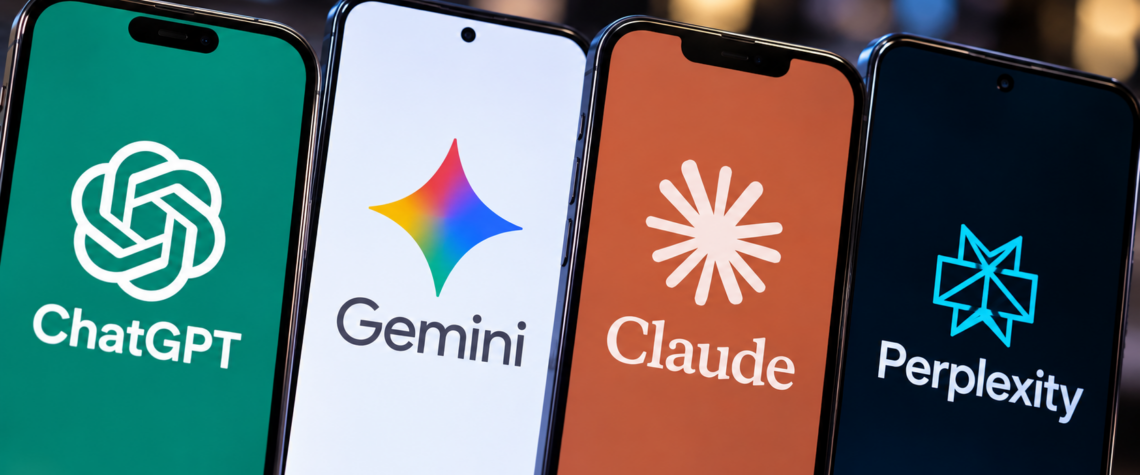
ChatGPT, Gemini, Claude and Perplexity can all answer questions, write, research and help you think. But they are becoming very different kinds of assistants. Here’s how to decide which one deserves a place in your life — and whether you should pay for it.
A strange thing has happened to artificial intelligence. Only a few years ago, choosing an AI assistant mostly meant deciding which chatbot gave you the answers you liked best. Today, that decision is becoming more like choosing an operating environment for part of your digital life.
ChatGPT can help you write, research, analyze files, create images and work through increasingly complex projects. Gemini reaches deeply into Google’s ecosystem and can combine AI with services such as Gmail, Drive and Search. Claude has developed a strong identity around writing, analysis, documents and sustained intellectual work. Perplexity began closer to an AI-powered search engine and has evolved into a research and productivity platform with access to models from several companies. OpenAI Help Center
They increasingly overlap. That makes the choice harder, not easier.
The good news is that most people don’t need to choose the “best AI.” They need to choose the one that best fits what they actually do.
ChatGPT: the generalist
ChatGPT has perhaps the broadest claim to being a general-purpose AI assistant. It can move from a conversation to writing, research, images, file analysis, planning and multi-step work without requiring the user to think very much about which category the task belongs to. OpenAI’s current Plus plan costs $20 a month and adds higher model limits and broader access to reasoning, voice, image generation, file analysis and Deep Research; substantially more expensive Pro tiers are aimed at heavy users. OpenAI Help Center
That breadth is its greatest advantage. If you want one AI that can help draft a letter in the morning, examine a spreadsheet in the afternoon, research a purchase, work with an image and then spend an hour helping you develop an idea, ChatGPT makes a compelling case.
It is increasingly becoming something more than a chatbot as well. OpenAI has been expanding ChatGPT’s ability to work with files, connected services and longer tasks, pushing it toward the agent model we discussed in AI NOW. OpenAI Help Center
Worth it for: someone who wants one versatile AI for many different parts of life and work.
Gemini: particularly compelling if you already live in Google
The strongest argument for Google Gemini may not be Gemini alone. It is Google.
Gemini’s Deep Research can use the open web and, when the user chooses, information from Gmail and Drive. Google’s AI plans also extend Gemini into products including Gmail and Docs. Canvas provides another layer for writing, research and creating interactive material, while Gems allow users to create customized assistants for recurring jobs. Google Help
That integration matters. If much of your digital life already exists inside Google, an assistant capable of working across that environment has an advantage that cannot be measured simply by asking two models the same trivia question.
Google’s free Gemini offering is already substantial, while its current Google AI Pro plan is $19.99 a month and includes greater Gemini access alongside additional Google services and storage. Gemini
Worth it for: people whose email, documents, files and daily digital routines already revolve around Google.
Claude: for people who work with words and ideas
Claude from Anthropic occupies an interesting position. It can search the web, analyze text and images, generate code and perform many of the same general tasks as its competitors. Its paid Pro plan currently costs $20 monthly, with lower effective pricing on an annual subscription, and includes Research, Projects, extended thinking and connections to Google Workspace and other tools. Anthropic
But feature lists don’t entirely explain why someone might prefer Claude.
For writers, editors, researchers and people who spend long periods developing an argument or working through a document, the character of the interaction matters. Claude has increasingly been designed around sustained work with content rather than simply producing quick answers. Anthropic’s current models also emphasize creating polished documents, presentations and spreadsheets alongside more traditional reasoning tasks. Anthropic
That doesn’t automatically make Claude a better writer than every competitor; writing quality is partly subjective and varies with the task and prompt. It does mean that someone whose day consists largely of reading, thinking, revising and writing should try Claude before deciding where to subscribe.
Worth it for: writers, researchers and knowledge workers who value long-form collaboration and careful work with documents.
Perplexity: start with the sources
Perplexity approaches the problem from another direction. Its roots are in search and research, and that remains its clearest identity.
Ask a question and Perplexity is designed to search for information, synthesize what it finds and make the underlying sources prominent. Its free plan provides practically unlimited basic searches but only limited Pro Searches. The paid tiers add more sophisticated research, file analysis, creation tools and access to advanced models. Perplexity AI
There is an unusual advantage here: paying for Perplexity doesn’t necessarily mean committing yourself to one AI company’s models. Its Pro service offers access to models from multiple providers, including OpenAI, Anthropic and Google, although availability changes as models are updated. Perplexity AI
For someone whose first instinct is “Show me where this information came from,” that research-centered design can be extremely attractive.
Worth it for: journalists, students, researchers and curious users who frequently investigate current information and want sources close to the answer.
Don’t choose an AI like a sports team
This may be the most important advice in this article. You don’t have to become a ChatGPT person, a Gemini person or a Claude person. The companies would understandably prefer that you build your habits inside their ecosystems. You don’t have to cooperate Use one AI to research something and another to challenge its conclusion. Try the same writing assignment in ChatGPT and Claude. Ask Gemini to work with information in your Google environment. Use Perplexity when finding and examining sources is central to the task. The differences become much easier to understand when you stop comparing feature lists and start giving the assistants your actual work.
Try free before you pay
This is especially important because the free versions have become remarkably capable. Gemini offers free access to everyday AI features, Claude has a free tier, Perplexity provides basic searches without a subscription, and ChatGPT likewise offers a free consumer service. Paid plans generally buy greater usage, more advanced models or tools, and broader access rather than admission to AI itself. Gemini
So don’t subscribe because somebody on YouTube tells you that one model has just beaten another on a benchmark.
Give yourself a week.
Take five things you genuinely need to do and try them with two or three assistants. Give them a difficult document. Ask them to research something you care about. Have them rewrite something you wrote badly. Plan something complicated. Challenge an answer you suspect may be wrong.
You will learn more about which AI fits you from those experiments than from a hundred benchmark charts.
The $20 problem
There is another reason to resist collecting AI subscriptions: twenty dollars doesn’t sound like much until you multiply it.
ChatGPT Plus is currently $20 a month. Claude Pro is $20 when billed monthly. Google’s AI Pro is $19.99. Perplexity’s mainstream paid service is also positioned as a premium subscription, while all four companies offer still more expensive tiers for heavy users. OpenAI Help Center Subscribe indiscriminately and AI can quietly become another bundle of monthly bills. For most consumers, one paid assistant — supplemented by the free versions of the others — is probably a more sensible starting point than four subscriptions.And you may discover that you don’t need to pay at all.
So which one should you choose?
If you want the broadest all-purpose assistant, start with ChatGPT. If your life already runs through Google’s services, Gemini deserves serious consideration. If your work revolves around writing, documents and sustained thinking, try Claude. If your priority is web research and visible sourcing, start with Perplexity.
But don’t treat those descriptions as permanent borders. These products are evolving so quickly that features once distinctive to one assistant regularly appear in another. That leads to the first rule of WORTH IT? Don’t ask which company has the smartest AI. Ask which AI makes you more capable. And only then ask whether it deserves your twenty dollars.