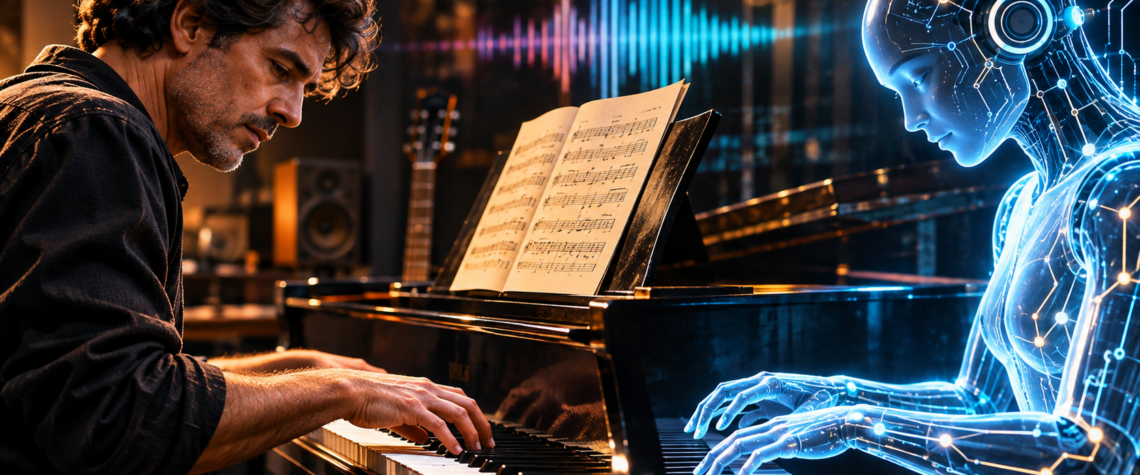
Artificial intelligence can compose melodies, imitate voices, and generate entire songs in seconds. But as machines enter the creative process, musicians, audiences, and lawmakers face difficult questions about originality, ownership, and the meaning of artistic expression.
For centuries, music has been one of humanity’s most intimate forms of expression. A composer transforms imagination into melody. A singer gives emotion a voice. A musician spends years mastering an instrument, searching for a sound that is recognizably their own.
Now a person with no musical training can type a few sentences into an artificial intelligence system and receive a complete song, with instruments, vocals, lyrics, and production, in less time than it takes to listen to it.
The results can be remarkably convincing. AI-generated music can imitate familiar genres, reproduce the characteristics of different instruments, and create synthetic performances that sound like recordings made by human musicians.
But technological capability raises questions that are far more complicated than whether a machine can produce an appealing melody.
Who deserves credit for the music? Who owns it? What happens to musicians whose work helped train the technology? And does the meaning of a song change when no human being has experienced the emotions it appears to express?
A Music Industry Facing an Unprecedented Flood
The transformation is already measurable. In July 2026, streaming service Deezer reported receiving approximately 90,000 fully AI-generated tracks daily. At peak levels in June, synthetic music represented more than half of all new tracks delivered to the platform.
That does not mean half of the music people listen to is AI-generated. Deezer reported that fully synthetic tracks accounted for only a small share of actual listening activity, between 1% and 3% of streams.
The distinction is important. AI has made music production extraordinarily easy, but generating a song is not the same as finding an audience.
Nevertheless, the scale of production creates a serious challenge for an industry already struggling with streaming economics, competition for attention, and fair compensation for artists. When music can be produced almost without limit, how does the work of a human musician retain its economic value?
From Musical Instrument to Creative Partner
Technology has always changed music. The piano expanded the expressive possibilities available to composers. Recording equipment allowed performances to reach audiences far beyond concert halls. Synthesizers introduced sounds that traditional instruments could not produce. Digital recording and editing software transformed the economics of music production.
Artificial intelligence belongs to this history of technological innovation, but it also introduces a significant difference.
Traditional instruments require a person to determine what is played. Generative AI can make many of the compositional and performance decisions itself. Systems such as Suno and Udio allow users to describe a musical style, mood, instrumentation, or lyrical theme and generate complete recordings.
For independent creators, these capabilities may open doors that were previously closed. A filmmaker with a limited budget can experiment with musical ideas. A songwriter can explore arrangements without hiring an entire ensemble. A student can hear variations of a composition while learning about musical structure.
AI can therefore function as a creative assistant.
But there is a meaningful distinction between a musician using AI to develop an original idea and a user asking a system to generate an entire song with minimal creative involvement. Both activities may produce music. They do not necessarily involve the same kind of authorship.
The Copyright Question: Who Owns the Song?
In January 2025, the U.S. Copyright Office published a major report examining whether works created with generative AI qualify for copyright protection. Its conclusion drew an important distinction between human creativity and machine-generated output.
A work that incorporates AI assistance may qualify for protection when a human contributes sufficient original expression. But material generated entirely by AI, without adequate human authorship, does not qualify for copyright protection under the Office’s interpretation of U.S. law.
Simply writing a prompt does not automatically establish authorship of everything the system produces. This creates uncertainty for musicians and businesses developing AI-generated content.
If someone writes original lyrics, selects particular musical elements, edits an arrangement, and combines them into a finished recording, some human-authored contributions may be protected. The precise scope depends on the facts.
But asking a machine to produce a complete song does not necessarily confer copyright ownership over its musical content.
There is also a separate legal question: whether companies developing music-generation systems may train their models on copyrighted recordings without permission.
These disputes involve copyright law, licensing, the rights of recording owners, and the interests of composers and performers. They cannot be resolved simply by determining who typed the prompt.
When AI Borrows a Famous Voice
Perhaps the most emotionally unsettling application of AI music is voice imitation. A synthetic recording can resemble a recognizable singer without that person ever entering a studio. For fans, the result may initially seem fascinating. Imagine hearing a familiar voice perform a song that its owner never recorded.
For the artist, however, the experience can be deeply troubling. A singer’s voice is not merely an instrument. It is part of their professional identity, developed through years of training, performance, and personal experience.
Unauthorized imitation raises questions about consent, deception, reputation, and compensation. It also creates opportunities for fraud. Listeners may believe they are hearing a genuine performance or endorsement when the recording is entirely synthetic.
The ethical distinction is straightforward: using technology to experiment with musical expression is different from exploiting another person’s recognizable identity without permission.
Licensing and informed consent can help establish legitimate uses, but they do not eliminate every concern about authenticity.
Can a Machine Express an Emotion It Has Never Felt?
Music is more than an arrangement of notes. A blues singer may transform personal suffering into a performance. A composer may write a piece in response to grief. A songwriter may preserve the memory of a relationship in a melody.
Listeners do not always know the experiences behind a song, but the possibility of a human story gives music an important dimension.
Generative AI complicates that relationship. A system can produce a convincing melancholy ballad without having experienced sadness. It can generate a celebratory anthem without feeling joy. It can reproduce the musical conventions associated with heartbreak without having loved anyone. Does that make the music less meaningful?
Not necessarily. Listeners bring their own experiences to what they hear. A melody can evoke memories or emotions regardless of how it was produced.
Yet there remains a difference between the emotional effect of a composition and the lived experience of the person who created it.
AI-generated music challenges us to consider whether artistic value resides primarily in the finished work, in the creative process, or in the human relationship between artist and audience. There may be no universal answer.
What Happens to Working Musicians?
Beyond the philosophical debate lies an immediate economic concern. Musicians earn income through performances, recording sessions, composition, licensing, teaching, and commercial production. Some of these activities are vulnerable to competition from inexpensive AI-generated alternatives.
A small business seeking background music for an advertisement may decide to generate a track rather than commission a composer. A video producer may replace licensed recordings with synthetic music. Companies may experiment with virtual performers that do not require traditional recording contracts.
These changes could reduce opportunities for some musicians, particularly those working in commercial production and other areas where cost and speed strongly influence purchasing decisions.
At the same time, AI tools may help independent artists create more ambitious projects with fewer resources. The economic consequences will not be identical for every musician. The central policy question is whether the benefits of greater creative access can coexist with meaningful compensation and protection for human artists.
Should AI-Generated Music Be Labeled?
Transparency may become one of the most important boundaries in the emerging music economy. In October 2026, Deezer introduced an option allowing listeners to filter fully AI-generated music from search results.
The company had already begun identifying AI-generated tracks and excluding detected synthetic music from certain recommendation systems. Such measures reflect an emerging principle: listeners should have meaningful information about the origin of the content they consume.
Labeling does not require audiences to reject AI music. It gives them the ability to choose. Some listeners may enjoy experimenting with synthetic compositions. Others may prefer recordings created and performed by human musicians. Both preferences can coexist if platforms are transparent about what they distribute.
However, detection systems are imperfect, and the boundary between AI-assisted and fully AI-generated music is not always clear. A recording might contain human vocals, AI-generated accompaniment, and conventional digital editing. Any labeling system must account for these differences rather than treating every use of AI as equivalent.
Where Should We Draw the Creative Boundary?
The debate over AI music is sometimes presented as a choice between technological progress and artistic tradition. That is a false dilemma.
Musicians have always adopted new technologies, often transforming them into forms of expression their inventors never anticipated.
AI may become another powerful addition to the creative toolkit. But creativity should not be confused with unrestricted appropriation.
Reasonable boundaries could include obtaining permission for commercial voice replicas, developing lawful licensing arrangements for training material, identifying fully synthetic recordings, protecting consumers against deceptive impersonation, and preserving meaningful human control over artistic decisions. None of these measures requires abandoning innovation.
They recognize that creative freedom exists alongside the rights and livelihoods of other people.
The Future of Music Is Still a Human Question
Artificial intelligence will almost certainly become more capable of generating sophisticated music. Its ability to reproduce musical styles, combine genres, and produce polished recordings will continue to challenge traditional ideas about artistic skill. But producing sound and creating culture are not necessarily the same thing.
Music connects generations, preserves traditions, expresses dissent, celebrates identity, and gives shape to experiences that words alone cannot communicate.
AI may help people participate in that process in new ways. It may also overwhelm digital platforms with recordings produced primarily to attract attention or generate revenue.
The outcome will depend not only on the technology, but on the decisions made by artists, technology companies, streaming platforms, lawmakers, and listeners. The question is not whether artificial intelligence should be allowed to make music.
It is whether the future of music will give human creativity more opportunities to flourish—or make the people behind that creativity increasingly invisible.