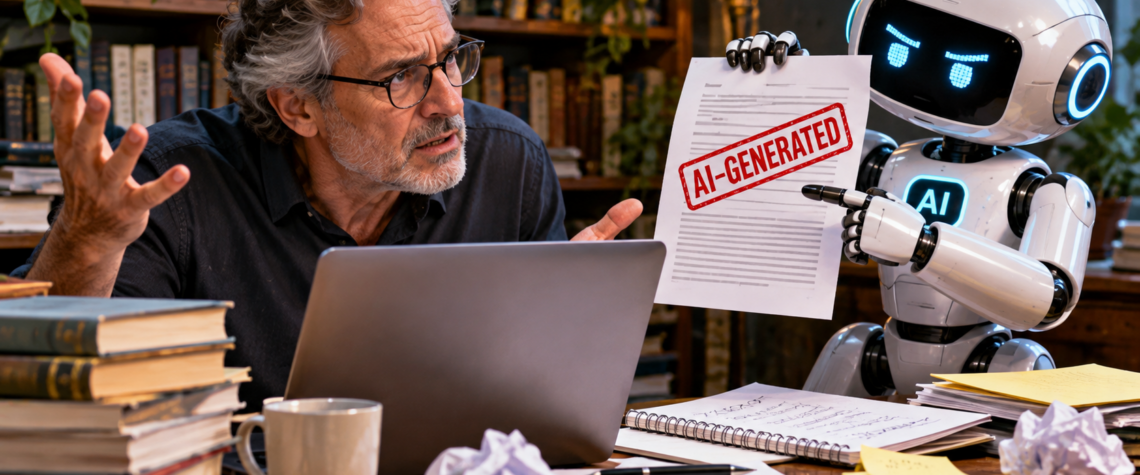
Tools like Pangram promise to distinguish human writing from artificial intelligence with remarkable accuracy. But as AI becomes part of everyday writing, a troubling question remains: Can an algorithm establish authorship—or merely make an educated guess?
Imagine spending an entire weekend writing a college essay. You research the subject, organize your arguments, revise your sentences, and submit the finished assignment. A few days later, your professor informs you that an artificial intelligence detector has flagged your work as AI-generated.
You insist that you wrote it yourself. The software suggests otherwise.
How do you prove that your own words belong to you?
This scenario illustrates one of the most consequential challenges emerging from the widespread adoption of generative artificial intelligence. As millions of students, professionals, journalists, and ordinary users turn to tools such as ChatGPT, a parallel industry has developed software designed to identify whether a text was written by a person or produced by a machine.
Among the companies attracting attention is Pangram, an AI-detection platform whose technology has performed particularly well in independent academic evaluations.
But the growing sophistication of these systems raises questions extending far beyond their technical accuracy. What exactly are they detecting? How reliable are their conclusions? And should an algorithm’s judgment be enough to accuse someone of presenting machine-generated work as their own?
How Can Software Recognize AI Writing?
Unlike plagiarism detection systems, which compare a document against existing sources to identify copied passages, AI-text detectors generally do not need to find an identical sentence anywhere on the internet.
Instead, they examine patterns in language.
Large language models learn to generate text by identifying statistical relationships among words and other elements of language. Their training enables them to produce coherent sentences, structured arguments, and convincing explanations across an enormous range of subjects.
Yet the choices these systems make can leave detectable patterns.
Pangram uses a neural-network classifier trained on examples of human-written and AI-generated documents. According to the company’s technical explanation, its system converts text into numerical representations and analyzes relationships among linguistic features before predicting whether the writing resembles human or machine-generated material.
The company says its training process includes difficult examples that earlier versions incorrectly classified, allowing the model to improve its ability to distinguish between the two categories.
This approach is considerably more sophisticated than searching for suspicious expressions or counting how frequently a writer uses certain words.
For example, the presence of a phrase such as “in today’s rapidly evolving world” does not prove that ChatGPT wrote a passage. Nor does the use of unusually polished grammar or long sentences.
The detector attempts to recognize broader patterns that emerge across the writing.
Even so, the underlying process remains a statistical classification. The software has not witnessed the author writing the document, and it cannot reconstruct every decision made during its creation.
How Accurate Is Pangram?
There is substantial evidence that some commercial AI detectors perform considerably better than earlier systems.
In a 2025 working paper titled Artificial Writing and Automated Detection, researchers Brian Jabarian and Alex Imas evaluated Pangram, Originality.ai, GPTZero, and an open-source detector known as RoBERTa.
The researchers tested the systems using human-written and AI-generated material spanning different genres, text lengths, and language models.
Their findings showed that commercial detectors generally outperformed the open-source alternative. Pangram performed particularly well, achieving near-zero false-positive and false-negative rates within the researchers’ evaluation.
A false positive occurs when a detector incorrectly identifies human writing as AI-generated. A false negative occurs when AI-generated writing is incorrectly classified as human.
Both errors matter, but their consequences can be very different.
A false negative might allow an AI-generated assignment to escape detection. A false positive could expose an innocent student to an accusation of academic misconduct.
Pangram itself reports a false-positive rate of approximately one in 10,000 documents under its published testing conditions.
These results suggest that AI detection has advanced significantly. However, performance measured on particular datasets does not guarantee identical results for every document, writing style, language, or future AI model.
A highly accurate detector can still make mistakes.
And the more consequential the decision, the more important those mistakes become.
When AI Detectors Got It Wrong
The history of AI detection offers reasons for caution.
In January 2023, OpenAI introduced a classifier intended to distinguish AI-generated text from human writing. Its performance was limited: in the company’s evaluation, the tool correctly identified only 26% of AI-written texts as likely AI-generated, while incorrectly flagging 9% of human-written texts.
OpenAI discontinued the classifier in July 2023 because of its low accuracy.
That early failure does not mean today’s detectors are equally unreliable. Pangram’s subsequent results indicate meaningful technical progress.
But it demonstrates why AI detection should not be treated as an infallible technology simply because its conclusions are presented as numerical scores.
There is another concern: not all writers use language in the same way.
A 2023 study by Stanford University researchers, published in the journal Patterns, found that several AI-text detectors disproportionately classified writing by non-native English speakers as AI-generated.
The researchers warned that such errors could disadvantage people whose writing reflects different linguistic backgrounds.
The study examined earlier detectors, not Pangram’s current system, so its findings should not be interpreted as proof that Pangram exhibits the same bias.
Nevertheless, the research demonstrates why evaluations should examine performance across different populations and writing styles, rather than relying exclusively on overall accuracy.
What Happens When Humans and AI Write Together?
Perhaps the greatest conceptual difficulty is that writing is no longer necessarily an activity performed entirely by either a human or a machine.
Consider a journalist who researches a subject, interviews sources, develops an original argument, and then asks ChatGPT to improve the clarity of several paragraphs.
Or a student who writes an essay but uses AI to correct grammar.
Or a business professional who provides detailed notes and asks an AI assistant to turn them into a polished report.
These situations involve different degrees of human authorship and machine assistance.
Yet a detector may identify characteristics associated with AI-generated prose without being able to determine the precise nature of the collaboration.
This distinction is important because institutions increasingly need to decide which uses of artificial intelligence are acceptable.
A university might permit grammar correction but prohibit generating an entire assignment. A publisher might allow AI-assisted editing while requiring that reporting, sourcing, and factual verification remain under human editorial responsibility.
An AI detector cannot independently determine whether those rules were followed.
It can analyze the resulting text, but it cannot fully establish the process through which the document was produced.
The distinction between detecting machine-generated language and proving misconduct is fundamental.
A New Challenge for Teachers
Schools and universities are among the institutions facing the most immediate decisions about AI detection.
Teachers need ways to evaluate whether students are developing their own understanding rather than simply submitting automatically generated assignments.
At the same time, students deserve protection against erroneous accusations.
The University of Chicago provides an instructive example. Its academic-integrity guidance acknowledges research showing Pangram’s strong performance, while emphasizing that AI detectors are not perfect.
The university permits Pangram to serve as supporting information within a transparent, human-led academic-integrity process.
That distinction offers a reasonable principle for other institutions: a detector’s result may justify further examination, but it should not automatically determine guilt.
A conversation with the student, examination of drafts, review of the assignment’s development, and consideration of the student’s ability to explain the work can provide additional context.
Such measures are not flawless either, but they recognize that authorship is a question about human activity, not merely a statistical pattern in a finished document.
What About Journalists and Professional Writers?
For journalism, the stakes are somewhat different.
A publication’s credibility depends not only on whether its sentences were written by a human being but also on whether its information is accurate, its sources are reliable, and its editorial judgments are responsible.
An entirely human-written article can contain fabricated quotations, unsupported claims, or serious factual errors.
Conversely, an article that received limited AI-assisted editing may still be based on original interviews, documented research, and independent reporting.
AI detection does not establish journalistic quality.
Editors should therefore distinguish among the origin of the information, the authorship of the prose, and responsibility for the final published work.
The central question is not simply whether artificial intelligence participated in the writing process. It is whether the publication can account for its reporting, verify its claims, and explain how the work was produced.
What Should You Do If Your Writing Is Flagged?
For students, journalists, and professionals concerned about false accusations, several practical precautions can help establish how a document was created.
Keep early drafts and research notes. Where possible, use writing applications that preserve version history, showing how a document evolved over time. Retain interview recordings, source material, outlines, and other evidence of original work when appropriate.
If an AI detector flags your writing, ask which system was used, what the result actually means, and whether the institution has a procedure for reviewing disputed classifications.
It is also important to understand the difference between a detection score and a probability of guilt.
A tool reporting a high level of confidence in its classification is not necessarily saying there is an equivalent probability that the writer violated a rule.
The interpretation depends on the detector, its calibration, the type of document, and the circumstances in which it is being used.
Most importantly, a detector’s output should be evaluated alongside other evidence.
Can We Ever Know for Certain?
As artificial intelligence becomes more capable, the boundary between human and machine-generated writing may become increasingly difficult to define.
Future systems may produce prose that more closely resembles individual human writing styles. Meanwhile, human writers will continue incorporating AI into their research, drafting, editing, and translation workflows.
Detection technology will likely evolve alongside these changes.
Other approaches, including document provenance, verified editing histories, and systems that record how digital content was created, may eventually provide stronger evidence of authorship than linguistic analysis alone.
But these methods introduce their own questions about privacy, accessibility, and control over creative work.
Pangram demonstrates that identifying AI-generated text is no longer the crude guessing exercise it sometimes appeared to be during the early days of ChatGPT.
Its strong performance in independent testing deserves recognition.
Yet even a remarkably accurate classifier cannot answer every question about creativity, intellectual responsibility, or the meaning of authorship.
A machine can analyze the patterns in our sentences.
Determining what those sentences represent—and who should be accountable for them—remains a human responsibility.
Sources and Further Reading
- Brian Jabarian and Alex Imas, Artificial Writing and Automated Detection, National Bureau of Economic Research, Working Paper 34223, September 2025.
- Pangram, How AI Detection Works and How Does Pangram Work?
- OpenAI, New AI Classifier for Indicating AI-Written Text, January 2023; discontinuation notice, July 2023.
- Weixin Liang and colleagues, GPT Detectors Are Biased Against Non-Native English Writers, Patterns, July 2023.
- University of Chicago, Academic Integrity & Student Conduct, guidance on Pangram and AI detection.