From factory floors to hospitals and eventually our homes, a new generation of AI-powered robots is learning to move, work, and adapt. China is racing ahead, Europe is fighting to catch up, and the consequences could reach far beyond manufacturing.
For decades, the promise of artificial intelligence was largely confined to computers. Machines could calculate, recognize patterns, analyze information, and eventually hold remarkably convincing conversations. But they could not easily pick up a fragile glass, fold a towel, or navigate an unfamiliar room without extensive programming.
That distinction is beginning to disappear. A new generation of robots is being developed to combine artificial intelligence with the ability to interact physically with the world. Instead of merely answering questions or generating images, these machines are learning to manipulate objects, recognize changing environments, and perform tasks that previously required human hands.
The implications could be enormous. Robots may eventually help address labor shortages, assist older adults, perform dangerous industrial work, and transform manufacturing. They could also disrupt employment, introduce new safety concerns, and concentrate economic power among the companies and countries that control the technology. The race to build them is already underway.
Teaching Robots to Learn
In Germany, a robotics company called Neura Robotics is pursuing an ambitious idea: Rather than programming a machine separately for every movement, why not teach robots through experience?
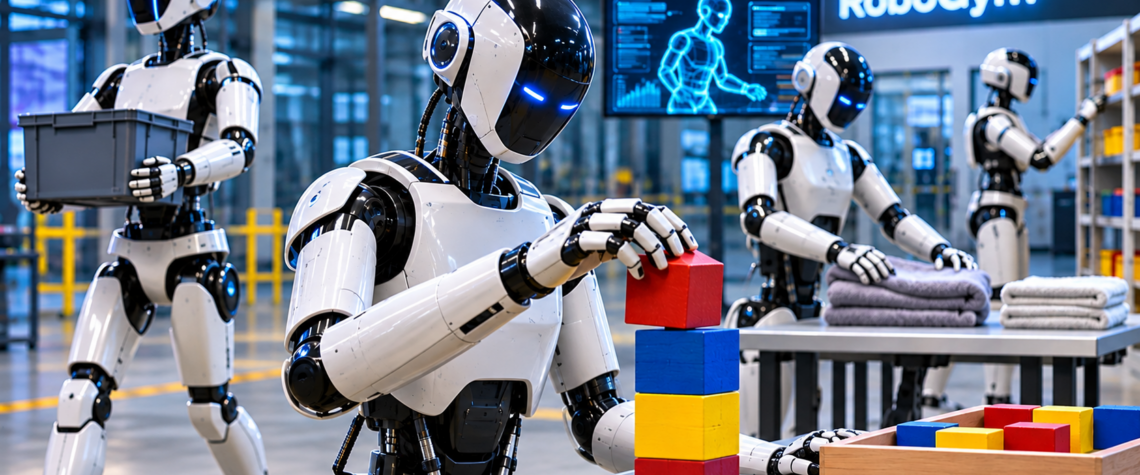
The company, founded by entrepreneur David Reger, is developing intelligent robots capable of learning physical skills. Near Munich, a training facility known as a RoboGym allows machines to practice tasks repeatedly, collecting information about their movements, mistakes, and successes.
The concept resembles the training of an athlete. A robot attempts a task, adjusts its movements, and tries again. Sensors record what happens, while artificial intelligence systems help translate the experience into improved performance.
The difference is that machines can potentially share what they learn. A successful technique developed by one robot may contribute to the training of others, accelerating progress across an entire fleet. This approach addresses one of robotics’ most persistent challenges: The physical world is far less predictable than a computer screen.
A chatbot can process a sentence without worrying about gravity. A robot reaching for a coffee cup must judge its position, estimate the force required to grasp it, avoid knocking over nearby objects, and respond if the cup begins to slip. Even a simple household chore can involve thousands of decisions.
China’s Enormous Head Start
China has already established a commanding position in industrial robotics. According to the International Federation of Robotics, Chinese factories had more than two million industrial robots operating at the end of 2024. The country installed approximately 354,000 additional industrial robots during 2025, accounting for nearly 59 percent of new installations worldwide that year.
These numbers illustrate the scale of China’s automation effort, although they should not be confused with the number of intelligent humanoid robots. Most industrial robots are specialized machines designed for particular manufacturing operations, not humanlike assistants capable of performing many different tasks.
Nevertheless, China’s manufacturing infrastructure provides an important advantage. Factories, suppliers, engineering teams, and large-scale production facilities create an environment in which new robotic technologies can be developed, tested, and manufactured.
Chinese companies are also investing heavily in humanoid robots and the training facilities needed to make them useful. The challenge for competitors is not simply to invent a more sophisticated robot. It is to develop an entire industrial ecosystem capable of producing reliable machines at affordable prices.

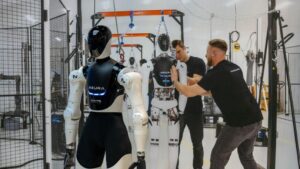
Neura is developing robots that do more than simply execute programmed movements. They want to teach them to learn physical tasks using AI. To achieve this, it participates in a training center known as RoboGym, where up to 100 robots continuously practice tasks.
Europe’s Attempt to Catch Up
Europe is approaching the robotics race from a different position. Germany has a long history of industrial engineering, precision manufacturing, and advanced machinery. Its companies possess expertise in motors, sensors, mechanical systems, and the components that allow robots to move accurately.
Neura Robotics hopes to combine those traditional strengths with modern artificial intelligence. The company’s strategy reflects a broader European ambition: to avoid becoming dependent on robotic systems developed elsewhere, particularly as manufacturing industries confront aging populations and shortages of skilled workers.
But technical excellence alone may not be sufficient. Companies must also attract investment, obtain the vast amounts of training data required by intelligent robots, and demonstrate that their products can operate safely and economically outside controlled laboratories.
Europe may have an advantage in engineering and safety standards. China has advantages in manufacturing scale and deployment. American companies, meanwhile, contribute important advances in AI models, computing hardware, and robotic research. The eventual winners may be those best able to combine all three capabilities.
What Makes a Robot Intelligent?
Traditional industrial robots are already extraordinarily capable. They assemble automobiles, weld metal, package products, and perform repetitive operations with precision. But their intelligence is usually limited to carefully defined tasks.
A newer generation of AI-powered robots aims to overcome those limitations by combining several technologies. Computer vision helps machines interpret their surroundings. Sensors measure distance, pressure, and movement. AI models help identify objects, interpret instructions, and select actions. Learning systems can improve performance through demonstrations, simulations, and repeated attempts.
Researchers increasingly describe this combination as physical AI or embodied AI. The distinction matters because intelligence in the physical world requires more than recognizing what should happen. A machine must also make it happen.
A robot may understand the instruction “clear the dinner table,” but completing that task requires recognizing dishes, distinguishing fragile objects, navigating furniture, and adjusting its movements when something unexpected occurs.
Human beings acquire many of these abilities through years of physical experience. Robots must learn them through a combination of data, engineering, and training.
Progress is real, but the gap between an impressive demonstration and a dependable commercial product remains substantial.
The Jobs Question
One of the most immediate consequences of intelligent robotics will be felt in the workplace. Manufacturers hope robots can perform repetitive, physically demanding, or hazardous tasks. Hospitals and care facilities may eventually use them to transport supplies, assist staff, or support certain routine activities. Warehouses could deploy more adaptable machines that handle different products without requiring extensive reprogramming.
In countries facing aging populations and declining workforces, these capabilities could help maintain essential services.
But the economic benefits will not necessarily be distributed equally.
Some occupations may change substantially as machines take over particular activities. Other jobs may emerge in robot maintenance, supervision, training, engineering, and safety management.
The central question is not simply whether robots will eliminate jobs or create new ones. It is whether workers will have opportunities to adapt, whether productivity gains will improve wages and working conditions, and who will ultimately own the machines generating those gains.
History suggests that technological revolutions can create enormous wealth. It also shows that the benefits do not automatically reach everyone.
When Robots Enter Our Homes
The most visible dream of the robotics industry is the general-purpose household assistant: a machine that can clean, carry groceries, prepare simple meals, and help people with limited mobility.
For older adults living independently, such technology could eventually offer meaningful assistance. But homes present challenges that factories largely avoid.
Every household is different. Furniture moves, objects break, pets behave unpredictably, and people make unexpected decisions. A robot must operate safely around children, visitors, and vulnerable individuals.
Privacy is another concern. Machines that navigate homes may depend on cameras, microphones, and other sensors capable of collecting sensitive information about everyday life.
Who would control that information? Could manufacturers use it to improve their systems? Would consumers be able to disable recording or delete collected data? And if an autonomous robot injures someone or damages property, who would be responsible: the owner, the manufacturer, or the company supplying its AI software?
These are not merely engineering questions. They involve consumer protection, liability, privacy, and public trust.
A Million Humanoids by 2030?
Some analysts believe the robotics industry is approaching a period of rapid expansion.
Zornitsa Todorova, a researcher at Barclays, has suggested that the number of humanoid robots deployed worldwide could rise from approximately 15,000 in 2025 to one million by 2030, provided costs decline and regulatory obstacles do not slow adoption.
That is a projection, not a guaranteed outcome. The economics remain uncertain. Robots must become affordable enough to justify their purchase, reliable enough to operate for long periods, and versatile enough to perform useful work.
They must also prove that they can function outside carefully staged demonstrations.
Still, the ambition reflects a significant shift in how technology companies view artificial intelligence. The next frontier may not be a more persuasive chatbot or a more powerful image generator, but a machine capable of acting independently in the physical world.
Who Will Control the Robotic Future?
The international competition surrounding robotics is often described as a contest between China, Europe, and the United States.
But the consequences will extend well beyond national borders. Countries that develop and manufacture intelligent robots may gain advantages in productivity, industrial competitiveness, and technological independence. Countries that rely entirely on imported systems could become dependent on foreign suppliers for increasingly important economic activities.
At the same time, widespread robotics could reshape global manufacturing. If machines reduce the importance of labor costs, some industries may reconsider where they locate production.
The effects could be particularly significant for developing economies that have traditionally depended on labor-intensive manufacturing to create employment. Yet robotics could also provide opportunities for smaller businesses, hospitals, and communities that cannot easily recruit enough workers.
Much will depend on affordability, access, education, and public policy. The most important competition may ultimately be about more than which country builds the largest number of robots. It may be about which societies learn to use them most effectively and fairly.
The Decade Ahead
For much of the modern technological era, machines have extended human physical abilities while computers have extended our capacity to process information.
Artificial intelligence is beginning to bring those two developments together. Robots that learn from experience could become more adaptable, more useful, and eventually more common. But there is no certainty that the rapid advances seen in digital AI will translate into equally rapid progress in the unpredictable physical world.
The coming decade will test that possibility. If the technology succeeds, robots may move from specialized industrial settings into workplaces, public spaces, and homes. Their arrival could transform how societies produce goods, deliver services, and care for people. But the success of the robotic revolution should not be measured solely by how many machines are manufactured or how closely they resemble human beings.
It should also be measured by whether they make human lives safer, healthier, more productive, and more independent. For decades, we have taught machines to process information. Now we are teaching them to act. The question is no longer simply how intelligent robots can become, but what kind of world we want them to help build.