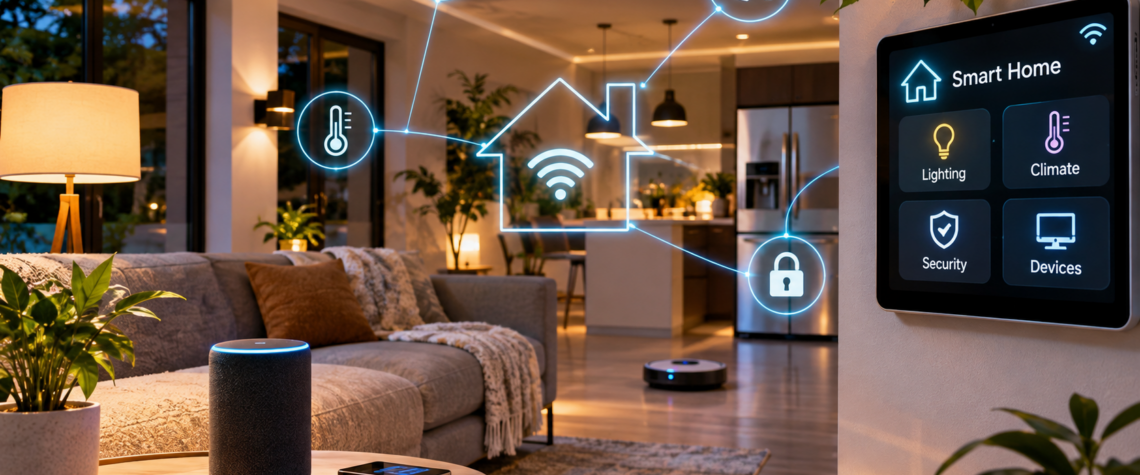
From lights that respond to your voice to thermostats that learn your routine, the Internet of Things is transforming everyday life. Here’s how smart homes work, what they can actually do, and what homeowners should know before connecting everything.
Imagine arriving home after a long day. The front door unlocks, the hallway lights turn on, and the thermostat has already adjusted the temperature to your preference. In the kitchen, a connected appliance sends a notification to your phone. Before going to bed, a single voice command turns off the lights and activates the security system.
This is no longer a vision of the distant future. Much of this technology is already available, although creating a home where everything works together can still require careful planning, compatible devices, and a reliable network.
The technology behind these conveniences is called the Internet of Things, or IoT. It describes a growing network of physical devices equipped with sensors, software, and communication capabilities that allow them to exchange information and perform tasks automatically.
But as homes become more connected, an important question emerges: Are these technologies giving homeowners greater control over their lives, or creating new dependencies on the companies that operate them?
What Makes a Home Smart?
A smart home is not simply a house filled with electronic gadgets. Its defining feature is the ability of connected devices to communicate, respond to information, and carry out tasks with limited human intervention.
Consider a conventional light switch. Someone must physically operate it to turn a lamp on or off. A smart lighting system can respond to a smartphone, a voice command, a motion sensor, or a predetermined schedule.
A connected thermostat can adjust heating and cooling based on occupancy or household routines. Smart locks can provide temporary access codes for visitors. Water-leak sensors can alert homeowners before a small plumbing problem becomes a costly disaster.
The real advantage emerges when these devices work together.
For example, a household could establish a “Good Night” routine that turns off selected lights, lowers the thermostat, and checks whether compatible doors are locked.
These routines generally rely on predefined rules rather than sophisticated artificial intelligence. Some newer systems incorporate machine learning to recognize patterns and make adjustments, but not every smart device is an AI device.
That distinction matters because automation and artificial intelligence are related technologies, not interchangeable terms.
Five Ways Smart Homes Can Make Everyday Life Easier
1. Managing energy consumption
Smart thermostats are among the most practical applications of home automation. They can adjust temperatures according to schedules, occupancy, or household preferences, potentially reducing unnecessary heating and cooling.
According to the U.S. Environmental Protection Agency’s ENERGY STAR program, certified smart thermostats are independently evaluated using real-world performance data to demonstrate energy savings.
Actual savings depend on the home’s heating and cooling equipment, climate, insulation, and how the system is used.
Smart plugs and lighting systems can also help reduce electricity waste by switching off devices when they are not needed.
2. Improving home security
Connected doorbells, cameras, motion detectors, and smart locks allow homeowners to monitor certain activities remotely. A camera may send an alert when movement is detected near an entrance. A smart lock may allow a homeowner to provide a temporary access code to a guest or service provider.
However, connected security systems introduce their own vulnerabilities. Cameras can expose private spaces if accounts or devices are compromised, and internet-dependent features may stop working during network outages. A smart security system should complement—not replace—basic physical security.
3. Making homes more accessible
For older adults and people with mobility limitations, automation can offer meaningful benefits. Voice-controlled lighting may eliminate the need to reach switches. Automated blinds can be operated without moving around a room. Smart speakers can provide reminders, and connected sensors may help caregivers identify certain unusual conditions.
These tools can support independence, although they cannot substitute for professional medical care or reliable emergency assistance. Their usefulness depends on accessibility, ease of operation, and whether residents remain comfortable using them.
4. Preventing household damage
Not every valuable smart-home application involves convenience. Water-leak detectors can identify moisture near washing machines, water heaters, or sinks. Some systems can work with compatible shutoff valves to stop water flow automatically.
Smoke and carbon monoxide detectors with connected features may send alerts to a phone, depending on the model and service configuration.
These technologies can provide earlier warnings, but they still require proper installation, maintenance, and testing.
5. Simplifying daily routines
Connected appliances, robotic vacuum cleaners, smart blinds, and automated lighting can reduce repetitive household tasks. A robotic vacuum may clean selected rooms on a schedule. Smart blinds may open in the morning. Outdoor lights may respond to sunset rather than a fixed clock time.
The benefits can be modest individually, but collectively they may make daily routines more convenient. The challenge is ensuring that automation serves the household rather than forcing residents to adapt to complicated technology.
How Do All These Devices Communicate?
Behind the apparent simplicity of a smart home lies a collection of networking technologies. Wi-Fi connects many devices directly to a household network. Bluetooth is often used for nearby communication and initial setup. Zigbee and Z-Wave are wireless technologies designed for connected devices, often using hubs or controllers. Thread is another low-power networking technology designed to help compatible devices communicate efficiently.
One of the most important developments is Matter, an interoperability standard supported by major technology companies and device manufacturers.
Matter is designed to make compatible products from different brands work together more easily. It uses existing networking technologies, including Wi-Fi, Ethernet, and Thread, rather than replacing them.
This matters because smart-home customers have historically faced a frustrating problem: a device purchased for one platform might not work properly with another.
Matter can reduce that fragmentation, although compatibility still depends on the particular device, supported features, and home platform.
Consumers should check the specifications before buying, rather than assuming every product labeled “smart” will work with their existing equipment.
Where Does Artificial Intelligence Fit In?
The Internet of Things provides devices with information about their surroundings. Artificial intelligence can help interpret that information and make predictions or recommendations.
A thermostat might learn when residents usually leave home and adjust its schedule. A security camera might distinguish between people, animals, and vehicles. A voice assistant may use AI to interpret increasingly complex requests.
In more advanced systems, information from multiple sensors could help identify patterns that would be difficult to detect through simple automation rules. But AI is not always necessary.
A motion sensor that turns on a hallway light performs a useful task without machine learning. A scheduled thermostat can save energy without making predictions.
For consumers, the important question is not whether a device advertises AI. It is whether its capabilities solve a real problem reliably.
The Hidden Cost: Your Home Becomes a Source of Data
A connected home can reveal surprisingly intimate information about its residents. A thermostat may indicate when people are usually home. A smart speaker may process voice requests. Cameras can capture visitors and household activity. Smart locks may record when doors are opened.
Individually, these details may seem harmless. Combined, they can create a revealing picture of daily life. Some devices process information locally, while others depend on cloud services operated by manufacturers or technology platforms.
That raises questions consumers should ask before installing them: What information is collected? How long is it retained? Is it shared with third parties? Can recordings or activity histories be deleted? What happens if the company discontinues support?
Privacy policies may contain the answers, but they are not always easy to understand.
The Federal Trade Commission advises consumers to secure connected devices, keep software updated, review privacy settings, and disconnect equipment they no longer use. The convenience of automation should not require surrendering more personal information than necessary.
What Happens When the Internet Goes Down?
A house filled with connected devices may be technologically sophisticated but surprisingly vulnerable to ordinary failures. If the internet connection stops working, some remote-control features, cloud-based automations, or voice assistants may become unavailable.
Certain locally controlled devices and routines can continue functioning, depending on their design and configuration.
This is an important consideration when choosing equipment. A smart home should remain usable during a network interruption. Essential functions such as door access, lighting, and heating should have appropriate manual controls or dependable fallback mechanisms.
Homeowners should also consider what happens if a manufacturer shuts down its cloud service, stops releasing security updates, or changes subscription requirements. A device that works perfectly today may become less useful tomorrow if its operation depends entirely on a company’s continued support.
How to Start Without Spending a Fortune
Building a smart home does not require replacing every appliance or installing an expensive centralized system.
A sensible approach is to begin with one practical problem. Someone concerned about energy costs might investigate a compatible smart thermostat. A homeowner worried about plumbing damage could start with a water-leak detector. Someone seeking convenience might try a few smart bulbs or plugs. Before purchasing, consumers should verify compatibility with their existing equipment, investigate whether subscriptions are required, and check how long the manufacturer promises to provide security updates.
Strong account passwords, multifactor authentication where available, updated router software, and careful management of connected devices are essential precautions.
Consumers should also avoid buying products simply because they promise an automated lifestyle. The best smart-home investment is one that delivers a measurable benefit without creating unnecessary complexity.
The Future of the Smart Home
The next stage of home automation may involve more capable AI assistants, improved interoperability, and systems that respond more intelligently to changing conditions.
Instead of requiring residents to configure numerous individual rules, future systems may become better at understanding broader instructions and coordinating compatible devices.
A homeowner might eventually ask a household assistant to reduce energy consumption while keeping occupied rooms comfortable, and the system could recommend or implement appropriate adjustments.
Yet greater automation will also demand greater transparency. Residents should be able to understand why a system made a decision, correct mistakes, protect their personal information, and override automated actions.
The future of the smart home should not be measured by how many devices are connected or how much artificial intelligence they contain.
It should be measured by whether the technology makes life safer, simpler, more affordable, and more comfortable.
A truly intelligent home is not one that makes every decision for its residents. It is one that gives them more control over the place where they live.