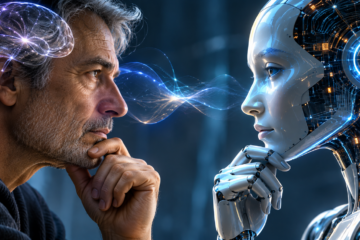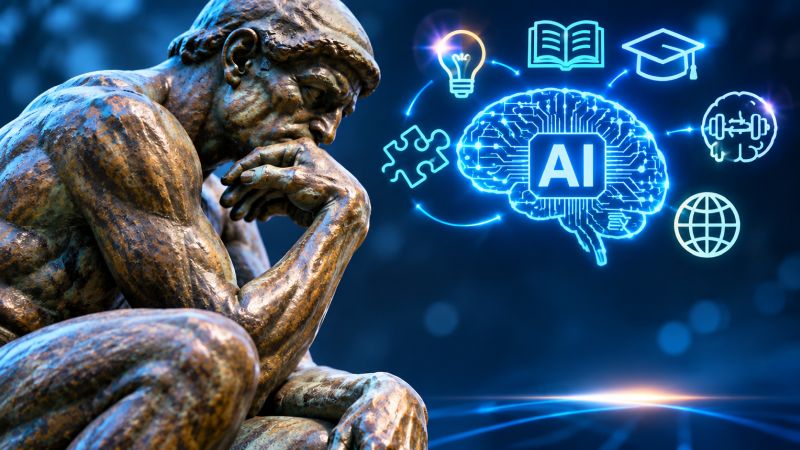
From memory exercises to learning new skills, artificial intelligence can help keep your mind active, curious, and engaged—if you use it the right way.
Your brain doesn’t come with an expiration date. Whether you’re 25, 55, or 85, there are opportunities to challenge your thinking, learn something unfamiliar, and discover abilities you never knew you had. And artificial intelligence is opening new possibilities for doing just that.
For years, keeping the brain active meant doing crossword puzzles, reading books, playing chess, or learning a foreign language. Those activities remain valuable. But AI tools such as ChatGPT can add something different: an interactive partner that asks questions, adapts explanations, creates personalized challenges, and encourages you to explore subjects at your own pace. The important distinction is that AI should exercise your brain, not replace its work.
Your Brain Needs Challenges, Not Just Information
The human brain remains capable of adapting and learning throughout life, a capacity known as neuroplasticity. Although some cognitive abilities change with age, people can continue developing knowledge and skills well into later adulthood.
Research suggests that intellectually stimulating activities may support cognitive functioning and cognitive reserve, although scientists are still investigating how different activities affect long-term brain health.
Simply consuming information isn’t necessarily the same as exercising your mind. Reading an explanation generated by AI requires relatively little effort. Trying to solve a problem before asking AI for help engages attention, reasoning, and memory. The difference is similar to watching someone exercise and doing the exercise yourself.
Turn ChatGPT Into Your Personal Brain Trainer
One of the simplest ways to use AI for mental stimulation is to ask it to become a tutor rather than an answer machine.
Instead of asking ChatGPT to explain a historical event, for example, ask it to quiz you about the event, provide clues when you struggle, and explain your mistakes afterward.
You can also request memory challenges, logic puzzles, vocabulary exercises, or short discussions about subjects you know very little about.
Try this prompt:
“Act as my personal brain trainer. Give me five challenging questions involving memory, logic, vocabulary, and general knowledge. Ask one question at a time, let me answer, and explain my mistakes without immediately revealing the correct answer.”
The goal isn’t to get every answer right. It’s to make your brain work.
Learn Something New, Whatever Your Age
Learning unfamiliar skills can challenge multiple cognitive abilities, including attention, memory, and problem-solving.
AI can make the process more accessible by breaking complicated subjects into manageable lessons. Someone who has never studied astronomy can explore the solar system. A retired accountant can begin learning Italian. A teenager can practice creative writing. A person in their seventies can discover the basics of computer programming.
And unlike a traditional textbook, an AI tutor can respond to questions immediately, adjust the difficulty, and explain the same concept in several different ways.
For example:
“I want to learn conversational Italian. Give me a 15-minute beginner lesson every day. Ask me questions, correct my mistakes, and gradually introduce new vocabulary. Don’t make the exercises too easy.”
The real benefit comes from recalling and using what you’ve learned, rather than merely reading the AI’s responses.
Exercise Your Memory Without Relying on AI to Remember Everything
Smartphones and digital assistants already remember phone numbers, appointments, directions, and countless details for us. AI makes it even easier to delegate everyday mental tasks.
That convenience can be helpful, but it also raises an interesting question: Are we giving our memories fewer opportunities to work?
Researchers study this phenomenon as cognitive offloading, the practice of relying on external tools to reduce mental effort. Offloading isn’t inherently harmful, and its long-term effects depend on the task and context. But if your goal is to practice remembering, you need to make an effort to recall information yourself.
Ask AI to create a short story containing ten unusual objects. Read it once, close the conversation, and write down as many objects as you remember. Then ask AI to check your answers.
Or request a list of historical events and try to place them in chronological order.
These activities offer opportunities to practice attention and recall. However, there is not yet convincing evidence that chatbot-generated memory games prevent dementia or produce broad improvements in everyday cognition.
Have Conversations That Make You Think
Mental stimulation doesn’t have to feel like homework.
One particularly interesting use of AI is as a conversational partner that challenges your ideas.
Ask ChatGPT to discuss whether technology makes people more independent, whether cities should restrict automobiles, or whether machines could ever become creative in the human sense.
Then ask it to disagree with you.
“Let’s debate whether social media has improved human relationships. I will defend one position. Challenge my arguments respectfully, ask follow-up questions, and make me reconsider my assumptions.”
This kind of exchange can encourage people to formulate arguments, consider alternatives, and explain their reasoning.
The key is to resist letting AI do all the intellectual work.
A 15-Minute Daily Brain Workout
You don’t need expensive software or hours of free time to experiment with AI-assisted mental exercises.
Here is a simple routine you can try:
Minutes 1–3: Memory. Ask AI to give you eight unrelated words. Study them briefly, then try to recall them without looking.
Minutes 4–6: Logic. Solve a short reasoning puzzle. Request hints rather than the solution if you get stuck.
Minutes 7–9: Language. Learn five words in a foreign language and use them in sentences.
Minutes 10–12: Creativity. Invent an alternative ending to a familiar story or explain an ordinary object from an unusual perspective.
Minutes 13–15: Reflection. Tell AI what you learned and ask it to test your understanding with two follow-up questions.
This is a suggested practice routine, not a scientifically validated treatment or a guaranteed way to improve cognitive performance. Its purpose is to make active learning a manageable daily habit.
The Danger of Letting AI Think for You
There is a paradox at the heart of artificial intelligence. The same technology that can encourage intellectual curiosity can also make it tempting to avoid difficult thinking.
Why struggle with a complicated article when AI can summarize it? Why solve a mathematical problem when a chatbot can provide the answer? Why write a paragraph when AI can produce one in seconds?
These tools can save time, but convenience and cognitive engagement aren’t always the same thing.
Research into AI-assisted learning and cognitive offloading has raised concerns about excessive dependence, although evidence about lasting effects on cognitive ability remains limited.
A useful rule is to attempt the task first, use AI for feedback or guidance, and then explain the answer in your own words.
That approach keeps the human mind actively involved.
AI Is Only One Part of Brain Health
Keeping your brain engaged involves more than digital exercises.
Physical activity, adequate sleep, social connections, management of cardiovascular risk factors, and opportunities for meaningful learning all contribute to healthy aging. Evidence supporting these habits is generally stronger than evidence for any particular AI brain-training routine.
AI can complement those activities. It can help you plan a walking schedule, explore a new hobby, prepare questions for a book club, or practice a language before speaking with another person.
But it shouldn’t replace physical movement, human relationships, or professional medical care. Anyone experiencing persistent or worsening memory difficulties should consult a qualified healthcare professional rather than relying on chatbot exercises.
The Best Brain Exercise May Be Curiosity
Perhaps the greatest contribution AI can make to lifelong learning isn’t its ability to answer questions. It’s its ability to encourage us to ask more of them.
A question about ancient Egypt can lead to a discussion of archaeology. A conversation about music can become a lesson in mathematics. A simple curiosity about the night sky can open the door to astronomy.
There is no age limit on discovering something new.
And the most valuable AI tool may not be the one that gives you the fastest answer, but the one that inspires you to keep exploring.
The smartest way to use artificial intelligence may be to make sure we never stop using our own.
Sources: