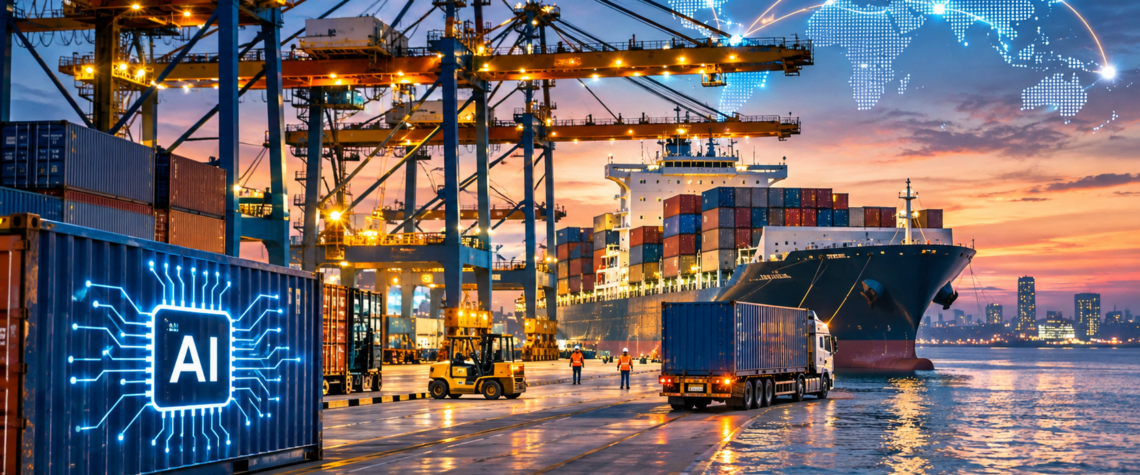
Products linked to artificial intelligence now account for nearly 20% of world trade, according to BBVA Research, as surging demand for chips, servers and computing equipment reshapes international supply chains.
Artificial intelligence is rapidly becoming one of the most powerful forces in international commerce. From advanced semiconductors manufactured in Asia to massive data centers being built in the United States, the global race to develop AI is creating new patterns of production, investment and trade.
A November 2026 analysis by BBVA Research estimates that products associated with artificial intelligence now represent nearly 20% of global trade. Exports of these goods are expanding at approximately 30% annually, compared with growth of around 5% for products unrelated to AI.
The findings suggest that the technology is doing more than transforming individual industries. It is helping reshape the relationships between some of the world’s largest economies.
A New Engine of Global Commerce
The boom is being driven by extraordinary demand for the physical infrastructure required to develop and operate artificial intelligence.
AI systems depend on powerful processors, advanced memory chips, servers, networking equipment and increasingly sophisticated data centers. Producing these components requires complex supply chains that extend across multiple countries.
A semiconductor may be designed in the United States, manufactured in Taiwan, incorporated into computing equipment elsewhere in Asia and ultimately installed in an American data center.
Each stage generates international trade.
According to BBVA Research, exports of AI-related products are growing roughly six times faster than those of other goods.
The World Trade Organization has also identified AI-related equipment as a major driver of international commerce. Its October 2026 outlook found that goods enabling artificial intelligence accounted for nearly half of the increase in the value of global merchandise trade during the first half of the year.
These figures illustrate how investment in a relatively concentrated group of technologies can influence the performance of the entire trading system.
The United States Is Driving Demand
The United States occupies a distinctive position in this transformation.
American technology companies are investing heavily in the computing infrastructure needed to train and operate increasingly powerful AI systems. But much of the equipment they require is manufactured abroad.
As a result, the United States has become the world’s largest net importer of AI-related inputs, according to BBVA Research.
This demand benefits several trading partners, particularly Taiwan, Vietnam and Mexico.
Taiwan plays a central role in advanced semiconductor manufacturing. Vietnam has become an important location for electronics production and assembly, while Mexico benefits from its proximity to the American market and its integration into North American manufacturing networks.
The result is a paradox: American companies lead much of the investment in artificial intelligence, but a significant share of the associated manufacturing activity takes place in other countries.
China Is Redirecting Its Exports
China is also adapting to the changing geography of technology trade.
Restrictions on access to certain advanced technologies and growing commercial tensions with Washington have encouraged Chinese manufacturers to expand their presence in alternative markets.
BBVA Research reports that China has accelerated exports of AI-related products to third countries, particularly in Asia.
This shift illustrates how restrictions intended to reshape trade relationships can also redirect commercial activity rather than eliminate it.
The expansion of AI-related commerce has therefore become an important counterweight to broader pressures toward economic fragmentation.
However, the technology boom has not eliminated existing trade imbalances. The United States continues to import more goods than it exports overall, while China maintains a substantial trade surplus.
Why the Benefits Are Uneven
Not every country is positioned to benefit equally from the expansion.
Producing advanced chips and computing equipment requires large investments, specialized engineering expertise, sophisticated manufacturing facilities and access to international markets.
Countries that already possess these capabilities are attracting much of the new demand.
Developing economies without comparable infrastructure risk being left behind, even as artificial intelligence creates opportunities to improve productivity in agriculture, manufacturing and services.
The concentration of production also creates vulnerabilities. Disruptions affecting semiconductor manufacturing, shipping routes or access to critical components can have consequences far beyond the technology industry.
And if investment in AI infrastructure slows, countries and manufacturers that have become heavily dependent on that demand could face a sudden reduction in orders.
What It Means for Businesses and Consumers
For businesses outside the technology sector, the transformation may appear distant. But its consequences can eventually reach everyday economic activity.
Demand for advanced electronics affects manufacturing capacity, component prices, transportation networks and energy infrastructure. Companies competing for computing equipment may face higher costs or longer delivery times.
At the same time, artificial intelligence can help businesses participate in international trade more efficiently.
AI-powered tools can assist with translation, inventory management, demand forecasting, customs documentation and logistics planning. Smaller companies may gain access to capabilities that previously required substantial resources.
The opportunity is significant, but the benefits will depend on access to reliable technology, affordable infrastructure and workers with the necessary skills.
Can the AI Boom Sustain Global Trade?
The extraordinary growth of AI-related commerce has helped support international trade during a period marked by geopolitical tensions and economic uncertainty.
But it also raises an important question: how much of today’s trade expansion depends on the continued willingness of technology companies to invest enormous sums in AI infrastructure?
The answer matters because the benefits of the boom are concentrated in a relatively small number of industries and countries.
For now, artificial intelligence is creating new commercial opportunities and strengthening international supply chains even as governments attempt to reduce their dependence on foreign technology.
The larger transformation may be only beginning.
AI is no longer simply a product traded across borders. It is becoming one of the forces determining how global trade itself is organized.