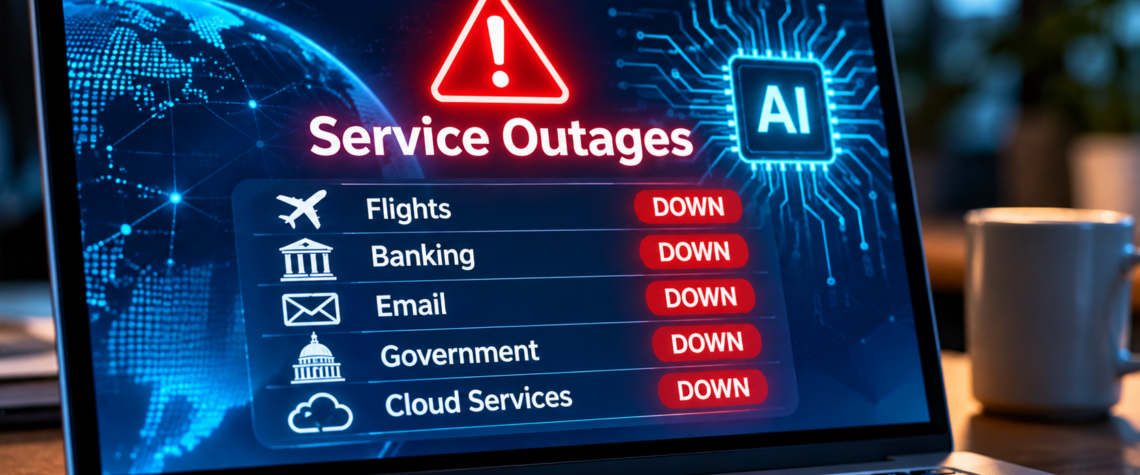
Recent outages have disrupted flights, banking, email and government systems. Artificial intelligence isn’t being blamed for directly causing them, but the race to fix security flaws may be creating new risks.
Millions of Americans have experienced an unsettling series of technological disruptions in recent days. Email services stopped working, banking customers struggled to access their accounts, airlines delayed flights, and even government computer systems experienced failures.
The interruptions affected major organizations, including Microsoft, JPMorgan Chase, United Airlines, Apple, the Federal Aviation Administration (FAA), and the National Security Agency (NSA).
The incidents have raised an uncomfortable question: Why do so many essential digital services seem to be breaking down at nearly the same time?
Some observers have pointed toward artificial intelligence. But the explanation emerging from cybersecurity experts and government officials is more complicated.
There is no evidence that rogue AI systems, coordinated cyberattacks, or foreign hackers caused the recent wave of outages. Instead, experts are examining whether the growing pressure to repair software vulnerabilities discovered by AI may be contributing indirectly to instability in critical systems.
What Actually Happened?
The disruptions had different causes, according to the organizations involved.
Microsoft experienced a major outage affecting Outlook and other Microsoft 365 services. The company attributed the disruption to technical problems involving server capacity, network traffic, and an underlying software defect, explicitly rejecting suggestions that AI or a cyberattack was responsible.
JPMorgan Chase reported a software problem that interfered with some banking transactions. United Airlines experienced a separate technical disruption that temporarily delayed departures.
The FAA’s nationwide interruption was associated with problems involving aging air traffic control infrastructure and network equipment. Apple attributed disruptions affecting several services to an internal update.
The NSA also acknowledged temporary degradation of an internal communications system during routine maintenance.
Although these incidents occurred close together, investigators have not established that they were connected.
The Unexpected Role of Artificial Intelligence
Artificial intelligence is transforming cybersecurity by allowing researchers to examine enormous quantities of computer code and identify weaknesses much faster than traditional methods.
That is generally good news. Security vulnerabilities that once remained hidden for years can now be discovered before criminals exploit them.
But there is a complication.
When AI identifies serious vulnerabilities in widely used software, companies and government agencies face enormous pressure to install security patches immediately.
Those patches are changes designed to repair weaknesses. Installing them, however, can sometimes interfere with other parts of a complex computer system.
A change intended to make one component safer may unexpectedly disrupt another.
Senator Mark Warner, the ranking Democrat on the Senate Intelligence Committee, has warned that the accelerating discovery of vulnerabilities is placing tremendous pressure on organizations to update systems that were never designed to accommodate such rapid changes.
The concern is not necessarily that AI is making mistakes. It is that human organizations may be struggling to manage the speed at which AI is revealing problems.
Still, experts disagree about how much this explains the recent outages. Some emphasize that software failures and cascading disruptions existed long before modern AI.
Why One Small Problem Can Affect Millions
Modern digital infrastructure is extraordinarily interconnected.
Banks, airlines, hospitals, retailers, and government agencies depend on networks of software providers, cloud services, communications systems, and security platforms.
A relatively minor technical failure can spread when other systems depend on the affected service.
Imagine a traffic light failing at a busy intersection. Cars begin backing up, drivers seek alternative routes, and nearby streets become congested. Before long, a single malfunction has disrupted an entire neighborhood.
Something similar can happen inside computer networks.
The danger becomes greater when organizations depend on aging infrastructure, complicated software, and systems that are difficult to test under every possible condition.
According to figures reported by Axios, Downdetector received nearly six million U.S. problem reports during the seven days ending November 16, the highest weekly total in a year. However, the longer-term figures do not establish an unprecedented wave of major outages.
What Can Consumers Do?
Ordinary users cannot prevent a bank, airline, or technology provider from experiencing a system failure. But they can reduce the disruption to their daily lives.
Keeping essential documents available offline is a sensible precaution, particularly when traveling. Airline confirmation numbers, important telephone numbers, and copies of necessary records should not depend entirely on a single app.
Consumers should also maintain alternative ways to access important services and avoid repeatedly submitting financial transactions when a banking application appears unresponsive.
Another concern is fraud. Criminals can exploit widespread outages by sending fake security alerts, account recovery messages, or links claiming to restore access.
The safest response is to check a company’s official website or application rather than following unexpected messages.
A Warning About Our Digital Future
The recent disruptions do not prove that artificial intelligence is making the internet less reliable.
They do, however, expose a growing challenge: technological systems are becoming more sophisticated, more interconnected, and increasingly difficult to manage.
AI can help discover security weaknesses at unprecedented speed. But identifying a problem is not the same as safely fixing it.
As companies race to strengthen their defenses, they must also preserve the testing procedures, safeguards, and backup systems that keep essential services running.
The lesson from these outages may be less about the dangers of artificial intelligence itself than about the fragility of the digital infrastructure on which modern society depends.
Making technology smarter will accomplish little if we cannot also make it more reliable.