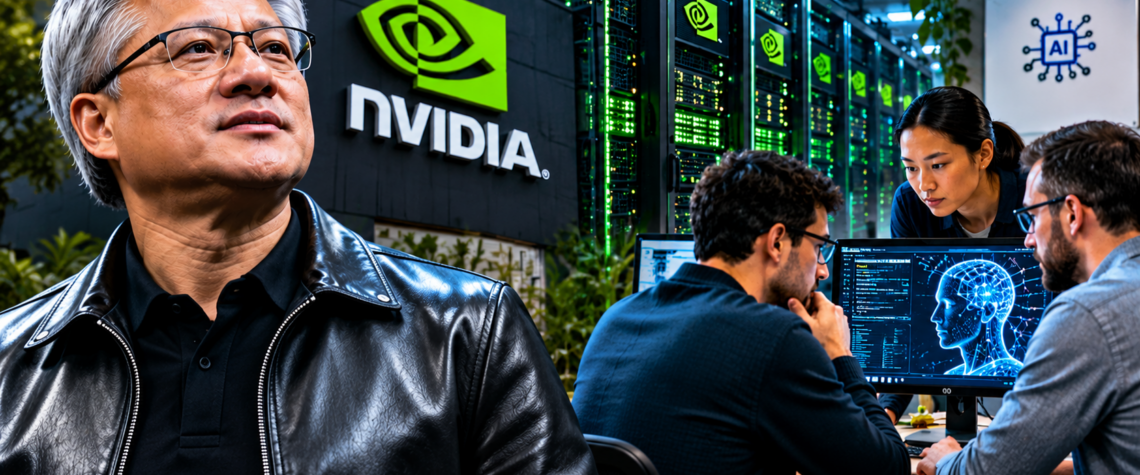
The departure of NVIDIA’s longtime CEO raises new questions about a financing strategy that promised to make artificial intelligence infrastructure more accessible—and the risks facing smaller companies that depend on it.
For years, Jensen Huang was more than the chief executive of NVIDIA. He was the public face of the artificial intelligence revolution, a tireless advocate for accelerated computing and an influential figure whose support could help emerging technology companies attract customers, investors and credibility.
His sudden departure on November 12, 2026, has introduced a new uncertainty into an industry already grappling with enormous infrastructure costs, aggressive expansion and questions about the sustainability of AI investment.
For smaller AI companies, the stakes extend well beyond NVIDIA’s leadership. The chipmaker has helped reshape how computing infrastructure is financed, creating opportunities for businesses that could never afford to purchase millions of dollars’ worth of specialized processors outright.
Now those companies must consider a difficult question: What happens when the person who championed that expansion is no longer in charge?
Turning Computing Power Into Financial Capital
One of the largest obstacles facing emerging AI businesses is the cost of computing power. Training sophisticated models, operating AI services and processing enormous volumes of information require specialized graphics processing units, or GPUs, often housed in expensive data centers. For a small company, purchasing the necessary infrastructure can require millions of dollars before a product generates meaningful revenue.
NVIDIA has helped promote a different approach: treating computing infrastructure as a productive financial asset capable of supporting investment and financing arrangements.
In August 2026, the company announced partnerships with Apollo, BlackRock, Blackstone, Brookfield, Goldman Sachs and KKR to establish financing platforms intended to mobilize more than $500 billion in third-party capital for AI infrastructure over time.
The initiative was designed to attract institutional investors to computing facilities and expand access to infrastructure across NVIDIA’s ecosystem, including AI laboratories, enterprises and cloud providers.
The $500 billion figure represents a long-term capital mobilization objective, not money already distributed to startups or a dedicated lending fund for small businesses. Nevertheless, the strategy could significantly influence how emerging companies obtain the computing resources they need.
When GPUs Become Collateral
Traditional business lending often depends on a company’s existing assets, operating history and ability to demonstrate reliable cash flow. Young AI businesses may have little of any of these. GPU-backed financing offers a possible alternative.
Under an asset-backed arrangement, specialized computing equipment can serve as collateral for a loan or other financing agreement. Instead of relying exclusively on the borrower’s broader corporate assets, lenders can evaluate the equipment’s value and its potential to generate revenue.
Consider a hypothetical AI startup that needs a $5 million GPU cluster but cannot afford to purchase it outright. A financing provider might fund the acquisition, using the equipment and associated revenue arrangements to secure repayment. The startup could then begin operating its service while paying for the infrastructure over time.
Such arrangements are not necessarily loans made by NVIDIA itself. Financing may involve banks, investment firms, equipment lessors or specialized infrastructure companies, each with different contractual requirements.
The approach can expand access to powerful technology, but it also introduces financial risks. GPU prices can change, newer processors can reduce the value of older equipment, and demand for computing services may not grow as quickly as borrowers expect. A company that cannot generate sufficient revenue may find itself servicing debt on equipment that is depreciating rapidly.
The Power of Jensen Huang’s Endorsement
Huang’s influence was not limited to NVIDIA’s hardware or financing initiatives. His public support for emerging AI companies, independent cloud providers and software developers helped place smaller businesses within a much larger technology ecosystem.
For an early-stage company seeking investors, association with a dominant industry supplier can provide valuable credibility.
This reputational advantage might be described as the Huang halo effect: the perception that a business supported or publicly recognized by NVIDIA’s founder has stronger prospects.
The term is a useful description of Huang’s influence, rather than the name of an official NVIDIA program.
His departure does not automatically eliminate the commercial value of NVIDIA partnerships. But it removes a prominent advocate whose personal reputation was closely associated with the company’s strategy. For smaller businesses seeking outside investment, that distinction could become important.
The Circular Financing Debate
NVIDIA’s expanding role in the AI economy has also attracted scrutiny. The company sells the processors that power AI systems while participating in an ecosystem of investments, partnerships and financing arrangements involving companies that purchase or use its technology.
Critics have raised concerns about arrangements sometimes described as circular financing, in which money invested or facilitated within the ecosystem ultimately helps support demand for the supplier’s products.
Such transactions are not inherently improper. Strategic investments and customer financing are established business practices across many industries.
The concern is whether complex financial relationships could make demand appear more independent or sustainable than it actually is.
If AI service providers depend heavily on outside capital to acquire GPUs, a slowdown in financing could affect both infrastructure expansion and future equipment purchases.
The risks could be particularly serious for smaller firms with limited cash reserves. However, the existence of interconnected financing arrangements does not, by itself, demonstrate that NVIDIA has artificially inflated sales or that its customers lack genuine demand.
Colette Kress Takes the Helm
Following Huang’s resignation, NVIDIA appointed longtime Chief Financial Officer Colette Kress as interim chief executive while the board searches for a permanent successor.
Kress joined NVIDIA in 2013 and has overseen the company’s finances during its transformation into one of the world’s most influential technology businesses.
Her financial background may make investors particularly attentive to how the company evaluates capital commitments, customer financing and infrastructure partnerships.
But there is currently no confirmed announcement that Kress intends to dismantle the financing strategy developed under Huang or withdraw support from smaller partners.
NVIDIA’s board has emphasized continuity in the company’s operations, customer commitments and technology roadmap. That distinction matters. A leadership transition creates uncertainty, but uncertainty is not the same as a change in policy. The more revealing developments may come from future financial disclosures, executive statements and decisions about new partnerships.
The Hidden Risk of Depending on One Technology Supplier
Financing is only one part of the challenge confronting smaller AI businesses. Many companies have built their applications around NVIDIA’s CUDA software ecosystem, which enables developers to use its GPUs for demanding computing tasks.
CUDA has become an important competitive advantage for NVIDIA because of its extensive software tools, developer community and integration with AI frameworks. For startups, that ecosystem can accelerate development and reduce technical complexity. But it can also make switching suppliers difficult.
Moving workloads to alternative processors may require software modifications, performance testing, engineering time and additional investment.
A company that relies on NVIDIA for its hardware, software environment and access to computing capacity may have limited flexibility if prices rise or financing terms change. This dependence becomes more consequential when a business has also borrowed heavily to finance its infrastructure.
What Small AI Businesses Should Do Now
The immediate lesson for smaller AI companies is not to abandon NVIDIA. Its technology remains central to much of the industry’s computing infrastructure. Instead, businesses should evaluate how exposed they are to changes in financing conditions, hardware prices and supplier relationships.
Companies using financed GPU infrastructure should review their repayment schedules, collateral requirements and contractual obligations. They should also examine what happens if computing demand falls short of expectations or if equipment loses value faster than anticipated.
Businesses purchasing cloud computing services should understand whether their providers have stable financing and sufficient capacity to honor long-term commitments.
Technical teams can also assess whether selected workloads could operate on alternative hardware or through different cloud providers. Open-source software and more portable development architectures may reduce switching costs, although they cannot eliminate every dependency.
Above all, smaller firms should distinguish between the economics of their own products and the availability of investment capital supporting the broader AI boom. Access to financing can help a company grow. It cannot substitute indefinitely for customers, revenue and a sustainable business model.
An Industry Facing a Test of Independence
NVIDIA’s transformation from a graphics chipmaker into a central force in global artificial intelligence was inseparable from Jensen Huang’s leadership. But the next phase of the AI economy may depend on whether the infrastructure and financing systems built around NVIDIA can function without relying on his personal influence.
The company’s partnerships with major financial institutions suggest that AI computing is increasingly being treated as a long-term infrastructure investment, much like telecommunications networks, power generation and other capital-intensive industries.
That evolution could ultimately benefit smaller companies by making computing resources more widely available. Yet it also introduces new relationships between technology suppliers, lenders, investors and customers—relationships whose stability has not been fully tested through a prolonged downturn in AI demand.
For emerging businesses, the challenge is clear: take advantage of the opportunities created by NVIDIA’s ecosystem without becoming so dependent on it that a change in leadership, financing or technology threatens their survival.
Huang’s departure has not ended NVIDIA’s ambitions. But it may provide the first major test of whether the AI economy he helped create can stand independently of the man who became its most recognizable symbol. Huang has often been compared to Steve Jobs for his visionary leadership and the extraordinary influence he exercised over the company he built. Jobs left Apple only to return years later and lead one of the most remarkable corporate comebacks in technology history. Could Huang follow the same path? If so, history might not merely repeat itself. It could offer Silicon Valley another extraordinary second act.