Researchers are using AI to reconstruct what people see from brain scans, raising extraordinary possibilities for medicine—and troubling questions about the future of mental privacy.
For centuries, human beings have taken one thing for granted: whatever happens inside their minds belongs to them alone. Governments may monitor their movements, companies may track their online behavior, and strangers may observe their expressions. But their private thoughts remain inaccessible.
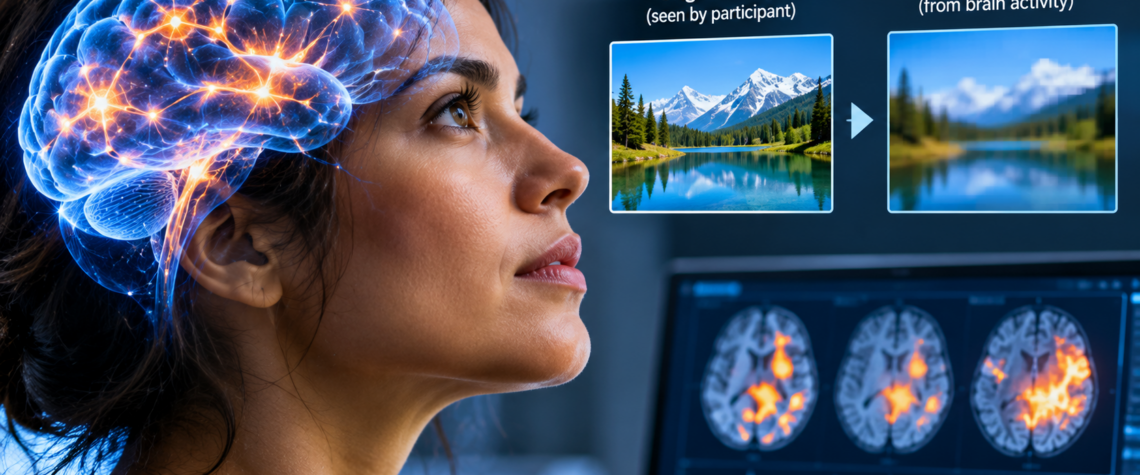
Artificial intelligence is beginning to challenge that assumption. Scientists at Israel’s Weizmann Institute of Science have developed an AI system capable of reconstructing images that people are looking at by analyzing patterns of activity inside their brains.
The technology, called Brain-IT, represents a significant advance in the emerging field of neural decoding, where researchers use computational models to interpret signals generated by the human brain.
It does not allow computers to read anyone’s secret thoughts. Nor can it extract memories or dreams on demand. But it demonstrates that information once considered inaccessible without a person’s description can, under carefully controlled conditions, be reconstructed from brain activity. And that possibility raises a question extending far beyond neuroscience: What happens to personal privacy when technology begins to reveal the contents of human perception?
Reconstructing What the Brain Sees
Imagine watching a baseball game. A player prepares to swing his bat, spectators fill the stadium, and the ball moves through the air.
Now imagine that a computer could produce a recognizable reconstruction of that scene without receiving the original photograph, relying instead on measurements of your brain activity. That is the kind of task Brain-IT was designed to perform.
Developed by researchers working with Professor Michal Irani, the system analyzes functional magnetic resonance imaging, or fMRI, recordings collected while participants view photographs.
Unlike conventional MRI, which primarily provides detailed images of the brain’s anatomy, fMRI measures changes associated with blood oxygenation. These changes provide an indirect indication of neural activity.
The researchers trained their AI system to identify relationships between visual information and patterns recorded in different brain regions.
When presented with new brain scans, the model attempts to reconstruct the images that produced those patterns.
The results are not perfect photographic copies. Details may differ, and some reconstructed elements are generated through the model’s learned understanding of visual patterns. Nevertheless, the technology can reproduce recognizable subjects, colors, and arrangements.
The achievement is particularly striking because the computer does not simply identify whether someone is looking at a face, an animal, or a landscape. It attempts to recreate the visual scene itself.
The Breakthrough: Learning Across Different Brains
One of the greatest obstacles to neural decoding has been the enormous variation between human brains.
Although people share broadly similar neurological structures, the precise location and organization of brain activity differ from one individual to another.
Earlier AI systems generally required extensive training using data collected from the same person whose brain activity they were attempting to interpret. That made the technology difficult to scale. Brain-IT takes a different approach.
The researchers developed a method that identifies functional similarities across different individuals’ brains. Their system organizes activity into 128 functional clusters associated with visual processing.
Rather than treating every brain as an entirely separate problem, the model learns patterns that can be shared across participants.
The research team also created a complementary AI model capable of predicting what brain activity might look like when someone views a particular image.
By combining image-to-brain prediction with brain-to-image reconstruction, the researchers expanded the information available for training without requiring thousands of additional hours of scanning.
According to the Weizmann Institute, Brain-IT can adapt to a new participant using approximately one hour of fMRI recordings, compared with the dozens of hours required by some earlier approaches.
The research also demonstrates that meaningful reconstructions can be produced with even smaller amounts of participant-specific data, although reconstruction quality depends on the available information.
This ability to transfer knowledge between different brains could make neural decoding considerably more practical for scientific research.
From Images to Thoughts: An Important Distinction
The phrase “mind reading” suggests that a machine might discover what someone is secretly thinking.
That is not what Brain-IT currently does. The published research focuses on reconstructing images that participants are actually viewing during controlled experiments.
Participants must undergo brain scanning, and the system relies on complex equipment, specialized software, and previously collected training data.
It cannot remotely scan people walking down the street. It cannot secretly extract a person’s political beliefs, intimate memories, or unspoken intentions.
Even the images it reconstructs are estimates generated by AI, not direct recordings of what exists inside someone’s mind.
The distinction matters because artificial intelligence can produce convincing images that contain details unsupported by the underlying brain measurements.
A reconstruction may resemble what a participant saw without reproducing every element accurately.
Scientists must therefore distinguish between information genuinely recovered from neural activity and details supplied by the generative model.
Nevertheless, the ability to recover meaningful visual information is an important scientific development.
It suggests that some aspects of human perception can be translated into a form that computers can interpret.
Could AI Eventually Reconstruct Dreams?
One of the most intriguing possibilities is the reconstruction of dreams.
Dreams are among the most private experiences human beings have. They can be vivid, emotional, fragmented, and difficult to describe after awakening.
Researchers hope that advances in neural decoding may eventually help scientists investigate what happens during dreaming without depending entirely on a person’s recollections. But substantial obstacles remain.
Brain-IT currently reconstructs static visual images. Dreams, like movies, involve rapidly changing scenes, movements, and complex experiences.
Functional MRI is relatively slow compared with the speed of visual perception. A typical scan captures changes over intervals measured in seconds, while visual experiences can change many times within a single second.
Moreover, observing an image and imagining one are not identical neurological processes.
A system trained to reconstruct photographs viewed by awake participants cannot automatically be assumed to reconstruct dreams accurately.
Irani’s research group is exploring ways to extend neural decoding to other forms of information, including auditory signals and potentially moving images.
For now, reading dreams remains a scientific ambition rather than an established capability.
A New Voice for People Who Cannot Speak
The most promising applications of brain-decoding technology may be medical.
For people living with severe paralysis or neurological conditions that prevent speech, brain-computer interfaces could provide new ways to communicate.
Researchers have already demonstrated experimental systems that translate certain neural signals into words or synthesized speech.
Some approaches require surgically implanted electrodes, while others investigate noninvasive techniques.
The underlying objective is to identify patterns associated with intended communication and translate them into language or other forms of expression.
Advances in AI could make these systems more accurate, adaptable, and accessible.
A person who cannot speak might someday communicate more naturally through technology that interprets neural activity.
Neural decoding could also help researchers understand how the brain processes vision, language, and memory, potentially contributing to the study of neurological disorders.
These possibilities explain why scientists are investing considerable effort in developing the field.
The same technology that raises concerns about mental privacy could also restore important abilities to people who have lost them.
When Brain Data Becomes Personal Data
The ethical implications begin with a simple question: Who owns the information generated by a person’s brain?
Today, technology companies collect enormous quantities of personal information, including browsing histories, locations, purchases, and behavioral patterns.
That information can be used to predict preferences, target advertising, and influence decisions.
Neural data could introduce an entirely different category of sensitivity.
Even if current systems cannot reveal arbitrary thoughts, future technologies may become increasingly capable of inferring aspects of perception, attention, emotional responses, or cognitive states.
Such information could be valuable to healthcare providers and researchers.
It could also attract commercial interest.
Imagine an employer seeking to measure workers’ attention, an advertiser hoping to identify emotional reactions to products, or an institution attempting to evaluate someone’s responses without relying on what that person chooses to disclose.
These scenarios are not demonstrated capabilities of Brain-IT. They are potential applications and abuses that become relevant as neural measurement and interpretation technologies improve.
The central concern is whether individuals will retain meaningful control over information derived from their own brains.
The Emerging Debate Over Mental Privacy
Legal scholars and human-rights advocates have begun discussing whether existing privacy protections are sufficient for an era of advanced neurotechnology.
Some propose recognizing specific protections for mental privacy, cognitive liberty, and freedom from unauthorized interference with neural processes.
These ideas are sometimes grouped under the term “neurorights.”
The debate concerns several fundamental principles.
People should understand when their neural data is being collected, how it will be analyzed, and who may receive it.
Consent should be meaningful rather than hidden inside complicated agreements.
Sensitive neural information should not be repurposed for unrelated commercial or institutional uses without appropriate authorization. And individuals should have safeguards against discrimination based on speculative interpretations of their cognitive or emotional states.
Such protections would need to account for the limits of the technology. Brain scans are not infallible records of thoughts, and AI-generated interpretations may contain substantial errors. That uncertainty makes oversight especially important.
A mistaken interpretation of someone’s online shopping preferences may be inconvenient. A mistaken interpretation presented as evidence of their mental state could have much more serious consequences.
Could Governments Use AI to Interrogate Minds?
The possibility of using neural technology for surveillance or interrogation has understandably attracted attention. However, today’s image-reconstruction systems are nowhere near capable of secretly extracting unrestricted thoughts from unwilling individuals.
Brain-IT requires sophisticated scanning equipment and controlled experimental conditions. It does not provide a portable device capable of identifying hidden beliefs or memories.
Nevertheless, the history of surveillance technology demonstrates why ethical questions should be addressed before a capability becomes widely available.
Technologies initially developed for medicine or scientific research can eventually find applications in law enforcement, employment, commerce, and national security. The appropriate response is neither panic nor complacency.
It is to establish clear boundaries for the collection, interpretation, and use of neural information while the technology is still developing.
The Last Frontier of Privacy
Artificial intelligence has already transformed the way computers interpret language, recognize faces, analyze images, and predict human behavior.
Neural decoding extends that transformation into a domain once considered uniquely personal. The Brain-IT research does not mean that machines can freely explore the human mind. It does show that certain aspects of visual experience can be reconstructed from measurable brain activity with increasing sophistication. For medicine, this could eventually open extraordinary possibilities.
For society, it raises questions about consent, autonomy, surveillance, and the limits of technological access to human experience.
Perhaps the most important distinction is between using artificial intelligence to help people express what they cannot communicate and using it to discover what they have chosen not to reveal.
The first could become one of the great achievements of modern medicine. The second could challenge one of the foundations of individual freedom.
As artificial intelligence moves closer to interpreting the activity of the human brain, society must decide not only what machines should be capable of discovering, but what every person should have the right to keep private.
………………
Verified Scientific Sources:
The research was presented at ICLR 2026 and publicly explained by the Weizmann Institute on September 14, 2026. The article relies on these materials for the technical results; the sections on surveillance and mental rights analyze potential future consequences, not already demonstrated capabilities.
Weizmann Institute of Science+2
– Weizmann Institute — The New Science of Mind-Reading
– Brain-IT — Scientific research presented at ICLR 2026
– Brain-IT — Project and visual results