Amazon’s new AI-powered wristband and smartphone accessory promise to turn everyday conversations into reminders, summaries, and useful advice. But their ability to listen to people nearby raises a troubling question: Who controls the words captured by someone else’s device?
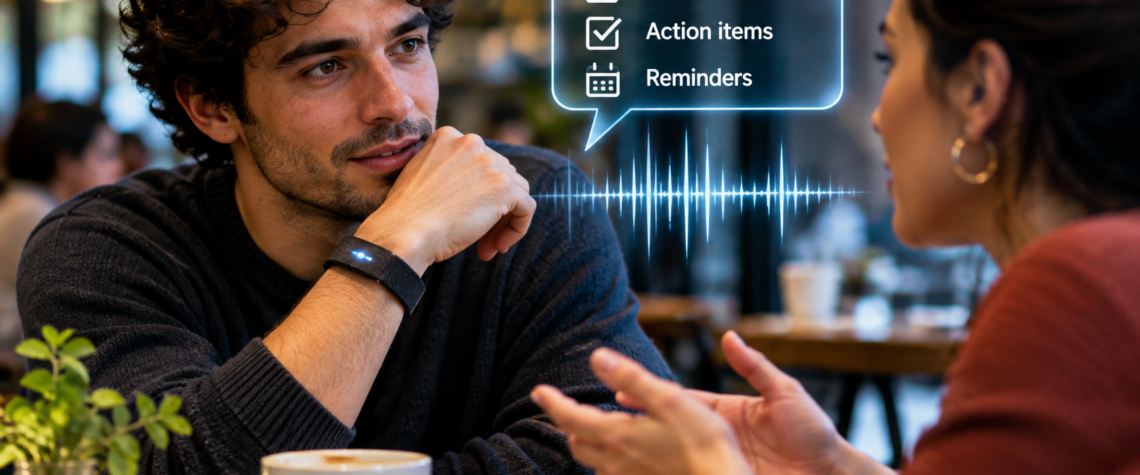
Imagine sitting in a café with a friend, discussing a personal problem, a medical appointment, or a difficult decision at work. You assume the conversation will remain between the two of you.
But your friend is wearing a small wristband that can listen, transcribe your words, and use artificial intelligence to produce a summary of everything you discussed.
The original audio may disappear almost immediately. The information contained in your conversation, however, can remain available as text.
That scenario illustrates the privacy debate surrounding Amazon’s latest artificial intelligence products.
On October 15, 2026, Amazon introduced two new devices under its Bee brand: a wearable wristband called Bee Frontier and a magnetic smartphone accessory called Bee Eclipse. Both are designed to help users remember conversations, organize commitments, and receive AI-generated suggestions.
The products represent another step toward what technology companies call ambient artificial intelligence: digital assistants that operate within everyday environments rather than waiting for users to type questions or issue commands.
The potential benefits are easy to understand. So are the concerns.
A Personal Assistant That Listens to Your Life
Amazon acquired Bee, a San Francisco-based startup specializing in AI-powered wearable devices, in 2025.
Its newest products are designed to transform spoken conversations into information that users can retrieve and act upon later.
Bee Frontier, priced at $74.99, can be worn on the wrist or clipped to clothing. It features two microphones, noise filtering, water resistance, and up to seven days of battery life.
Bee Eclipse, starting at $99.99, attaches magnetically to a smartphone and offers more than 21 days of battery life. Amazon says the device will become available after the Frontier launch.
The devices can generate transcripts, summaries, reminders, and suggested tasks. A conversation about a family vacation might produce a list of travel arrangements. A meeting could become a set of follow-up assignments. A casual discussion about dinner plans might generate a calendar reminder.
Users can also connect Bee with services including Gmail, Google Calendar, and Microsoft Outlook. Optional integrations with Alexa+ and Amazon.com extend its ability to retrieve information and recommend products.
Basic conversation summaries and a 14-day memory feature are included with the devices. More advanced features require Bee Pro, a subscription priced at $11.99 per month.
For busy professionals, students, and people who struggle to remember details, the technology could be genuinely useful.
But usefulness does not resolve the question of consent.
The Person Wearing Bee Is Not the Only Person Being Recorded
The central controversy concerns people who are not using Bee themselves.
A person wearing the wristband may understand that the device is processing a conversation. Someone sitting across the table may not.
Amazon says users control recording through a physical button, and an indicator light shows when the device is active. The company also prompts users to obtain permission from participants in recorded calls.
Yet those safeguards depend heavily on the behavior of the person operating the device.
Jeff Williams, a former senior principal security engineer at Amazon Web Services, raised this concern shortly after the products were announced.
As reported by GeekWire, Williams argued that the devices place responsibility for consent on their owners while providing people nearby with little practical control over whether their words are captured.
A small indicator light may be difficult to notice, particularly if a device is partially concealed by clothing or outside someone’s field of vision.
The distinction is significant. A person can agree to wear a recording device without everyone around them agreeing to be recorded.
In an office, that could involve confidential business discussions. In a restaurant, it might involve private family matters. During a medical conversation, it could involve highly sensitive personal information.
The device does not need to retain someone’s voice to preserve information that person never intended to share with an AI system.
Amazon Says the Audio Is Deleted
Amazon has introduced privacy protections that deserve attention.
Its Bee Private Compute architecture is designed to process audio in real time and discard the original recording rather than store it.
According to the company, conversation transcripts, summaries, and other information are encrypted using keys controlled by the user’s device. Amazon says its employees cannot access that protected information.
Users can delete transcripts and summaries, and recording can be started or stopped manually.
These measures address genuine security risks associated with storing personal conversations.
But deleting audio does not mean deleting the information extracted from it.
Bee can retain text transcripts, summaries, recommendations, and other insights. According to Amazon’s own documentation, users may also create voice profiles or identify speakers.
And when users connect Bee to other services, selected information can leave Bee’s protected environment and become subject to those services’ privacy policies.
That creates two separate questions: How securely is information stored, and should it have been collected in the first place?
Strong encryption can help answer the first. It cannot automatically answer the second.
What Happens When Bee Connects to Amazon’s Other Services?
The devices also raise questions about how personal information may influence future recommendations.
Amazon says Bee can connect to Amazon.com and suggest products related to items mentioned in conversations.
For example, a discussion about needing household supplies could eventually produce a shopping suggestion.
This may be convenient. But it also changes the relationship between private conversation and commercial recommendation.
A person might casually mention a product without intending to create a shopping signal.
Amazon says these integrations are optional and that users control whether information is shared with connected services.
There is no basis to conclude that Amazon automatically uses every Bee conversation for advertising. The more precise concern is that optional integrations create new pathways through which conversation-derived information may be used.
Users need to understand what information crosses those boundaries and what happens to it afterward.
The Legal Question: Is Everyone’s Permission Required?
Recording laws differ across jurisdictions.
In the United States, federal law and many state laws generally allow certain recordings when one participant consents, subject to exceptions and other legal requirements.
Other states require the consent of all participants in covered private conversations.
Whether an AI wearable violates a particular law depends on where the conversation occurs, the circumstances, the applicable statute, and how the device captures or processes information.
The fact that a device converts audio into text rather than permanently storing the original recording does not automatically resolve those legal questions.
Amazon’s Bee documentation places responsibility on users to respect others’ privacy and comply with applicable laws.
For businesses, this creates additional challenges. Employees wearing personal AI devices could capture confidential meetings, customer information, or discussions subject to professional obligations.
Companies may need to establish explicit policies governing when such devices can be used and who may authorize their use.
A New Kind of Social Etiquette
The implications extend beyond law and cybersecurity.
People have long adjusted their behavior when they know a camera or microphone is recording.
Ambient AI introduces a subtler possibility: a device that looks like an ordinary accessory may be converting conversations into searchable records and personal insights.
The result could be a change in how freely people speak.
Would someone discuss a personal relationship, financial difficulty, or workplace disagreement in the same way if they knew a companion’s wristband was creating a transcript?
The answer will vary. Some people may welcome the convenience. Others may feel uncomfortable, even if the information is encrypted.
Technology companies can develop sophisticated security systems, but social trust depends on something more fundamental: people knowing when their conversations are being captured and having a meaningful opportunity to decline.
How to Protect Your Conversations
Consumers considering Bee or similar AI devices should begin by understanding what the technology records, what it retains, and which services can receive the resulting information.
Before activating a device during a conversation, users should clearly inform everyone involved and obtain any consent required by law. A visible recording light should not replace a direct explanation.
Sensitive discussions involving medical information, financial matters, legal advice, or confidential workplace issues deserve particular caution.
Users should also review optional integrations before enabling them, especially those that share conversation-derived information with shopping, productivity, or voice-assistant services.
Regularly reviewing and deleting unnecessary transcripts can reduce the amount of personal information retained.
And people who do not wish to be recorded should feel entitled to say so.
The Future of AI May Depend on Who Gets to Say No
Amazon’s Bee devices demonstrate how quickly artificial intelligence is moving beyond computer screens and smartphones.
A wearable assistant that remembers appointments, organizes meetings, and retrieves forgotten details could become an everyday convenience.
Amazon has also made substantial efforts to protect stored information, including encryption, audio deletion, and user-controlled recording.
But privacy is not simply a technical feature.
It is also a relationship between people.
The person wearing an AI assistant may benefit from its memory. The person sitting across the table may have no interest in becoming part of that memory.
As artificial intelligence becomes increasingly capable of listening to the world around us, the most important question may not be whether these devices can remember everything.
It may be whether everyone involved has the right to decide what should be remembered.