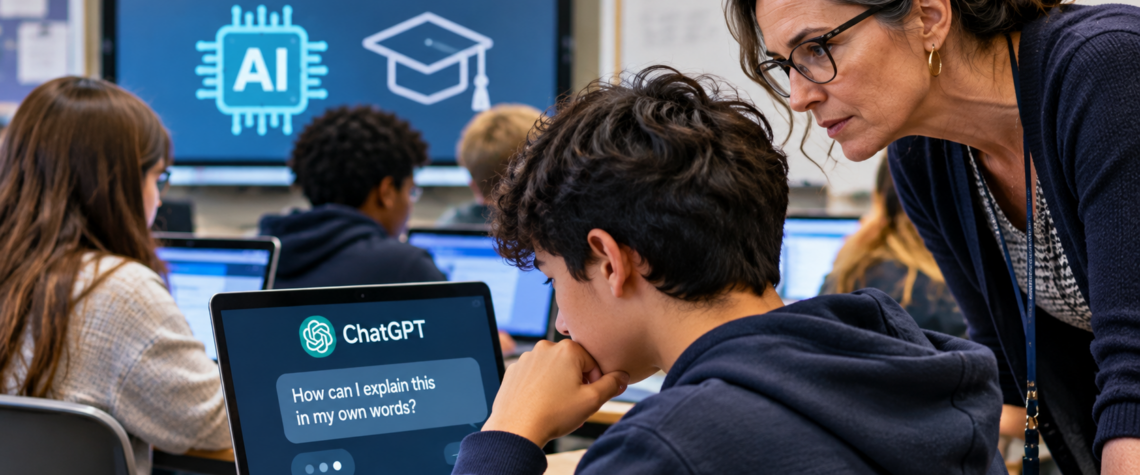
Schools are experimenting with chatbots, virtual tutors, and even humanoid robots while researchers warn that reliable evidence of their educational benefits remains scarce.
Artificial intelligence is rapidly becoming part of American education. Teachers are using it to prepare lessons, students are receiving feedback from chatbots, and school districts are investing thousands of dollars in technologies that promise to transform learning.
But an important question remains unanswered: Are students actually learning more?
A growing number of educators and researchers are concerned that schools are adopting AI faster than they can evaluate its effectiveness. A recent NPR investigation documented how districts across the United States are experimenting with artificial intelligence despite limited scientific evidence, inconsistent policies, and uncertainty about the consequences for children’s intellectual and emotional development.
The debate is no longer simply about whether students should be allowed to use ChatGPT to complete homework. It is about how much responsibility schools should delegate to machines, what safeguards children need, and who will be accountable if the experiments fail.
A Chatbot That Asks Students for Emotional Advice
In Dayton, Ohio, students at an alternative school participated in an unusual experiment. Instead of using artificial intelligence to solve mathematical problems or practice writing, they interacted with a chatbot named Jordan, designed to simulate a troubled teenager.
Jordan described emotional difficulties and asked students to suggest solutions. The idea was to encourage adolescents to reflect on their own feelings by helping a fictional character manage his problems.
The Dayton Public Schools district paid educational technology company SchoolAI $72,600 during the previous academic year for several AI tools, including Jordan.
School administrators hoped the chatbot would help students express emotions they might otherwise hesitate to discuss with teachers or counselors. The conversations could also provide information useful to school staff.
Some students reported positive experiences. One teenager told NPR that advising Jordan helped him think through his own problems.
But the experiment also raised difficult questions.
Can a chatbot genuinely help adolescents develop emotional skills? How should schools measure improvements in mental well-being? And what happens when children begin treating an artificial personality as a friend rather than a computer program?
According to NPR, the district informed students and families that conversation records could be reviewed by school employees, an external evaluator, and company personnel.
That arrangement introduces another concern: the privacy of potentially sensitive information shared by minors.
Stanford Finds a Serious Evidence Gap
The enthusiasm surrounding educational AI contrasts sharply with the available scientific evidence.
Researchers at Stanford University’s Accelerator for Learning reviewed a repository containing more than 800 academic papers relevant to artificial intelligence in K–12 education.
Their March 2026 review identified only 20 studies providing strong causal evidence about AI’s effects on students or teachers.
The researchers found no high-quality causal studies of student-facing AI interventions conducted in American K–12 settings in the evidence they reviewed.
Many studies involved adults, took place outside the United States, or examined short-term interactions rather than sustained learning.
A November update found that additional research had begun addressing some earlier gaps. Nevertheless, researchers still lacked convincing evidence that AI tools produce lasting improvements in learning or consistently reduce educational inequalities.
This does not mean artificial intelligence cannot improve education. It means the technology’s potential benefits have not yet been demonstrated adequately across the different environments in which schools are introducing it.
A chatbot that helps a student finish an assignment may appear effective. But completing an assignment is not necessarily the same as understanding the material.
That distinction is particularly important when schools evaluate technologies that can generate answers almost instantly.
When Innovation Moves Faster Than Policy
School districts are taking dramatically different approaches to artificial intelligence.
In Wichita, Kansas, administrators have introduced AI cautiously. Younger students learn about the technology without receiving unrestricted access to chatbots. Middle school students can experiment with selected creative tools, while some high school students use specialized AI tutoring applications.
District officials have acknowledged that they still lack a clear method for measuring the educational value of these programs.
Elsewhere, experimentation has been more ambitious.
In western New York, the Salamanca City Central School District purchased an AI-powered humanoid robot named Sally for nearly $58,000.
The district planned to introduce the robot into classrooms, hoping it would help students who were reluctant to ask teachers or classmates for assistance.
But concerns from parents, educators, and state officials, including questions about student privacy, led the district to suspend the planned experiment.
The episode illustrates a growing problem: purchasing advanced technology is relatively easy compared with establishing whether it belongs in a classroom.
Some of America’s Largest Districts Are Pulling Back
While some schools are expanding AI programs, others are restricting them.
New York City Public Schools introduced a one-year prohibition on student-facing AI for preschool through eighth grade during the 2026–27 school year, while permitting limited high school experiments.
The Los Angeles Unified School District also restricted student access to AI on district devices.
These decisions reflect concern about exposing children to technology whose educational and developmental effects remain uncertain.
However, restrictions create their own dilemma.
Students are growing up in a world where artificial intelligence will increasingly influence employment, communication, research, and everyday decisions. Preventing them from learning how these systems work could leave them unprepared for that reality.
The challenge is finding a balance between protecting students and preparing them for a technology-driven future.
The Risk of Outsourcing Thinking
One of the most important concerns is whether frequent dependence on artificial intelligence could weaken students’ ability to reason independently.
AI systems can summarize books, solve equations, generate essays, and explain complex subjects in seconds.
Used appropriately, these capabilities could provide personalized assistance to students who need additional support.
But they could also encourage students to avoid the intellectual effort required to develop knowledge.
Learning involves more than obtaining correct answers. It requires questioning assumptions, making mistakes, evaluating evidence, and developing the patience to solve difficult problems.
A student who receives an AI-generated essay may complete an assignment successfully without acquiring the ability to construct an argument.
Similarly, a student who repeatedly asks a chatbot for mathematical solutions may become more efficient at finishing homework without developing the underlying reasoning skills.
These risks are plausible, but their extent remains an open research question. Schools need to measure what students can do independently after using AI, not simply how quickly they complete tasks with assistance.
Can AI Become an Emotional Companion?
Educational chatbots that engage students in personal conversations present another challenge.
A virtual tutor that explains fractions performs a fundamentally different function from a chatbot that asks a teenager about loneliness, anxiety, or relationships.
Children may respond emotionally to systems that simulate empathy, even when those systems do not possess human feelings or understanding.
Researchers have warned that excessive reliance on artificial companions could influence how young people develop relationships and seek emotional support.
That does not establish that every educational chatbot is harmful. Carefully designed tools may offer useful opportunities for practicing communication and reflection.
But schools should distinguish between teaching emotional skills and encouraging children to form attachments to artificial personalities.
Teachers, counselors, and families must remain central to decisions involving students’ emotional well-being.
Five Questions Parents Should Ask Their Schools
Parents do not need technical expertise to evaluate whether their children’s schools are introducing artificial intelligence responsibly. They can begin with five practical questions:
- What educational problem is this AI tool supposed to solve? Schools should be able to explain why the technology is necessary and how it improves upon existing methods.
- What evidence shows that it improves learning? Testimonials and student enthusiasm are useful observations, but they are not substitutes for reliable evaluations.
- What information does the system collect? Parents should understand whether student conversations, assignments, personal details, or behavioral information are stored and who can access them.
- Can students learn without depending on the tool? Schools should assess whether students retain knowledge and can complete comparable work independently.
- Who is responsible when something goes wrong? Teachers and administrators should have clear procedures for addressing inaccurate information, inappropriate responses, privacy concerns, and complaints.
These questions are especially important when AI systems interact directly with younger children.
The Real Test of Educational AI
Artificial intelligence could become a valuable educational resource. It may help teachers prepare individualized lessons, support students with learning difficulties, and make specialized instruction more accessible.
But technological sophistication should not be confused with educational effectiveness.
Schools have a responsibility to evaluate new tools before making them essential parts of children’s learning experiences. That requires independent research, transparent policies, meaningful teacher involvement, and clear protections for student data.
It also requires something that is often missing from the excitement surrounding artificial intelligence: patience.
The future of education should not be determined by which school district purchases the newest technology or introduces the most impressive robot.
It should be determined by whether students emerge from their classrooms more knowledgeable, more capable of thinking independently, and better prepared to understand the world around them.
The real measure of artificial intelligence in education is not what the technology can do for students, but what students can learn to do for themselves.