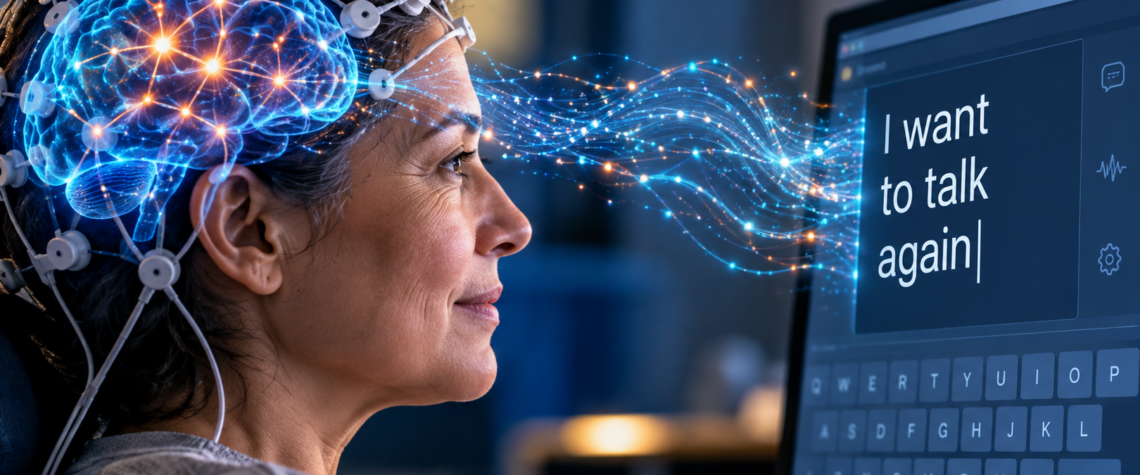
An experimental brain-computer interface can now reconstruct sentences from brain activity without implanted electrodes. The breakthrough could eventually help people who cannot speak or move, although major obstacles remain.
Imagine a person who has lost the ability to speak after a devastating stroke. Their mind remains active. They recognize loved ones, understand conversations and have thoughts they desperately want to express. But the physical connection between those thoughts and spoken words has been damaged. What if artificial intelligence could help restore that connection without requiring brain surgery?
Researchers at Meta are exploring that possibility with Brain2Qwerty, an experimental system that uses AI to translate patterns of brain activity into written language. Its latest version represents a significant advance in the emerging field of brain-computer interfaces, bringing scientists closer to a technology that could someday offer a new means of communication to people with severe disabilities.
The research is still far from becoming a practical medical device. Nevertheless, it offers an intriguing glimpse of a future in which communication might no longer depend entirely on speech, hand movements or conventional keyboards.
How Can a Computer Read Brain Activity?
Every thought, movement and sensation involves complex electrical activity among billions of neurons. That activity produces extremely weak electrical and magnetic signals that specialized instruments can detect. Brain2Qwerty uses a technology called magnetoencephalography, or MEG, which measures the tiny magnetic fields generated by neural activity.
Unlike brain implants, MEG does not require electrodes to be surgically placed inside the skull. Instead, sensors positioned around the head record signals from outside the brain. The challenge is interpreting those signals. Brain activity is extraordinarily complex. Millions of neurons participate in overlapping processes, making it difficult to distinguish the patterns associated with particular actions or language production.
This is where artificial intelligence becomes essential. Meta’s researchers trained deep-learning models to recognize relationships between recorded brain activity and the letters, words and sentences that volunteers were typing. The system learns to identify patterns that help predict the text being produced. It is not reading arbitrary private thoughts. Rather, it is decoding neural activity associated with a specific language-production task under carefully controlled experimental conditions.
The First Breakthrough
The original Brain2Qwerty research involved 35 healthy volunteers at the Basque Center on Cognition, Brain and Language in Spain. Participants were asked to type short, previously memorized sentences while researchers recorded their brain activity using either MEG or electroencephalography, known as EEG.
EEG measures electrical activity through electrodes placed on the scalp. MEG measures magnetic fields and, in this experiment, provided substantially more useful signals for reconstructing typed language. Researchers trained an AI system to predict the characters participants were producing. The results demonstrated that meaningful information about typed language could be recovered from brain recordings without implanted electrodes. But the original system had important limitations. It depended on knowing when individual keystrokes occurred and could not continuously produce text in real time. The research established an important proof of concept rather than a ready-to-use communication device.
Brain2Qwerty v2: A Significant Advance
In June 2026, Meta announced Brain2Qwerty v2, an improved system designed to decode complete sentences directly from continuous recordings of brain activity. The researchers collected approximately 22,000 sentences from nine volunteers, each of whom participated in about ten hours of recording while typing. The new approach uses deep learning to analyze neural signals and combines predictions at the character, word and sentence levels.
Language models also help the system use context to interpret noisy or incomplete signals. The results are promising. Brain2Qwerty v2 achieved an average word accuracy of 61%, rising to 78% for its best-performing participant. For that participant, more than half of the decoded sentences contained no more than one word error. These results represent substantial progress over earlier noninvasive approaches, although the system still makes too many mistakes for dependable everyday communication. Importantly, the researchers found that accuracy continued to improve as more training data became available, suggesting that further development could produce better results.
Why Avoiding Surgery Matters
Some of the most advanced brain-computer interfaces rely on electrodes implanted in or on the brain. These devices have demonstrated remarkable capabilities, including helping certain people with paralysis communicate through computers or synthetic speech. But implantation requires neurosurgery, with associated medical risks and practical limitations. A reliable noninvasive alternative could potentially make brain-computer communication available to a much broader population.
That possibility is especially important for people affected by strokes, traumatic brain injuries or progressive neurological diseases that impair speech and movement. Conditions such as amyotrophic lateral sclerosis, or ALS, can gradually destroy the ability to control muscles while leaving important cognitive functions intact. For some patients, losing the ability to communicate becomes one of the most devastating consequences of their illness.
Technology that could translate intended language into text might eventually provide an additional way to express needs, maintain relationships and participate in everyday life. However, Brain2Qwerty has not yet demonstrated that capability in patients who cannot move or speak. Its experiments involved healthy volunteers performing actual typing movements. Translating the method to people who can only imagine or attempt those movements remains a major scientific challenge.
The Machine Is Still Too Big
There is another obstacle: the equipment. Although MEG does not require surgery, the scanners used in this research are large, expensive and highly specialized. They operate in carefully controlled environments because the magnetic signals produced by the brain are extraordinarily weak and can be overwhelmed by external interference. This makes the technology very different from an ordinary wearable device.A person cannot currently put on a simple headset and use Brain2Qwerty to compose an email while sitting at home.
Researchers are investigating more compact and wearable MEG systems, but making them practical, affordable and reliable for everyday communication will require further advances. The distinction between noninvasive and convenient is important. Avoiding surgery is a major achievement, but it does not automatically make a technology accessible.
Can AI Really Read Your Mind?
Research like Brain2Qwerty inevitably raises questions about mental privacy. Could a future computer reconstruct a person’s private thoughts without permission? The current system does not demonstrate that capability. Brain2Qwerty requires specialized equipment, extensive training data and active participation in a defined experimental task. It is not a general-purpose mind-reading machine. Nevertheless, improvements in neural decoding raise legitimate questions about how brain data should be protected.
Unlike an ordinary password or browsing history, neural recordings may contain information associated with highly personal cognitive processes. As brain-computer interfaces become more sophisticated, researchers, lawmakers and technology companies will need to address consent, data security and the appropriate limits of neural-data collection. A technology developed to restore communication should not undermine the privacy and autonomy of the people it is intended to help.
What Happens Next?
Meta has released research resources associated with Brain2Qwerty to support further scientific work, including code and data from the earlier version. This collaborative approach could help other researchers investigate neural decoding, improve algorithms and develop new applications. But several challenges remain.
The technology must become more accurate, work reliably across different individuals and adapt to people who cannot physically type. It must also move beyond expensive laboratory equipment before it can become a practical assistive device. Clinical testing will be essential to determine whether the approach can genuinely improve communication for patients. No timetable has been established for a consumer or medical product based on Brain2Qwerty.
Giving People Their Words Back
Artificial intelligence is often celebrated for its ability to write essays, generate images and answer questions. But some of its most meaningful applications may be those that help people regain abilities they have lost. For someone unable to speak, even a simple sentence can carry extraordinary significance. The words might be a request for help, an expression of discomfort, a conversation with a child or a declaration of love.
Brain2Qwerty does not yet make those possibilities available to patients. Its achievements remain experimental, and the distance between a successful laboratory demonstration and a reliable medical technology is considerable. Still, the research points toward a compelling future. The most extraordinary achievement of artificial intelligence may not be teaching machines to speak like humans, but helping humans who have lost their voices speak again.
Fuentes:
El artículo está basado en documentación científica y técnica de Meta y en el estudio publicado en Nature Neuroscience:
- Meta AI — Brain2Qwerty v2, June 2026. Resultados de la nueva versión y objetivos de investigación.
- Nature Neuroscience — Noninvasive decoding of typed sentences from human brain activity. Estudio científico de la primera versión.
- Brain2Qwerty Research Project. Explicaciones técnicas, resultados y limitaciones.