From reading DNA to creating virtual cells, AI is giving biologists powerful new tools to understand living organisms, investigate diseases and accelerate scientific discovery.
For centuries, biologists have tried to understand life’s extraordinary complexity by observing organisms, studying their structures and conducting experiments. Today, artificial intelligence is introducing a new way to investigate the living world: learning patterns from enormous collections of biological information and using them to predict what might happen inside cells.
The implications are profound. AI systems can help scientists identify genetic mutations associated with disease, predict the shapes and interactions of proteins, analyze microscopic images and explore how cells might respond to drugs.
Some researchers are pursuing an even more ambitious goal: creating virtual representations of living cells that could allow scientists to test biological hypotheses on computers before conducting experiments in laboratories.
The technology is not replacing biology. It is changing how biological research is conducted.
Learning to Read the Language of DNA
Every living organism carries genetic instructions encoded in DNA. These instructions influence how cells develop, function and respond to their environment.
But understanding what a particular DNA sequence does is far more difficult than simply reading its chemical letters.
Scientists can sequence genomes containing billions of genetic letters, yet interpreting the consequences of many genetic variations remains a major challenge.
Artificial intelligence is helping researchers address that problem.
In March 2026, researchers published details of Evo 2, an AI model developed through a collaboration involving the Arc Institute, NVIDIA and several universities. The system was trained on approximately nine trillion DNA base pairs drawn from organisms across the tree of life.
Evo 2 can analyze genetic sequences, identify patterns associated with biological functions and help predict the effects of certain mutations. It can also generate new biological sequences for researchers to investigate.
This capability could eventually help scientists understand genetic diseases, study evolution and design useful biological components.
However, a computer-generated genetic sequence is not automatically a functioning biological system. Its predicted behavior must still be tested experimentally.
Understanding Proteins, the Machinery of Life
Proteins perform many of the essential tasks that keep organisms alive. They transport substances, regulate chemical reactions, help cells communicate and participate in the immune system.
Their functions depend heavily on their three-dimensional structures and interactions with other molecules.
Traditionally, determining those structures could require extensive laboratory work.
AI systems such as AlphaFold have transformed this area of research by predicting protein structures from their sequences.
AlphaFold 3 extended this approach to modeling interactions involving proteins, DNA, RNA, small molecules and other molecular components.
These predictions can help researchers investigate how biological molecules work together and identify promising directions for drug discovery.
For example, understanding how a protein interacts with another molecule may help scientists explore whether a potential drug could interfere with a disease-related biological process.
Yet predictions are not the same as experimental proof. Molecular behavior inside living organisms can be more complicated than any computational model.
The Race to Build Virtual Cells
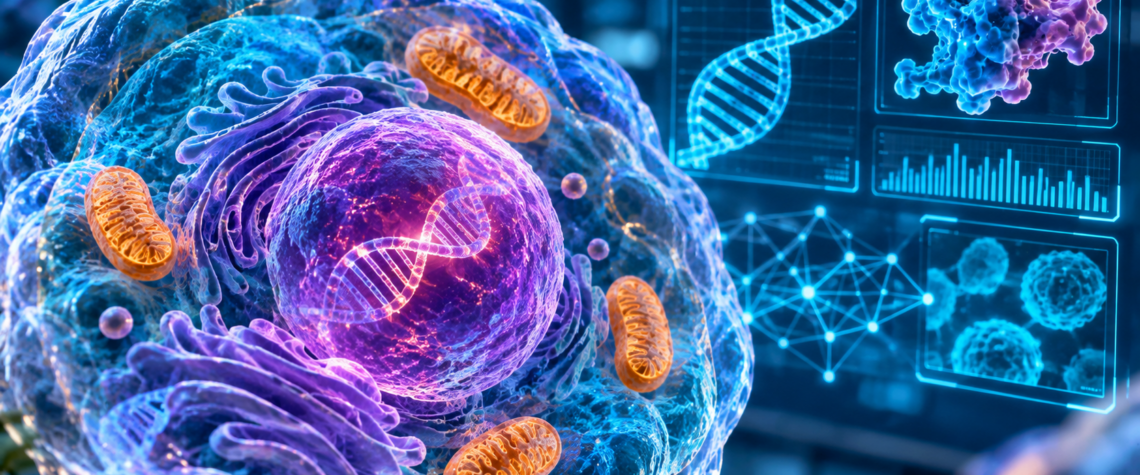
One of the most ambitious projects in modern biology is the development of the virtual cell.
Imagine a computer model capable of predicting how a living cell might react when a gene is modified, a chemical is introduced or a disease disrupts its normal activity.
Researchers could use such a system to investigate thousands of possible experiments before selecting the most promising ones for laboratory testing.
In July 2026, researchers writing in Nature described a framework for developing a virtual yeast cell. Their proposal combines specialized biological models, experimental data and AI systems to represent different cellular processes.
Yeast is particularly useful for this work because it is extensively studied and shares important cellular characteristics with more complex organisms.
Other research groups are developing models that predict how human cells respond to genetic changes and pharmaceutical compounds.
The ultimate ambition is to simulate increasingly complex biological processes with enough accuracy to guide real-world discoveries.
But scientists emphasize that reliable virtual cells remain an unfinished goal. Living cells are dynamic systems whose behavior depends on countless interactions, many of which are not yet fully understood.
A New Approach to Drug Discovery
Developing a new medicine is expensive, time-consuming and uncertain.
Researchers may investigate thousands of compounds before identifying a promising candidate. Even then, a substance that performs well in early experiments may fail during later testing.
AI offers several ways to improve this process