From a beloved bald eagle watched by millions to elephants protected by intelligent cameras and birds identified by their songs, technology is giving conservationists powerful new ways to understand and protect the natural world.
For years, a camera mounted high in a tree overlooking California’s Big Bear Valley allowed people around the world to witness something extraordinary: the private lives of two bald eagles.
Jackie and Shadow became unlikely internet celebrities. Viewers watched them build their nest, endure winter storms, protect their eggs, and raise their young. Their daily routines, once hidden from human observation, became a shared experience for an international audience.
The fascination went beyond entertainment. The eagles helped people develop a personal connection with wildlife and brought new attention to the importance of protecting natural habitats.
When Jackie died in August 2026 after weeks of veterinary treatment, her loss was felt far beyond the California mountains where she had lived.
Her story illustrates a remarkable transformation in wildlife conservation. Technology is no longer simply helping scientists observe animals. It is also bringing the natural world closer to the public and providing researchers with new tools to protect vulnerable species. And increasingly, artificial intelligence is becoming part of that effort.
The Eagles That Brought Wildlife Into Millions of Homes
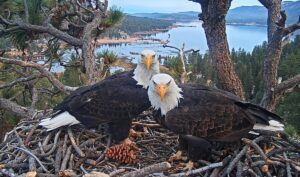 Jackie and Shadow lived near Big Bear Lake in Southern California, where the nonprofit Friends of Big Bear Valley operated a camera that allowed viewers to follow the eagles without disturbing their nest. Their popularity demonstrated how a relatively simple technology could change public attitudes toward wildlife.
Instead of reading occasional reports about bald eagles, viewers could observe their behavior directly. They witnessed the patience required to incubate eggs, the difficulties of raising chicks, and the unpredictable dangers of life in the wild. The camera also provided valuable opportunities for education and observation.
Although the Big Bear livestream was not itself an artificial intelligence project, it represented an important step toward a new era of technology-assisted conservation: continuous observation of animals in their natural environment. AI is now extending that approach to habitats where human observers cannot easily follow wildlife.
Cameras That Recognize Animals Automatically
Wildlife researchers have long used motion-activated cameras to photograph animals in forests, grasslands, and remote habitats. These devices can operate for months, capturing species that are difficult to observe directly. But their success creates another problem: enormous quantities of photographs that scientists must examine and classify.
Artificial intelligence is helping solve that challenge. Google’s SpeciesNet, an open-source AI model, can identify nearly 2,500 categories of mammals, birds, and reptiles in camera-trap images.
The system was trained using approximately 65 million labeled images contributed by conservation partners. Instead of manually reviewing every photograph, researchers can use AI to identify animals and organize observations much more quickly.
In Tanzania’s Serengeti National Park, the Snapshot Serengeti project used SpeciesNet to analyze a backlog of approximately 11 million wildlife photographs in a matter of days.
The resulting information can help researchers study animal populations, activity patterns, and changes in ecosystems over time. For conservationists with limited funding and personnel, this ability to process large amounts of information can make monitoring programs more practical.
Listening to the Forest With Artificial Intelligence
Not every animal is easily photographed. Many birds and other species live in dense vegetation, move primarily at night, or avoid areas where humans are present. But even when animals remain invisible, they often reveal themselves through sound.
Scientists are increasingly using microphones placed in forests and other natural environments to record wildlife calls. AI systems can analyze those recordings and identify species based on distinctive vocal patterns.
One example is BirdNET, a technology developed through research involving Cornell University’s K. Lisa Yang Center for Conservation Bioacoustics and Chemnitz University of Technology. In Colombia, researchers have used BirdNET to analyze rainforest recordings and improve the identification of Amazonian bird species.
Working with local bird experts, the project expanded the system’s ability to recognize species that had previously been difficult to identify automatically.
This information can help scientists determine which birds inhabit particular landscapes and how their populations respond to environmental changes. The technology may be especially valuable in regions where conventional wildlife surveys are expensive, difficult, or dangerous. Instead of requiring researchers to remain in remote forests for extended periods, recording devices can gather information continuously. AI then helps transform thousands of hours of sound into useful ecological observations.
Protecting Elephants Before Conflict Occurs
Artificial intelligence is also being used to address one of conservation’s most difficult problems: conflicts between people and wild animals. In parts of Asia and Africa, elephants sometimes enter agricultural areas or villages, damaging crops and creating dangerous encounters. Traditional approaches often depend on people noticing approaching animals and warning others. AI-powered monitoring systems can provide earlier alerts.
A study published in Conservation Science and Practice examined an intelligent camera system deployed in West Bengal, India. The cameras detected elephants approaching areas where people lived and transmitted alerts to response teams. During the study, the system recorded 266 elephant detection events, with alerts transmitted in an average of approximately 42 seconds.
The researchers reported no human fatalities or serious injuries during the deployment period, although the findings do not establish that the technology alone caused that outcome. The project illustrates how AI can support conservation by helping communities respond before encounters become dangerous. Protecting wildlife does not always mean keeping people away from animals. Sometimes it means helping both coexist more safely.
Watching Habitats From Above
Satellites and aerial imaging provide another important source of conservation information. Researchers can use satellite observations to monitor forest loss, changes in vegetation, habitat fragmentation, and other environmental pressures. AI can help analyze these images, identify patterns, and detect changes that might otherwise require extensive manual review.
Drones equipped with cameras can also support wildlife surveys, although their use must be carefully managed to avoid disturbing animals. Combined with field observations, these technologies can help conservation organizations decide where to concentrate limited resources.
For example, researchers may identify habitat corridors that connect isolated animal populations or areas where human development is creating new pressures on wildlife. The goal is not simply to collect more images. It is to turn information into decisions that improve conservation outcomes.
Can AI Really Save an Endangered Species?
The growing use of AI in conservation raises an important question: Does better technology necessarily mean better protection? Not always. An algorithm may identify an animal correctly without revealing whether its population is increasing or declining. A camera can document a threatened species without preventing habitat destruction. And a sophisticated monitoring system cannot replace laws, protected areas, adequate funding, or the work of local communities.
AI systems also make mistakes. Animals photographed in unusual lighting, partially hidden by vegetation, or seen from unfamiliar angles can be misidentified. Models trained in one region may perform less reliably in another.
A 2026 scientific review of AI-based wildlife monitoring found that relatively few studies had progressed to operational deployment and that performance could deteriorate when systems encountered unfamiliar environments.
Human expertise therefore remains essential. Biologists must interpret results, verify uncertain identifications, and determine what the information means for conservation policy. AI can accelerate scientific work, but it cannot independently make all the ecological and ethical decisions required to protect wildlife.
When Technology Creates a Connection With Nature
Perhaps the most surprising lesson from Jackie and Shadow is that technology can influence conservation even without sophisticated algorithms.
Their camera did not merely transmit images of two birds. It allowed people to become emotionally invested in animals they might never encounter in person. That connection matters.
Conservation depends partly on scientific evidence, but it also depends on public support. People are more likely to care about threatened species when they understand their behavior, recognize the challenges they face, and see them as living creatures rather than abstract statistics.
AI-assisted wildlife monitoring could extend that experience to many more species. Imagine being able to follow the seasonal movements of elephants, listen to endangered birds in a distant rainforest, or observe rare mammals without disrupting their habitat.
Such technologies could make conservation science more accessible to schools, communities, and ordinary citizens. But they also bring responsibilities. Sensitive location data must be protected when revealing an animal’s whereabouts could expose it to poachers or other threats. And images or videos presented as authentic wildlife observations must be carefully verified, particularly as AI-generated content becomes increasingly realistic.
A New Alliance Between Science and Nature
The natural world is facing enormous pressures from habitat destruction, pollution, climate change, and human activity. Artificial intelligence cannot solve those problems on its own.
What it can do is help scientists observe more, analyze information faster, and respond to certain threats earlier.
From cameras identifying animals in the Serengeti to microphones recognizing birds in the Amazon and warning systems protecting elephants in India, AI is expanding the possibilities of wildlife conservation. Jackie’s story reminds us of something equally important.
Technology becomes especially powerful when it connects scientific knowledge with human concern. The camera that brought a bald eagle into millions of homes did not save her life. But it helped people understand why her life mattered. And that may be one of technology’s most meaningful contributions to conservation: giving us better tools to protect the natural world while reminding us why it deserves protection in the first place.
Sources: