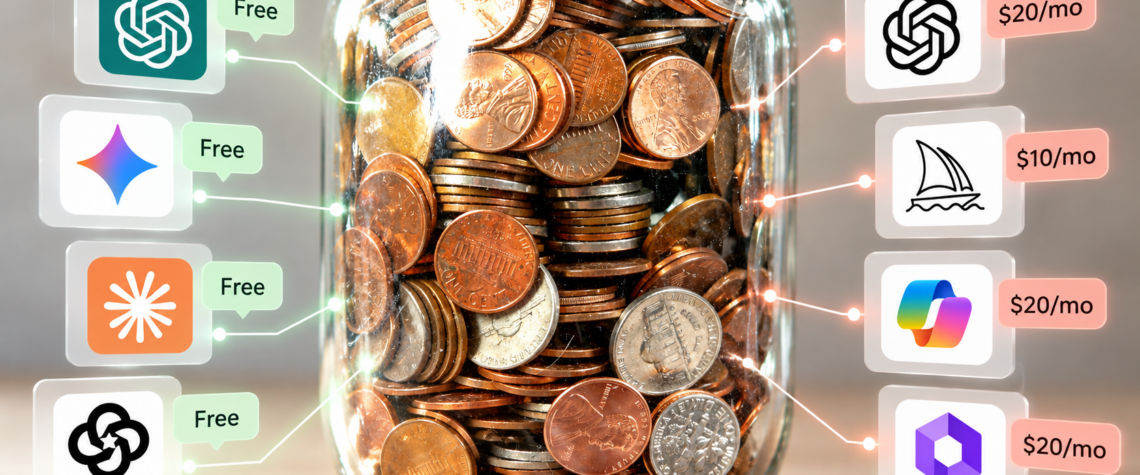
The AI industry would like you to believe that the best artificial intelligence begins with a monthly subscription. For many people, it doesn’t. Before adding another charge to your credit card, find out how much you can already do for free.
Subscriptions have quietly become part of modern life. We pay for television, music, cloud storage, newspapers, software, exercise programs and sometimes services we barely remember signing up for. Now artificial intelligence wants a place on that list. Ten or twenty dollars a month may not sound like much. But subscribe to several AI services and suddenly you’re spending hundreds of dollars a year on technology you may not actually need. That’s especially easy to do because the major AI companies constantly introduce new models, features and premium plans. The temptation is understandable: if everyone is talking about a powerful new AI tool, the paid version must be dramatically better. Sometimes it is. But before paying, ask a more useful question: What do I actually need AI to do? For many everyday users, the free versions of today’s major AI services can already accomplish a remarkable amount.
Start with ChatGPT
ChatGPT has become the starting point for millions of people experimenting with generative AI.
You can use its free service for many ordinary tasks: explaining difficult subjects, brainstorming, rewriting text, planning, asking questions, working with images and files, and getting help with everyday problems. OpenAI currently offers additional capabilities to paying users, along with higher usage limits, but you don’t need a subscription simply to discover whether conversational AI is useful to you. Start with the free version. Use it for a few weeks. Ask it to explain something confusing. Give it a piece of writing and ask for suggestions. Use it to plan a project or learn something unfamiliar. You’ll quickly discover whether AI is becoming part of your routine or merely something you visit occasionally. That is useful information to have before you subscribe.
Try Google’s Gemini if you live in Google’s world
If Gmail, Google Docs, Maps, YouTube and other Google services already occupy much of your digital life, Gemini is worth trying. Google offers free access to Gemini, while paid Google AI plans provide access to higher limits and additional capabilities. But again, don’t begin with the subscription. Begin with the question. What do you want Gemini to do that you cannot already accomplish with the free service? Perhaps its relationship with Google’s ecosystem is useful to you. Perhaps another AI assistant gives you answers you prefer. The only way to discover that is to use the tools rather than compare their marketing pages.
Claude is particularly interesting for reading and writing
Claude, from Anthropic, is another major AI assistant with a free tier. Many users turn to Claude for writing, analyzing material, working through ideas and discussing documents. Anthropic also offers paid plans with greater usage and additional capabilities. The same rule applies: experiment first. Give the free service a document you’ve written and ask it to identify weaknesses. Ask it to explain a difficult idea. Compare the way it answers a question with the answer you receive from ChatGPT or Gemini. You may discover that you prefer one assistant’s style for certain tasks and another for something else. That doesn’t mean you need subscriptions to both.
Perplexity approaches the problem differently
Sometimes you don’t want a long conversation with an AI. You want to research something. Perplexity combines AI-generated responses with web research and visible source links. It offers a free service as well as paid options with additional capabilities and higher limits. This can be particularly useful when your real objective is not merely getting an answer but finding the information behind it. Ask about a subject, examine the sources it provides and open them yourself. That last step matters. An AI research tool can accelerate the process of finding information. It should not eliminate your responsibility to determine whether the information is credible.
Don’t choose an AI assistant the way you choose a sports team
There is a peculiar tendency in technology to turn products into tribes. iPhone versus Android. Mac versus PC. And now ChatGPT versus Gemini versus Claude versus everything else. You don’t need to participate. These are tools. One may be better for a particular kind of writing. Another may be more convenient for research. Another may work particularly well with services you already use. The free tiers give you something valuable: an opportunity to find out. Ask the same real-world question of several assistants. Don’t ask which AI is “best.” Ask which one is most useful to you. The distinction matters.
Free doesn’t necessarily mean unlimited
There is an important catch. Free AI services generally have limits. Companies may restrict how much you can use their most capable models, how many files you can analyze, which advanced features are available or how frequently certain tools can be used. Those limits can also change as AI companies revise their products. That’s why it isn’t particularly useful to memorize that one service gives exactly this many messages and another gives exactly that many. Those numbers may be different by the time you read this. Instead, use the free service until you encounter a limitation that actually interferes with something you need to accomplish. Now you have a reason to consider paying. Not because an advertisement told you the premium version is better. Because you have identified a problem that the paid version solves.
Don’t subscribe because you’re afraid of missing out
This may be the most important rule.The AI industry is moving extraordinarily quickly. Every few weeks brings another announcement about a supposedly transformative model or feature. You will not keep up with all of it. You don’t need to. Most people don’t need the most powerful artificial intelligence available. They need an AI system capable enough to help with the tasks they actually perform. If you use AI occasionally to draft emails, understand documents, plan trips or answer questions, a free service may be entirely sufficient. If you’re using it for hours every day professionally, regularly reaching usage limits, working with large amounts of material or depending on advanced capabilities, paying may make perfect sense. Your usage should determine the subscription—not the excitement surrounding the technology.
Be careful about paying for several services
Ten or twenty dollars here and there adds up quickly. Suppose you subscribe to three or four AI services because each has one feature you like. You can easily find yourself paying hundreds of dollars a year. Before adding another subscription, look at what you’re already paying for. Does an existing service now include the feature you wanted elsewhere? Are you still using the AI product you subscribed to three months ago? Would the free version now be enough? This is a good habit for every digital subscription, not just AI. Put a reminder on your calendar every few months and conduct a small subscription audit. You may be surprised by what you’re paying for.
Know what you’re paying for
Eventually, you may reach the point where a paid AI plan is worthwhile. That’s fine. But you should be able to finish this sentence: “I’m paying for this because…” I use it every day for work. I repeatedly hit the free limit. Or a particular feature saves me several hours every week. I need to work with more files or larger documents. It replaces another service I’m already paying for. Those are reasons. “I heard the paid version is amazing” isn’t much of one.
Use the free market the AI companies created
One of the great advantages consumers have right now is competition. ChatGPT, Gemini, Claude and Perplexity are competing for your attention. Their offerings and limits change frequently, but all provide ways for consumers to experience their services without immediately committing to a paid monthly plan. Take advantage of that. Try them. Compare them. Give them real problems rather than artificial tests. And don’t be surprised if you discover that the best combination isn’t one premium AI assistant that does everything. It may be several free tools that you use selectively.
Pay when AI earns its place
There is nothing wrong with paying for good software. If an AI assistant saves you time, helps you work better, teaches you things, improves your writing or becomes something you genuinely depend on, a subscription can be excellent value. But make the machine prove its value first. Start free. Learn what the technology can do. Discover what you actually use. Notice which limitations genuinely bother you. Then decide whether AI has earned a place on your monthly bill. That’s a much smarter reason to subscribe than simply being told that you’re missing out.