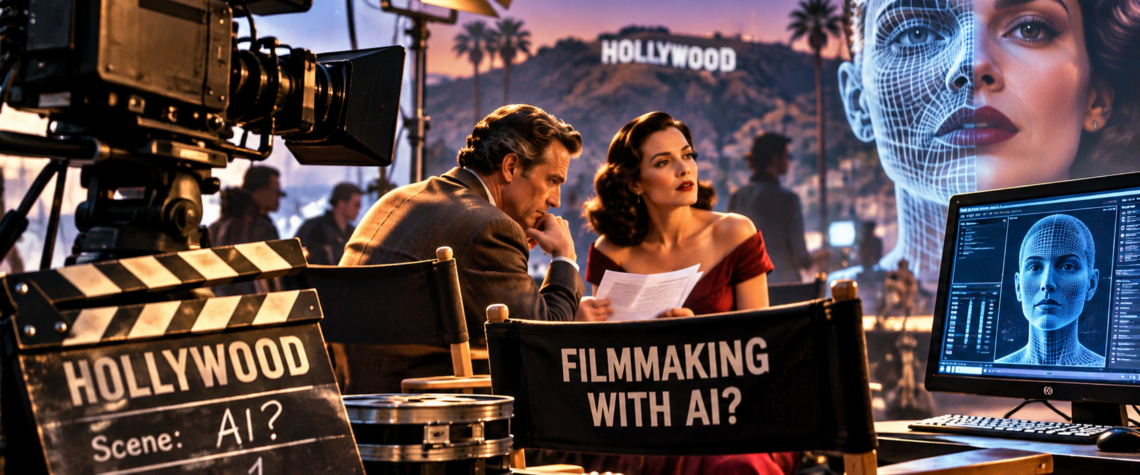
As studios quietly embrace artificial intelligence, actors, writers and musicians confront an uncomfortable question: Who benefits from the technology, and who risks being replaced?
Hollywood has spent more than a century turning technological innovation into entertainment. Sound transformed silent movies. Color changed visual storytelling. Computer-generated imagery made imaginary worlds appear real.
Now the entertainment industry faces another technological revolution, but this time the enthusiasm is accompanied by something unusual: reluctance to talk about it.
Artificial intelligence is entering film production, animation, visual effects, sound design, dubbing, marketing, and other activities traditionally performed by creative professionals.
Yet publicly acknowledging its use can provoke criticism from actors, writers, unions, and audiences concerned that the technology could undermine the human talent on which Hollywood was built.
The contradiction was captured by music producer Tushar Apte in an October 2026 interview with the French newspaper Le Monde. Comparing AI in music to a controversial shortcut, he observed that its use is widespread even as professionals hesitate to acknowledge it.
The remark points to a growing tension inside the entertainment business: AI promises faster production and lower costs, but its economic advantages may come at the expense of the people who make movies and music.
Hollywood Is Hiring for an AI Future
One of the clearest signs of Hollywood’s changing relationship with artificial intelligence can be found in its employment advertisements.
A July 2026 investigation by the Los Angeles Times examined approximately 250 publicly available job postings from major entertainment companies, including Disney, Netflix, Amazon MGM, Universal, Paramount, Warner Bros., and Sony.
About 30 appeared to involve artificial intelligence.
The positions suggested that studios were recruiting specialists to develop AI-assisted production systems, improve visual effects, automate certain technical processes, and analyze audiences.
Some companies were also seeking expertise to protect their intellectual property against unauthorized AI use.
Netflix, for example, advertised a position focused on integrating generative AI workflows into film production. Disney-related operations were recruiting specialists working at the intersection of computer graphics, artificial intelligence, and filmmaking.
The investigation did not establish that studios were replacing actors or screenwriters with AI. Nor did the job postings reveal the full extent of AI adoption.
But they offered evidence of something significant: artificial intelligence is becoming part of Hollywood’s production infrastructure, even while its public use remains controversial.
The Promise of Cheaper, Faster Filmmaking
For producers, the attraction is easy to understand. Film and television production can require enormous investments in personnel, locations, equipment, visual effects, and postproduction.
AI-assisted tools can help generate preliminary visual concepts, organize footage, improve sound, assist with dubbing, and accelerate certain editing and visual-effects tasks. Independent filmmakers may benefit particularly from these capabilities.
A small production company that cannot afford elaborate effects or extensive postproduction resources may be able to create more ambitious projects with AI assistance.
The technology could also help filmmakers experiment with visual ideas before committing to expensive shoots.
But the same efficiencies create an uncomfortable economic possibility.
If AI allows a production to complete certain assignments with fewer employees, the savings that make filmmaking more affordable may also reduce opportunities for artists and technicians.
The central issue is not simply whether AI can make movies cheaper. It is how the resulting benefits will be distributed.
Actors Are Fighting for Control of Their Digital Identities
For performers, one of the most troubling possibilities is the creation of digital replicas.
AI systems can generate or manipulate images and voices to produce representations resembling real people. In entertainment, these capabilities raise questions about consent, compensation, ownership, and the future use of an actor’s likeness.
The 2023 Hollywood labor disputes brought these concerns into public view.
Since then, SAG-AFTRA, the union representing actors and other entertainment professionals, has pursued contractual protections governing the use of digital replicas and synthetic performers.
In June 2026, union members ratified a new four-year television and theatrical agreement that strengthened those protections.
The agreement addresses several issues involving digital replicas, including consent, security, dubbing, and the use of biometric information.
It also establishes additional obligations for producers seeking to use synthetic performers—AI-generated characters that resemble human beings without necessarily depicting an identifiable actor.
The agreement does not prohibit AI outright. Instead, it seeks to preserve employment opportunities and establish enforceable limits on how the technology can be used.
That distinction reflects a pragmatic reality: Hollywood’s unions recognize that artificial intelligence is unlikely to disappear, but they want workers to retain rights and bargaining power as it develops.
What Happens to the People Behind the Camera?
Actors and screenwriters attract the most attention, but filmmaking depends on thousands of professionals whose names rarely appear in headlines.
Editors, sound technicians, visual-effects artists, storyboard specialists, animators, production assistants, and other workers contribute to the finished product.
Some of their tasks are particularly suitable for AI assistance.
A system that accelerates background removal, preliminary animation, dialogue cleanup, or routine image processing may improve productivity.
But if studios use these tools to reduce staffing, the consequences could extend across the production workforce.
The effects may be especially significant for younger workers who traditionally enter the industry through technical or supporting assignments.
If entry-level tasks become automated, aspiring professionals could find fewer opportunities to develop the experience required for more demanding creative positions.
Hollywood could therefore face a paradox: increasingly sophisticated production technology alongside a shrinking pipeline for developing the next generation of filmmakers.
The Creative Question: Can AI Replace an Artist?
The economic debate is inseparable from a more difficult question about creativity itself. AI systems can generate images, music, dialogue, and video sequences that resemble human-produced material. But producing a convincing imitation is not necessarily equivalent to creating an original artistic vision.
Filmmaking involves choices shaped by experience, culture, emotion, collaboration, and personal interpretation.
A director’s decision to hold a shot for several uncomfortable seconds, an actor’s unexpected expression, or a composer’s unconventional musical choice can transform an ordinary scene into something memorable.
AI may reproduce recognizable patterns associated with successful films, but whether it can independently develop an artistic vision comparable to that of a human creator remains contested.
Some filmmakers see the technology as an extension of existing creative tools. Others fear that reliance on generated material will encourage studios to produce inexpensive variations of familiar stories rather than take risks on original work.
The question is not whether AI-generated images can look cinematic.
It is whether an industry increasingly focused on automated production will continue investing in the people who bring distinctive ideas to the screen.
The Audience May Have the Final Say
Hollywood’s future also depends on viewers. Audiences have embraced computer-generated effects for decades, often without knowing which elements of a film were created digitally.
Generative AI introduces a different concern because it can potentially replace aspects of human performance rather than merely enhance them.
Will audiences accept a leading character created entirely by AI? Will they care whether a song was written by a person or generated by software? Should filmmakers disclose when artificial intelligence has played a substantial creative role?
There are no settled answers. Public resistance to AI-generated entertainment may influence how studios introduce the technology. But consumer attitudes could also change as the tools improve and become more familiar.
What audiences ultimately value—spectacle, authenticity, recognizable stars, compelling stories, or some combination of them—will help determine which applications succeed.
A Crisis That AI Did Not Create
Artificial intelligence is arriving at a difficult moment for Hollywood. The industry has already been disrupted by changing streaming economics, competition from production centers outside California, rising costs, and the consequences of recent labor disputes.
A reduction in local film production has affected not only studios but also the businesses and workers that support them.
AI did not create those problems, and it would be misleading to attribute Hollywood’s broader economic difficulties entirely to automation.
Nevertheless, the technology could accelerate changes already underway.
Studios under pressure to control costs may find AI particularly attractive. Workers facing fewer opportunities may see the same technology as another threat to their livelihoods.
The result is an industry divided between the need to innovate and the desire to preserve the human workforce that made its success possible.
Who Will Own Hollywood’s AI Future?
The entertainment industry has survived numerous technological revolutions, but artificial intelligence raises questions that earlier innovations did not confront in quite the same way.
Who controls a performer’s digital identity? Who receives compensation when AI systems are trained on copyrighted creative work? Who benefits when automated production reduces costs? And who decides how much human involvement is necessary for a film to remain an artistic creation? These questions cannot be answered by technology companies alone.
They require negotiations among studios, artists, unions, lawmakers, and audiences.
Artificial intelligence may eventually become as ordinary a filmmaking tool as digital editing software. It may also fundamentally change the economics of creative employment. For now, Hollywood is moving in both directions: adopting AI while debating its consequences.
The industry’s greatest challenge may not be teaching machines to make movies. It may be ensuring that the people who make movies still have a place in the industry that emerges.