

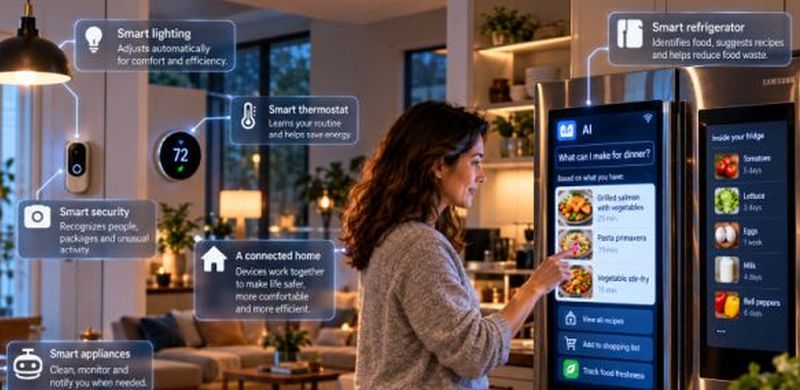
Your refrigerator can recognize food. Your thermostat can learn your routine. Your doorbell can distinguish people from packages. Artificial intelligence is giving the Internet of Things something it never really had before: intelligence.
For years, the technology industry promised us the “smart home.” Smart lights. Smart thermostats. Smart doorbells. Smart refrigerators. Smart washing machines. The idea became known as the Internet of Things, or IoT: ordinary objects equipped with sensors, software and an internet connection so they can exchange information and be controlled remotely. But there was always something slightly misleading about the word smart.
A lightbulb that you could turn on from your phone was certainly connected. Was it really intelligent? Artificial intelligence is beginning to change that distinction. The next generation of connected devices won’t simply wait for us to press a button. They may increasingly observe, interpret, recommend and act. And one of the best places to see that transformation is somewhere surprisingly ordinary: The kitchen.
What happens when your refrigerator knows what’s inside?
Open a conventional refrigerator and you have to answer a familiar question: What can I make for dinner? An AI-enabled refrigerator could approach the problem differently. Some current smart refrigerators already combine internal cameras, displays, connected services and food-management features. Manufacturers are increasingly adding AI-based recognition and recommendations. The refrigerator can potentially help identify some of the food inside, keep track of ingredients and suggest recipes based on what’s available. So instead of searching the internet for a recipe and then discovering that you’re missing three ingredients, you could ask: “What can I make with what I already have?”
That sounds like a small convenience. But it represents something much larger. The appliance is no longer simply keeping food cold. It is beginning to interpret information about what is inside it.
The washing machine doesn’t need to be fascinating
This may be one of the most important things to understand about AI in the home. The best applications may be profoundly boring. Nobody wakes up in the morning hoping to have an intellectually stimulating conversation with a washing machine. We simply want clean clothes. AI can potentially help appliances detect loads, recommend appropriate cycles, optimize water or energy use and alert owners when something requires attention. That is a very different vision of artificial intelligence from a chatbot writing poetry. And perhaps a more practical one. The technology becomes useful precisely because we don’t have to think about it very much.
Your thermostat can learn how you live
The thermostat offers another example. A traditional thermostat waits for instructions. Set the temperature to 72 degrees. A connected thermostat allows you to change that temperature remotely. A more intelligent system can go further. It can learn patterns. When do people usually wake up? When does everyone leave? When do they return? Which rooms are being used?
Combined with sensors and automation, a home can potentially adjust heating and cooling according to actual patterns rather than a fixed schedule. The difference is subtle but important. The old machine follows a command. The newer machine attempts to understand context.
Your doorbell is becoming a computer-vision system
The humble doorbell has undergone an extraordinary transformation. Once, its entire job was to make a sound. Now connected doorbells can include cameras, microphones, motion detection and software capable of analyzing what happens outside the home. AI can help distinguish between different kinds of events. A person approaching. A package being delivered. An animal crossing the yard. A vehicle arriving. Instead of receiving an alert every time something moves, the system can attempt to determine what kind of movement matters. Again, the significant change isn’t simply connectivity. It’s interpretation.
The real transformation happens when devices work together
A refrigerator, a thermostat, a security camera connected to the internet is useful. But the larger idea behind the Internet of Things is that these devices can become part of a system.
Imagine leaving home. The house recognizes that nobody remains inside. The lights turn off. The thermostat changes. The doors are checked. Security monitoring changes mode. Certain appliances reduce their energy use. No single device is particularly revolutionary. The intelligence comes from coordination. That is where AI could fundamentally change the smart home. Instead of controlling ten smart devices individually, we may increasingly tell one system what we want: “I’m leaving for the weekend.” The home figures out the rest.
The smart home may become conversational
Today, operating a connected home can be surprisingly complicated. Different apps, accounts, manufacturers, menus, commands. AI could simplify that. Instead of finding the correct control inside an application, you might simply say: “It’s too warm upstairs.” Or: “Did I leave the garage door open?” Or: “We’re going to bed.”
The important technological advance isn’t necessarily that the devices themselves become dramatically smarter. It may be that humans no longer have to learn how to operate each one separately. Conversation becomes the interface.
But who owns the information about your home?
There is another side to all of this. For a home to become more intelligent, it needs information. When are you home? When are you away? Which rooms do you use? What do you eat? When do you sleep? Who comes to your door? What devices do you own? Potentially even what you say to a voice assistant. Individually, each piece of information may appear insignificant. Together, they can describe a surprisingly detailed picture of someone’s private life. That makes privacy an essential part of the smart-home conversation. Consumers should understand what information a device collects, whether recordings or data are stored, what is processed locally versus in the cloud, and what privacy controls are available. The smartest appliance isn’t necessarily the one with the most features. Sometimes it may be the one that knows when not to collect information.
Connected also means vulnerable
There is another simple rule: Anything connected to a network can potentially become a security concern. A refrigerator may not contain your banking information. But a poorly protected connected device can still become part of the digital environment of your home. Basic precautions matter. Use strong, unique passwords. Enable automatic security updates when available. Use multifactor authentication when the service supports it. And before buying a connected appliance, ask a question consumers rarely had to ask about refrigerators: How long will the manufacturer provide software updates? A conventional refrigerator might remain useful for fifteen years. Its compressor doesn’t need a cybersecurity patch its software might.
Do you really need an intelligent refrigerator?
This may be the most consumer-oriented question of all. Not every object needs AI. A toaster does not necessarily become better because it can talk. A refrigerator does not automatically justify a higher price because “AI” appears on the box. Before buying any smart appliance, ask: What useful problem does this solve for me? Does it save energy? Reduce food waste? Improve security? Save time? Make the appliance easier to use? If the answer is unclear, the intelligent version may simply be a more complicated version. Technology should earn its place in the home.
The Internet of Things is becoming the Intelligence of Things
The original Internet of Things was largely about connection. Connect the thermostat. Connect the camera. Connect the refrigerator. Connect the lights. Artificial intelligence adds another layer. Understand. Predict. Recommend. Coordinate. That doesn’t mean our houses are about to become sentient. It means something much more practical. The objects surrounding us are beginning to receive the ability to interpret information and respond to it. A refrigerator that helps decide dinner. A thermostat that understands when nobody is home. A doorbell that recognizes the difference between a visitor and a package. A washing machine that adjusts itself to what we’re washing. Individually, these may seem like conveniences. Together, they suggest a much larger transformation. For decades, we have gone to computers when we wanted intelligence. Now intelligence is beginning to move into the objects around us. And eventually the most remarkable thing about the smart home may be that we stop thinking of it as smart at all. It will simply be home.






