

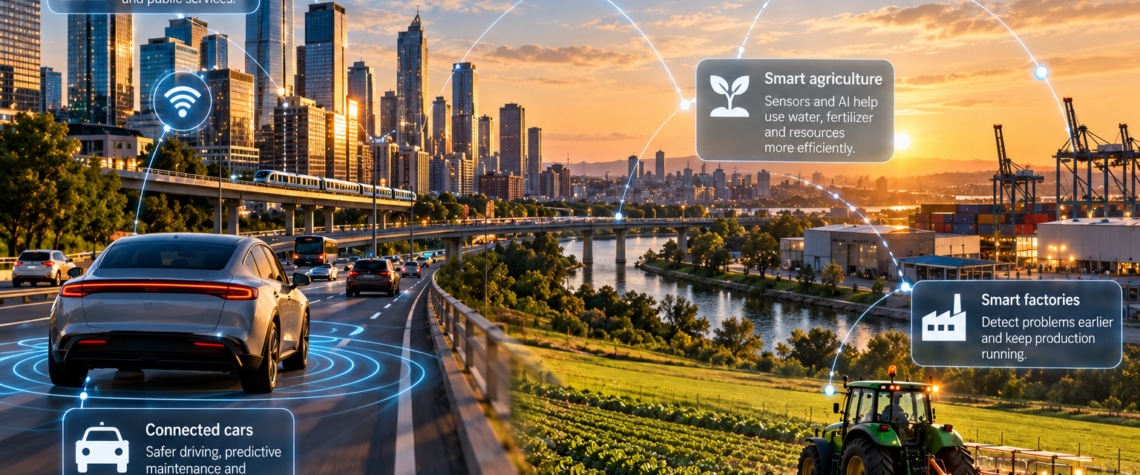
Artificial intelligence is leaving the screen. Connected sensors in cars, streets, farms, factories and buildings are giving AI something it never had before: the ability to understand—and increasingly respond to—the physical world.
For most of us, artificial intelligence still lives inside a screen. We open an app. We type a question. AI gives us an answer. But another technological revolution is happening much more quietly. Millions of machines and objects around us are acquiring sensors. Cars have cameras and radar. Factories monitor vibration and temperature. Farms measure moisture in the soil. Buildings detect movement and energy consumption. Cities use cameras and sensors to understand traffic.
This is the Internet of Things, or IoT. Add artificial intelligence to those billions of streams of information and something important happens. AI no longer has to wait for a human being to tell it what’s happening. The physical world can begin telling AI directly.
From the Internet of Things to the Intelligence of Things
The original idea behind the Internet of Things was relatively simple: Connect objects to the internet. A sensor measures something. The information travels through a network. Software records it. A person—or another machine—can respond. Artificial intelligence changes the equation because the system can begin interpreting the information.
A temperature sensor can tell you that a machine is getting hot. An AI system analyzing thousands of measurements may be able to recognize a pattern suggesting that the machine requires attention. That distinction—between collecting information and understanding patterns within it—is at the heart of what is sometimes called AIoT: the Artificial Intelligence of Things. And we’re already beginning to encounter it.
Your car is becoming a collection of intelligent sensors
Consider the modern automobile. It can contain cameras, radar, ultrasonic sensors, GPS and dozens of computers monitoring what happens both inside and outside the vehicle. Some systems can recognize lane markings. Others can detect another vehicle in a blind spot. Cameras can help identify pedestrians or traffic signs. Driver-assistance systems can use these streams of information to warn the driver—and in certain circumstances intervene. The car isn’t simply connected anymore. It is constantly trying to answer questions: What’s around me? Where am I? Is something dangerous happening? This does not make the car infallible or autonomous. Drivers still need to understand the capabilities and limitations of the systems they use. But it illustrates something larger. AI is acquiring eyes and ears in the physical world.
A city can sense what is happening
Now enlarge the same idea from one automobile to an entire city. Traffic lights. Parking spaces. Buses. Roads. Air-quality monitors. Electrical systems. Water networks. Public buildings.All can potentially produce information. Traditionally, much of that infrastructure operated independently. But when sensors are connected and their information can be analyzed together, cities can potentially respond more intelligently to changing conditions. Imagine traffic signals that adjust according to actual congestion rather than simply following the same predetermined cycle all day. Or transportation systems that identify where delays are developing. Or water networks that recognize unusual patterns that might indicate a leak. The objective isn’t to create a science-fiction city that “thinks.” It’s much more practical: See what’s happening and respond more efficiently.
The farm is becoming a data network
The same transformation is happening far away from cities. Walk across a farm and the technology may be almost invisible. Sensors can measure soil moisture. Weather stations can monitor local conditions. Cameras and drones can examine crops. Connected equipment can collect information while moving through fields. AI can help analyze that information. Instead of watering an entire field according to a fixed schedule, farmers can potentially determine which areas actually need water. Instead of discovering a crop problem after it has spread widely, image-analysis systems may help identify unusual patterns earlier. This matters because agriculture constantly faces a difficult problem: How do you produce more while wasting less? Water, fertilizer, fuel, labor and time all cost money. The promise of AIoT in agriculture isn’t a robot farmer replacing human judgment. It’s better information arriving at the moment a decision has to be made.
The factory that knows something is wrong
Factories provide perhaps one of the clearest examples. Industrial machines generate clues about their own condition. Temperature changes. Unusual vibration. Changes in pressure. Electrical fluctuations. Strange sounds. A human technician may recognize some of those warning signs. But a connected monitoring system can observe machines continuously. AI can then search the data for patterns associated with equipment problems. This creates the possibility of predictive maintenance. Instead of waiting for a machine to break and then repairing it, a company may be able to identify signs of trouble earlier and schedule maintenance before a failure causes a shutdown. It’s not glamorous AI. It doesn’t write novels. It doesn’t create pictures. But preventing one critical machine from unexpectedly stopping a production line can be extraordinarily valuable.
Buildings can respond to the people inside them
The office building is changing too. A traditional building doesn’t know whether a conference room contains twenty people or nobody at all. The lights may remain on. The air conditioning continues running. Energy continues being consumed. Connected sensors can provide information about occupancy, temperature, air quality and energy consumption. AI can potentially use those patterns to help manage the building more efficiently. Lights where people actually are. Heating and cooling adjusted to occupancy. Maintenance directed toward equipment showing signs of trouble. The building begins responding to how it is actually being used rather than simply following a timetable. This is the same principle we saw in the smart home. Only bigger.
AI is getting a body
There’s an even more interesting consequence. Robots also depend on sensors. A robot moving through a warehouse needs to know where objects and people are. A delivery robot needs to understand sidewalks, obstacles and intersections. A robotic arm needs to know where an object is before it can pick it up. AI provides some of the intelligence. Sensors provide the connection to reality. Put the two together and AI gains something it doesn’t have inside a chatbot: the ability to perceive and potentially act upon the physical world. That is a profound change.
More sensors also mean more surveillance
But there is another side to this connected world. Sensors generate data. Lots of it. A traffic camera can help understand congestion. It can also record people and vehicles. A workplace sensor may help manage energy. It may also reveal when employees arrive, where they spend time or how spaces are used. A connected vehicle can provide valuable safety and maintenance information. It can also generate detailed information about where that vehicle travels. The question therefore isn’t simply: What can the sensor see? It is also: Who gets to see the sensor’s data? Who owns it? How long is it stored? Can it identify individuals? Can it be sold or shared? Can the system be hacked? The smarter the physical world becomes, the more important these questions become.
And what happens when AI gets it wrong?
There is another difference between AI on a screen and AI in the physical world. If a chatbot gives you a bad restaurant recommendation, the consequences may be an unpleasant dinner. If an AI system misinterprets information controlling machinery, transportation or critical infrastructure, the consequences can be much more serious. That means AI systems operating in the physical world require something consumers should increasingly understand: different levels of trust for different levels of risk.
An AI system recommending when to water tomatoes is one thing. An AI system helping control a moving automobile is another. The technology may be related. The consequences of failure are not.
The computer is disappearing again
Something similar has happened before. Computers once occupied entire rooms. Then they moved onto our desks. Then into our pockets. Now computing is beginning to disappear into everything else. The thermostat. The automobile. The factory machine. The tractor.
The traffic signal. The building. The refrigerator. And increasingly, those computers are being connected to artificial intelligence. The result may be one of the biggest changes of the AI era—and one that receives much less attention than chatbots. Artificial intelligence is moving beyond the digital world. It is beginning to see, hear and measure the physical world around us. The Internet connected people. Then it connected computers. The Internet of Things connected objects. Artificial intelligence may be the technology that teaches those connected objects what all that information means. And that is when the Internet of Things becomes something considerably more interesting: an Internet of intelligent things.






