The smartphone taught us to touch technology. AI may make that interface disappear. We are entering a world where machines can listen to us, see what we see, understand our surroundings—and increasingly act in the physical world.
For nearly two decades, the smartphone has been the center of our digital lives. We tap it. Swipe it. Type into it. Look down at it. Even artificial intelligence, for most people, still arrives through a familiar rectangle of glass: open an app, type or speak a question, wait for an answer. But something more fundamental is beginning to change. AI is moving beyond the screen. It can listen through microphones, interpret images from cameras, receive information from devices worn on our bodies and increasingly interact with cars, homes and machines around us. That suggests a very different technological future. Instead of learning how to operate computers, computers may increasingly learn how to interact with us.
First came the keyboard. Then came touch. Now comes conversation.
For decades, humans had to adapt themselves to computers. We learned commands, menus, icons, where to click. The smartphone simplified much of this by replacing the mouse with something humans already understood intuitively: our fingers.
AI introduces another interface that is even older. Language. Instead of finding the correct button, we can increasingly say what we want. “Find the photograph I took in Boston last summer.” “Explain what I’m looking at.” “Remind me to call David when I get home.” “Translate what this person is saying.” If computers become capable of understanding ordinary conversation reliably, the interface begins to disappear. You don’t necessarily need to know how the machine works. You need to explain what you want.
AI is beginning to see
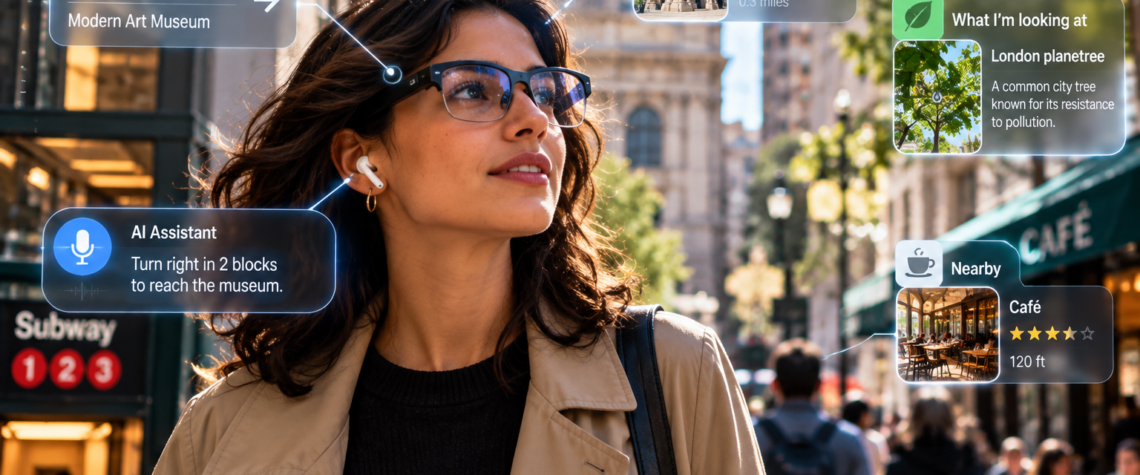
The camera on a phone was originally designed to take pictures. Now a camera can also become an eye for artificial intelligence. Point it at a flower and ask what it might be. Show it a restaurant menu and request a translation. Photograph a complicated document and ask for an explanation. Show it something broken and ask what may be wrong. This idea becomes considerably more interesting when the camera moves from the phone to something we wear. Smart glasses, for example, could allow an AI system to receive visual information about the same environment the wearer is seeing. Imagine looking at a building and asking:
“What is that?”
Or looking at a sign in another language:
“Translate this.”
Or searching for something around the house:
“Where did I leave my keys?”
The computer no longer waits inside a screen.
It begins to share our physical environment.
AI is learning to listen
Voice assistants have existed for years. But traditional voice systems often depended on relatively rigid commands. “Set a timer.” “Play music. ”What is the weather?”. Conversational AI potentially changes that relationship. Instead of memorizing the correct phrase, we can speak more naturally, interrupt, clarify and continue a conversation. That could make headphones and earbuds surprisingly important AI devices. Imagine walking through an unfamiliar city while an assistant quietly provides directions. Or hearing someone speak another language while a translation is delivered through your ear. Or asking a question without ever taking a device from your pocket. In that world, the interface isn’t something you look at. It’s something you talk to.
Your body can become part of the interface
Smartwatches already collect information about movement, heart rate, sleep and other measurements. Other wearable devices can collect additional signals. AI can help interpret patterns within that information. That creates potentially useful applications, particularly in fitness and health. But it also raises an important question:
How much should technology know about our bodies?
The more personal the interface becomes, the more important privacy, security and accuracy become. A system that knows what article you’re reading is one thing. A system continuously receiving information about your body is something else. Convenience and intimacy often arrive together.
Your car is becoming an interface
Modern cars already contain cameras, microphones, sensors, navigation systems and increasingly sophisticated software. AI can help interpret information from those systems. Drivers may interact with vehicles through ordinary speech rather than navigating complicated screens. “Find a charging station along my route.” “Why is that warning light on?” “Take me somewhere nearby for lunch.”
More advanced driving systems introduce a much larger question: how much responsibility should be transferred from the human driver to the machine? The transition is unlikely to happen all at once. For years, people may live in an uncomfortable middle ground where machines can perform some driving tasks but humans must still understand when they need to take control. That makes the human-machine interface not merely convenient. It can become a matter of safety.
The home may begin anticipating instead of waiting
The “smart home” has existed as a promise for years. Turn on a light with your voice. Adjust the thermostat remotely.
See who’s at the door from your phone. AI could make those systems less dependent on explicit commands. A home might learn patterns. It might recognize that nobody is home and reduce energy use. It might notice unusual activity. It might coordinate appliances, lighting and temperature without requiring separate instructions for every device. That sounds convenient. It also means technology may need to know considerably more about what happens inside our homes. Once again, the same question appears: How much convenience are we willing to exchange for information about ourselves?
Then there are robots
For most people, AI currently exists as software. Robotics gives it a body. A robot connected to sophisticated AI could potentially see objects, understand spoken instructions, navigate rooms and manipulate things in the physical world. Factories and warehouses already use specialized robots extensively. The more difficult challenge is the unpredictable environment of everyday human life. A kitchen isn’t a factory. Neither is a hospital room, a sidewalk or your living room. For robots to become genuinely useful around ordinary people, they must learn to deal with the disorder of the real world. That is a much harder problem than answering a question on a screen.
And eventually, perhaps, the interface could be us
The most radical possibility doesn’t involve talking, touching or looking at a device. It involves signals from the nervous system itself. Brain-computer interfaces are being researched for applications including helping people with severe paralysis communicate with computers. This technology remains far removed from the everyday experience of most consumers, and extraordinary claims about its future deserve skepticism. But the underlying idea is profound.
The history of computing has been partly a history of reducing the distance between human intention and machine action. Punch cards. Keyboard. Mouse. Touchscreen. Voice. Gesture. Perhaps neural signals. Each step asks the computer to understand us a little more directly.
When the interface disappears, something else becomes more important
There is an appealing vision here. Technology becomes easier. You don’t search through menus. You don’t study manuals. You don’t stare constantly at screens. You simply speak, look, move or gesture. But invisible technology creates its own problems. If an AI is always available, is it also always listening? If smart glasses can recognize what you’re looking at, what happens to the privacy of everyone around you? If an assistant begins making decisions for you, when should it ask permission? If a machine interprets your body, your voice and your surroundings, who controls that information? The better AI understands us, the more important these questions become.
The future may not look like a computer
For generations, we have imagined advanced technology as more screens. Bigger screens. Smaller screens. Screens in our pockets, cars, kitchens and watches. Artificial intelligence suggests another possibility. Perhaps the most advanced computer will be the one we hardly notice. It listens when we speak. It sees when we need it to see. It helps when asked. And then it gets out of the way. The great technological change may therefore not be that artificial intelligence becomes more visible. It may be exactly the opposite. The interface disappears—and the intelligence remains.