Artificial intelligence is changing the demand for workers, reshaping familiar occupations and creating new opportunities. But the benefits—and the risks—will not be shared equally.
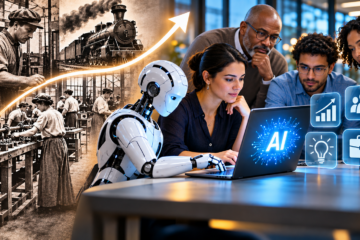
For generations, technological progress has transformed the workplace. Machines replaced much of the physical labor once required in factories, computers changed office work, and the internet created industries that scarcely existed a few decades earlier. Artificial intelligence represents another turning point. But this time, technology is reaching beyond repetitive physical tasks into activities once considered distinctly human: writing, analyzing information, designing images, preparing financial reports, and answering complex questions.
The result is a fundamental change in the relationship between technology and employment. Businesses are reconsidering not only how work gets done, but how many workers they need, which skills they value, and what they are willing to pay for them. For employees, the question is becoming increasingly personal: Will AI make my work more valuable, or will it make my job less necessary?
The Difference Between Replacing a Task and Replacing a Worker
One of the most important distinctions in the employment debate is the difference between automating a task and eliminating an entire job. Consider an accountant who spends several hours each week preparing reports. AI software may reduce that work to minutes. But the accountant may still be needed to interpret financial information, advise clients, detect irregularities, and exercise professional judgment.
The same principle applies to teachers, journalists, lawyers, designers, and many other occupations. A 2025 study by the International Labor Organization estimated that one in four workers worldwide held occupations with some exposure to generative AI. However, the organization concluded that transformation rather than outright replacement was the more likely outcome for most jobs.
That distinction is encouraging, but it does not eliminate the risks. If one employee can complete work that previously required several people, employers may decide not to replace departing workers or may reduce future hiring. An occupation can survive while the demand for people entering it declines.
Why AI Changes Labor Demand
In economics, labor demand refers to how many workers employers are willing to hire at different wage levels. Businesses generally hire workers because their contributions help produce goods or services that customers are willing to buy. Artificial intelligence can change that calculation in two opposing ways.
First, AI can substitute for human labor. If software performs a task more cheaply, a company may need fewer employees to accomplish the same amount of work. Second, AI can complement human labor. By helping workers become more productive, technology can make their services more valuable and potentially increase demand.
Imagine a small architectural firm. AI tools might automate portions of drafting, visualization, and administrative work, reducing the hours needed for each project. But if the firm can consequently serve more clients, it might expand and hire additional architects, project managers, or construction specialists. Which outcome prevails depends on costs, customer demand, business strategy, and the ability of workers to adapt. There is no universal rule that AI must destroy jobs or create them.
The Occupations Facing the Greatest Changes
Office and administrative work is particularly exposed because many routine activities involve processing information. Scheduling appointments, preparing standard documents, summarizing reports, responding to routine customer inquiries, and entering data are increasingly within the capabilities of AI-powered systems. Customer service departments can use chatbots to handle common requests, while human representatives concentrate on unusual problems requiring judgment or negotiation.
Marketing teams can generate initial advertising concepts and analyze campaign results more quickly. Software developers can use AI assistants to write and review code, although testing, security, and system design still require substantial expertise. Creative occupations face a different challenge. AI can produce illustrations, music, videos, and written material at low cost, potentially putting pressure on some freelance assignments.Yet creative direction, originality, editorial judgment, and relationships with clients remain important sources of human value.
The central question is not simply whether AI can perform a particular activity. It is whether businesses and customers consider the automated result sufficiently reliable, useful, and economical.
New Jobs Are Emerging, Too
While some occupations face reduced demand, others are expanding. Businesses adopting AI need people who can integrate new systems, manage data, protect digital infrastructure, evaluate automated decisions, and ensure that technology operates responsibly. Demand is growing for specialized capabilities in machine learning, cybersecurity, data management, and AI implementation. But not every new opportunity requires becoming a computer scientist. A healthcare administrator who understands AI-assisted scheduling, a teacher who knows how to evaluate AI-generated learning materials, or a small-business manager who can automate routine processes may become more valuable to an employer.
The World Economic Forum’s Future of Jobs Report 2025 projected substantial worldwide employment turnover by 2030. Across several economic and technological trends—not AI alone—it estimated 170 million jobs could be created and 92 million displaced, producing a net increase of 78 million.
These are projections based on employer expectations, not guaranteed outcomes. They also conceal an important reality: newly created jobs will not necessarily appear in the same locations, industries, or wage categories as those that disappear.
The Problem for Entry-Level Workers
One of the most difficult questions concerns young people entering the labor market. Traditionally, junior employees learn through assignments that may appear routine: preparing summaries, researching information, organizing documents, producing initial drafts, or assisting experienced professionals.
These are also activities that AI can increasingly perform. If companies automate much of their entry-level work, they may have less incentive to hire beginners. That could create a paradox. Employers may continue needing experienced professionals while reducing the opportunities through which future professionals acquire experience.
This is a risk rather than an inevitable outcome, and its scale will differ across industries. Nevertheless, it raises important questions for universities, employers, and governments. Training programs may need to emphasize practical judgment, supervised experience, and collaboration with AI systems rather than simply teaching tasks that software can already perform.
Will AI Increase Wages or Put Pressure on Them?
Higher productivity does not automatically mean higher wages. If AI allows a worker to produce more valuable output, that worker may gain bargaining power—particularly when specialized knowledge is scarce. But if technology makes a skill easier to reproduce, competition may increase and compensation may come under pressure.
For example, an experienced professional who combines industry expertise with AI capabilities might command higher pay. Someone offering a standardized service that can be generated cheaply by software may face stronger price competition.
The distribution of AI’s economic benefits will depend partly on who owns the technology, how competitive labor markets remain, and whether workers have the opportunity to share in productivity gains. This makes AI not only a technological issue, but also an economic and political one.
What Workers Can Do Now
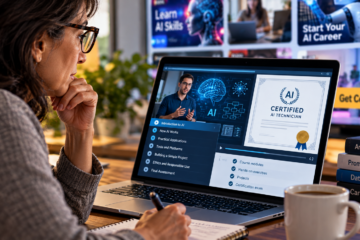
Workers cannot control every technological change, but they can take practical steps to strengthen their position. The first is to understand how AI is affecting their particular occupation. A nurse, electrician, accountant, and graphic designer face very different opportunities and risks. The second is to identify which tasks can be automated and which depend on human expertise, responsibility, trust, or physical presence. Third, workers can begin experimenting with appropriate AI tools, learning their strengths and limitations without assuming that every AI-generated answer is correct. Finally, professional development should include transferable abilities: communication, critical thinking, problem-solving, adaptability, and the capacity to work effectively with other people.
A 2026 OECD report on AI and skills emphasized that the ability of workers and businesses to use the technology effectively is a major factor in realizing its benefits. For many employees, the immediate goal is not to become an AI specialist. It is to become more capable in a profession that increasingly uses AI.
The Future of Work Is Also a Human Decision
Artificial intelligence will influence the number and kinds of jobs available, but technology alone will not determine the outcome. Employers will decide whether productivity gains lead to expansion or workforce reductions. Governments will shape education, labor protections, and retraining opportunities. Workers and their representatives will seek a voice in how new systems are introduced.
The challenge is not simply to create a more productive economy. It is to ensure that productivity translates into opportunities, economic security, and better working conditions. AI may be able to perform an increasing share of the world’s work. Whether that leads to broader prosperity or greater inequality will depend on the choices society makes along the way.