The exposure of Homeland Security personnel records raises serious questions about government cybersecurity, employee safety, and the technologies used in federal surveillance.
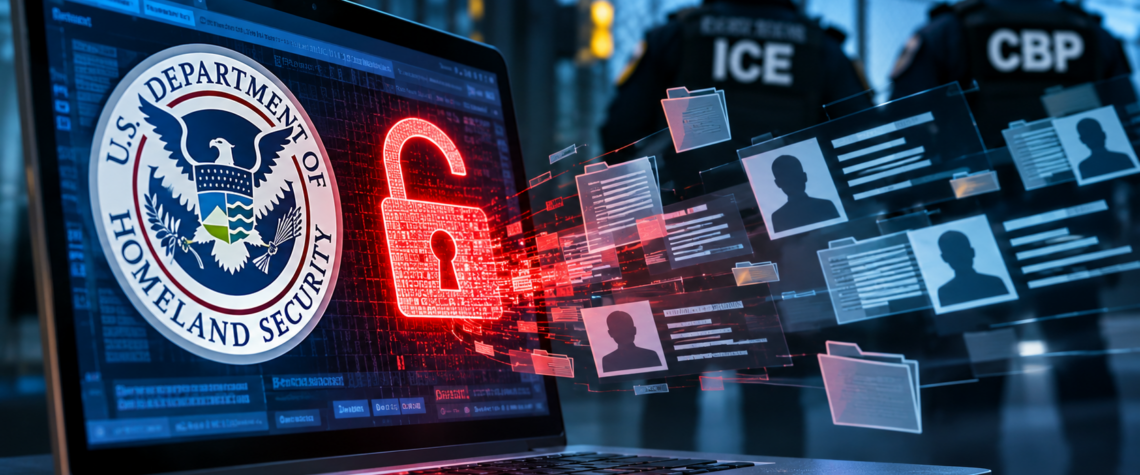
A massive leak involving more than 41,000 employees and contractors of the U.S. Department of Homeland Security (DHS) has exposed sensitive information about federal personnel, including individuals associated with undercover operations, surveillance programs, and immigration enforcement.
The records, published on October 28 by the nonprofit transparency organization Distributed Denial of Secrets (DDoSecrets), contain names, workplace contact information, job titles, organizational assignments, and internal group memberships across several DHS agencies.
The incident, first examined in detail by WIRED, has prompted concerns about the security of federal identity-management systems and the potential consequences of revealing information about employees involved in sensitive investigations.
It has also exposed an uncomfortable contradiction: Government agencies that collect and analyze enormous amounts of information about the public may themselves struggle to protect their own personnel data.
What Was Exposed?
The leaked archive, known as “Icepick,” contains records associated with Immigration and Customs Enforcement (ICE), Customs and Border Protection (CBP), and other Homeland Security agencies.
According to reporting by WIRED, some records reveal connections to undercover investigations, electronic surveillance activities, and specialized government technologies.
The information includes organizational relationships and membership in internal groups associated with wiretap programs, Palantir software, and xAI’s Grok chatbot.
These references do not establish that the underlying surveillance databases or AI systems were breached. They do, however, provide insights into which parts of the department may have access to particular technologies.
That distinction is important. A leak of employee records and access-group information can reveal sensitive operational relationships without necessarily exposing the contents of the systems those employees use.
How Did the Leak Happen?
A group calling itself the Department of Peace claimed responsibility for obtaining the records and said the information came through DHS’s employee authentication infrastructure.
The group reportedly identified Okta, a widely used identity and access management provider, as part of the system involved.
However, Okta said it had found no evidence that its own systems or data had been compromised.
The precise method used to obtain the information remains publicly unresolved. It would therefore be premature to conclude that attackers exploited a vulnerability in Okta’s technology.
The incident nevertheless illustrates why identity-management systems are particularly sensitive. They can connect employees to applications, permissions, organizational structures, and other information that may become valuable to attackers.
DHS Warns of Risks to Employees
The Department of Homeland Security acknowledged that it was responding to a potential security breach and working to protect affected personnel.
According to Reuters, DHS sought to have the information removed or restricted by an Icelandic hosting provider, warning that publication could expose more than 40,000 individuals to harassment, stalking, or physical harm.
The hosting company declined the request, disputing the characterization of the published workplace contact information.
The controversy highlights a difficult question about transparency and privacy.
Public accountability is especially important when government agencies exercise extensive surveillance and enforcement powers. But publishing information that could identify undercover personnel may create risks for employees, their families, and ongoing investigations.
The distinction between legitimate scrutiny of government operations and unnecessary exposure of individuals is central to the debate.
Why Palantir and Grok Matter
One of the most revealing aspects of the leak is its connection to the technological infrastructure used by Homeland Security.
WIRED reported that some internal group memberships referenced Palantir software and xAI’s Grok chatbot, alongside other tools and surveillance-related programs.
Palantir develops data-analysis platforms used by government agencies, including immigration enforcement operations. Separately, reporting has documented ICE’s use of Palantir-supported AI tools to process and summarize information submitted through its tip system.
The leaked records do not demonstrate that Palantir or Grok themselves were hacked, nor do they establish precisely how every referenced technology was being used. Instead, they offer a partial picture of the increasingly complex relationship between government agencies, commercial software providers, and artificial intelligence.
As AI becomes more integrated into public-sector operations, securing the identities and permissions of people who use these systems becomes an increasingly important cybersecurity challenge.
The Hidden Danger of Organizational Data
A database does not need to contain classified documents to create serious security risks. Employee directories, job assignments, contact details, and access-group memberships can help malicious actors understand how an organization operates.
Such information may be useful in targeted phishing attacks, impersonation attempts, or efforts to identify individuals with access to sensitive systems.
For large organizations, this means cybersecurity cannot focus exclusively on protecting confidential files. Information about who works where, who reports to whom, and which technologies employees can access may also require strong safeguards.
The DHS incident is a reminder that seemingly routine administrative records can become highly sensitive when combined.
What This Means for Everyone
Although the immediate controversy involves federal agencies, the underlying security lessons apply to businesses, schools, hospitals, and individuals.
Organizations increasingly rely on centralized systems to manage employee identities and access to digital services. These systems offer efficiency and convenience, but they also require careful oversight.
Strong multifactor authentication, limited access privileges, regular reviews of employee permissions, and monitoring for unusual activity can help reduce exposure. None of these measures alone guarantees protection.
For individuals, the incident reinforces the importance of recognizing suspicious messages, protecting account credentials, and understanding how personal information can be combined with other records to support impersonation attempts.
A Warning for the AI Era
The DHS leak is more than a story about thousands of exposed employee records. It illustrates the security challenges emerging as government operations become increasingly dependent on interconnected databases, cloud services, and artificial intelligence.
The more information these systems connect, the more consequential failures in access control and data protection can become.
Artificial intelligence may give institutions unprecedented capabilities to analyze information. But those capabilities also make responsible security practices essential.
The central lesson is straightforward: An organization cannot rely on increasingly sophisticated technology while neglecting the protection of the people and systems behind it.