Electronic shelf labels are spreading through American supermarkets. They promise efficiency, but also raise questions about the future of pricing, consumer privacy, and corporate power.
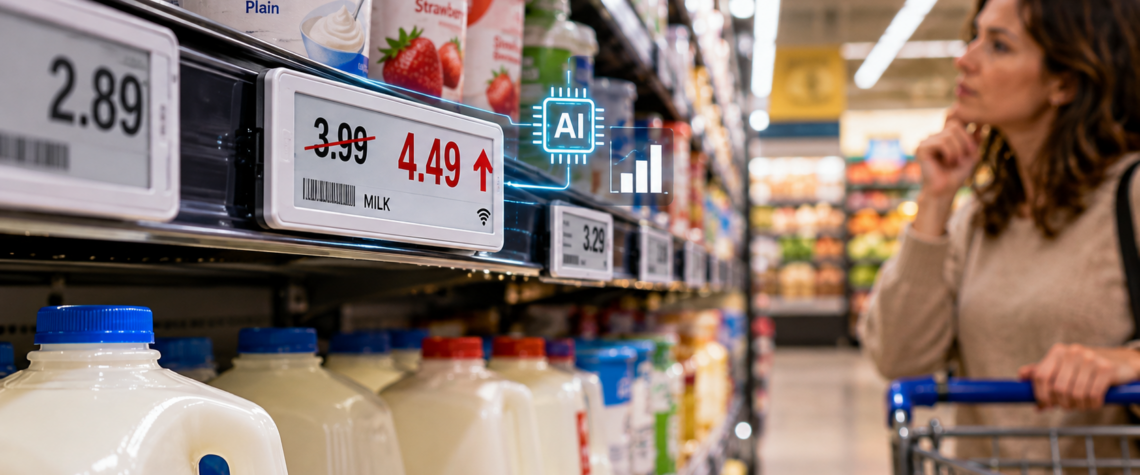
Imagine walking into a supermarket to buy a gallon of milk. You glance at the price displayed on the shelf, reach for the carton, and continue shopping. Nothing unusual. But what if the price could change electronically while you were still walking through the store? And what if an algorithm, rather than a store manager, helped determine what you should pay?
This possibility is moving from a technological curiosity to a serious public debate as American retailers replace traditional paper price tags with electronic displays. Walmart, the nation’s largest retailer, reported in March 2026 that approximately 2,300 of its U.S. stores were already using digital shelf labels, with plans to extend the technology throughout its chain.
The small screens may look like an insignificant innovation. Yet they raise a much larger question: As artificial intelligence becomes increasingly involved in retail decisions, who will control the price of everyday necessities?
Goodbye, Paper Price Tags
For decades, changing prices in a supermarket required employees to walk through aisles, remove paper labels, and replace them individually. In a large store carrying tens of thousands of products, the process could consume many hours. Electronic shelf labels eliminate much of that manual work. Connected to a centralized system, they can display approved price changes within minutes. They can also help employees locate merchandise, replenish shelves, and fulfill online orders.
For retailers, the advantages are obvious: lower administrative costs, fewer labeling errors, and faster operations. For customers, accurate shelf prices that match checkout prices are a genuine benefit. But there is an important distinction between changing how prices are displayed and changing how prices are determined.
A digital label is not, by itself, an artificial intelligence system. It is essentially a miniature electronic screen. The intelligence, when present, operates elsewhere—in software that analyzes sales, inventory, competition, customer demand, and other information to recommend pricing decisions. Connecting those two technologies creates possibilities that extend well beyond replacing paper.
When Algorithms Enter the Supermarket
Airlines, hotels, and ride-hailing services have accustomed consumers to dynamic pricing: the practice of adjusting prices as market conditions change. A hotel room may cost more during a major convention. An airline ticket may become more expensive as departure approaches. A ride can cost significantly more when demand suddenly exceeds the number of available drivers.
Artificial intelligence can make such decisions faster and more sophisticated by examining enormous quantities of information and predicting how customers may respond to different prices. Now imagine similar capabilities applied to groceries.
A retailer could theoretically adjust the price of strawberries as supplies diminish, reduce the cost of products approaching expiration, or change prices in response to competitors. Some adjustments might benefit consumers by reducing food waste and making discounts available more quickly. Others could raise troubling questions.
Should bottled water become more expensive during a heat wave? Should basic necessities cost more when demand suddenly increases? And should a retailer be permitted to use information about an individual shopper to calculate how much that person might be willing to pay?
These are different practices, and they should not be confused. Dynamic pricing responds to market conditions. Personalized or surveillance pricing uses information about particular consumers to influence what they are charged. Artificial intelligence can support either approach, but electronic labels alone establish neither.
What Walmart Says—and What It Doesn’t Do
Walmart has strongly rejected suggestions that its electronic shelf labels are being used to manipulate prices according to the customer, the weather, or the time of day. In an October 2026 statement, the company emphasized that it does not use individual customers’ personal information, income, shopping history, or willingness to pay to establish personalized prices.
Walmart says prices are established centrally, approved changes are reviewed by employees, and electronic labels simply display those prices. The company also says the labels contain no cameras or microphones and do not collect customer information. These distinctions matter. There is no basis for claiming that Walmart’s digital labels are secretly identifying shoppers or automatically increasing prices as customers approach a product. But Walmart’s assurances do not eliminate the broader policy question. Technology that makes price changes easier can be used in different ways by different retailers, under different rules.
The debate is not simply about what one company is doing today. It is about what the retail industry may be capable of doing tomorrow.
A Growing Political Debate
Concern over algorithmic pricing has reached state legislatures and Washington. In 2024, Senators Elizabeth Warren and Bob Casey questioned Kroger about the potential for electronic shelf labels to facilitate sudden price increases. Their concern was that retailers could eventually use rapidly changing prices to take advantage of consumers when demand is highest.
The issue has since expanded into a national debate over transparency, fairness, and the use of personal information in commerce. Research has also complicated some of the more alarming predictions. Studies of electronic shelf-label adoption have not established that the technology inevitably produces sudden price spikes. Retailers have practical reasons to maintain stable prices, including customer trust and the risk of driving shoppers to competitors. The danger, therefore, should not be exaggerated. But neither should the need for safeguards be dismissed.
States Are Beginning to Draw the Line
The debate over algorithmic pricing is no longer confined to consumer advocacy groups and technology conferences. Several states have begun translating concerns into law, although their approaches differ considerably.
Maryland has taken one of the strongest positions. Its Protection From Predatory Pricing Act, effective October 1, 2026, restricts dynamic grocery pricing and the use of consumers’ surveillance data to determine prices. The law covers food retailers and certain third-party delivery services and is intended to prevent sudden, data-driven price increases on essential purchases.
New Jersey has also enacted legislation targeting surveillance pricing in groceries and other food products. Its Fair Price Protection Act prohibits pricing strategies that determine or vary food prices using personal data, addressing the possibility that different customers could be charged differently based on information collected about them.
Vermont has adopted a more direct restriction on electronic shelf labels. Its 2026 legislation prohibits retailers from using those labels to increase prices through real-time dynamic pricing while stores are open to the public. The law addresses how quickly and under what circumstances digital displays may be used to raise prices, rather than treating the technology itself as inherently unlawful.
Connecticut has established disclosure requirements for surveillance pricing. Its approach emphasizes informing consumers when personal data is used in pricing decisions, allowing shoppers to recognize practices that might otherwise remain invisible.
Meanwhile, New York lawmakers have introduced proposals that would restrict electronic shelf labels or regulate deceptive algorithmic pricing. Those proposals remain distinct from enacted legislation.
At the federal level, the Federal Trade Commission has also examined personalized pricing and proposed greater transparency about the use of consumer information. These developments reflect an emerging regulatory principle: Retailers may adopt sophisticated pricing technology, but consumers should not be left in the dark about how it affects what they pay.
How Consumers Can Protect Themselves
While lawmakers debate the limits of algorithmic pricing, shoppers do not have to wait for new legislation to take practical precautions. The first defense is surprisingly simple: Pay attention to the price displayed on the shelf and compare it with the amount charged at checkout. When a discrepancy appears, ask for clarification before completing the purchase. A photograph of the shelf label, including the product description and date, can provide useful evidence if a dispute arises.
Consumers should also compare unit prices rather than relying exclusively on promotional signs. The price per ounce, pound, or other standard measurement often reveals whether a supposed bargain is genuinely less expensive than competing products. Digital coupons and loyalty programs deserve closer scrutiny. They can produce legitimate savings, but they may also involve sharing purchase histories, contact information, location data, or other personal details. Shoppers should review privacy settings, limit unnecessary permissions, and decide whether the benefits justify the information being collected.
When shopping online, comparing prices while signed out of a retailer’s account may sometimes help identify differences between publicly displayed prices and account-specific offers. However, a price difference does not necessarily prove discriminatory or surveillance-based pricing; promotions, store locations, delivery fees, and other factors can also explain it.
Consumers can further protect themselves by checking advertised prices against receipts, keeping records of unexplained discrepancies, and reporting potentially deceptive practices to their state attorney general’s consumer protection office.
Most importantly, shoppers should understand that digital shelf labels and personalized pricing are not the same thing. An electronic display does not automatically mean a store is monitoring individual customers. The more useful questions are whether personal information influences prices, whether prices can change during a shopping trip, and whether the retailer clearly explains its practices. Awareness, comparison shopping, and careful management of personal information cannot eliminate every risk. But they can give consumers greater control in a marketplace where pricing decisions are becoming increasingly automated.
Who Benefits From Intelligent Pricing?
Artificial intelligence can improve retail efficiency in ways that benefit everyone. Better demand forecasting can prevent empty shelves. More accurate inventory management can reduce waste. Faster markdowns can make perishable food more affordable before it expires.
These are meaningful improvements. The problem arises when the same analytical power is used primarily to identify how much additional money a consumer might be persuaded—or compelled—to spend. Unlike an airline ticket or a hotel reservation, groceries are not discretionary purchases for most families. Milk, bread, eggs, vegetables, and medicine are necessities. Consumers cannot always postpone buying them until prices become more favorable.
That imbalance gives the question of algorithmic pricing an ethical dimension. A system designed to maximize revenue may be commercially successful without necessarily serving the public interest. Efficiency and fairness are not interchangeable goals.
The Right to Know What Determines a Price
As AI becomes more deeply embedded in commerce, consumers will need something more than assurances that technology is making shopping easier. They will need clear explanations of how prices are determined, what personal information is used, and whether automated systems are permitted to change prices according to demand or individual characteristics.
Retailers should be able to demonstrate that their pricing practices are consistent, transparent, and subject to meaningful human oversight. Regulators, meanwhile, face the challenge of establishing safeguards without preventing innovations that genuinely reduce costs.
The electronic price tag may be only a small screen attached to a supermarket shelf. But behind it lies a much larger transformation in the relationship between technology, business, and consumers. The question is not whether artificial intelligence can calculate the price that produces the greatest profit. It is whether that should be the only calculation that matters.