

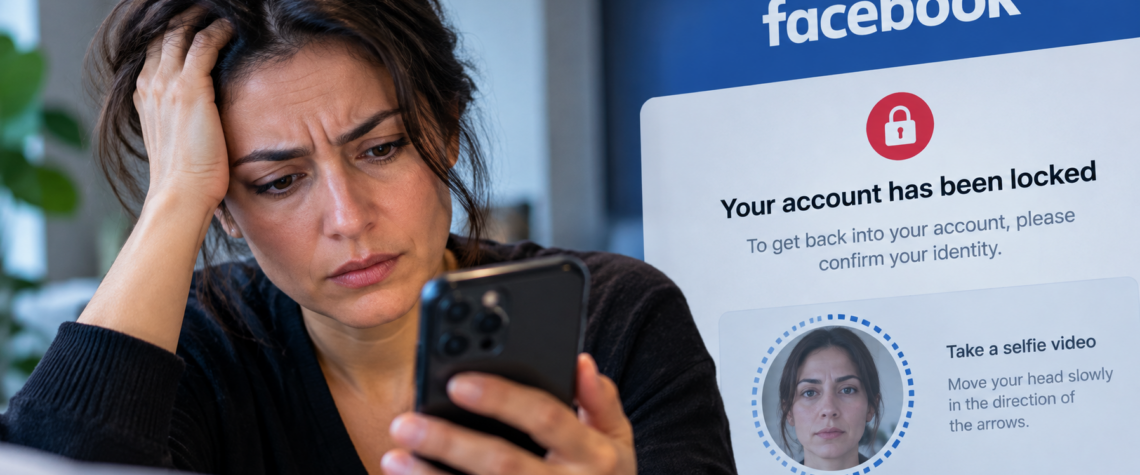
Facebook uses artificial intelligence and facial recognition to protect accounts from fraud. But when automated systems make mistakes, legitimate users can find themselves locked out, unable to reach a human being or recover years of personal history.
For millions of people, Facebook is more than a social network. It is a collection of family photographs, personal messages, professional relationships, community connections, and memories accumulated over many years. For small businesses, it may also be an essential channel for reaching customers.
Losing access to an account can therefore mean much more than losing access to a website. Facebook’s parent company, Meta, increasingly relies on artificial intelligence and automated security systems to detect suspicious activity, prevent account takeovers, and verify users’ identities. These technologies serve a legitimate purpose. Fake accounts, identity theft, phishing, and online scams are serious problems that affect users around the world. But what happens when the system designed to protect an account prevents its rightful owner from entering? For some users, the result is a frustrating cycle of identity checks, automated responses, rejected verification attempts, and appeals that appear to lead nowhere.
Millions of users are affected annually by account-recovery and verification frictions in Facebook. Meta has not published a single official total for how many people are currently locked out of Facebook due to its identity and automated moderation systems. Local tech reporting suggests roughly 110 million people experience a Facebook account lockout or restriction annually, driven by automated checks, selfie video verifications, and identity prompts. Meta’s automated moderation systems have experienced spikes in false positives (including a notable increase during late 2025 due to system updates), falsely flagging genuine accounts for Community Standard violations or suspicious login activity.
The precise scale of the problem remains unclear. Although estimates of Facebook account lockouts circulate online, Meta has not published a comprehensive figure identifying how many legitimate users are currently unable to access their accounts because of mistaken automated security decisions. What is clear is that the problem has attracted growing scrutiny.
When a Computer Decides You Are Not You
One of Meta’s account-recovery methods involves recording a short video selfie. Users may be asked to position their face within a frame and move their head according to instructions displayed on the screen. Meta has explained that its facial recognition technology can compare the submitted video with profile photographs associated with the account. The objective is to determine whether the person requesting access is the legitimate account holder. In theory, the process is straightforward. In practice, identity verification is not always so simple.
A longtime Facebook user may have few personal photographs on the account. Some users display landscapes, family members, company logos, or illustrations instead of their own faces. Others may have difficulty completing a video verification because of camera problems, lighting conditions, accessibility barriers, or unfamiliarity with the technology.
A failed verification attempt does not necessarily mean that the person is an impostor. It may simply mean that the available evidence does not satisfy the system’s requirements. Yet for a user who cannot complete the process, the distinction may offer little comfort. The fundamental problem arises when automated verification becomes an obstacle without a clear alternative or meaningful opportunity for human review.
The Problem With Automated Decisions
Artificial intelligence systems are particularly useful when organizations must evaluate enormous volumes of activity. Facebook operates at a scale that makes exclusively human monitoring impractical.
Automated systems can identify unusual login patterns, detect suspicious behavior, and respond to potential security threats far more quickly than a human review team. But speed and accuracy are not the same thing.
A legitimate user traveling abroad, changing phones, attempting to recover an old account, or suddenly logging in from an unfamiliar device may trigger security checks. Such checks can be reasonable precautions. They become problematic when a false alarm leads to a prolonged loss of access. The danger is not simply that an algorithm makes a mistake. All complex systems make mistakes.
The greater danger is allowing an automated decision to become effectively final when the person affected has no practical way to challenge it. In June 2026, Meta’s Oversight Board raised serious concerns about transparency, due process, and the availability of effective appeals in the company’s account-disabling practices. The Board called for clearer explanations of account restrictions, greater disclosure of automation’s role in decisions, and meaningful opportunities for human review in difficult cases.
Although its findings concerned account enforcement rather than every type of login or identity-verification failure, the underlying principle applies more broadly: people affected by consequential automated decisions need understandable explanations and workable avenues of appeal.
The Hidden Cost of Losing an Account
For an individual, a Facebook lockout can mean separation from friends, family, and communities built over many years. For a small business, the consequences can be financial. A company that relies on Facebook to communicate with customers, advertise products, or manage its public presence may suffer when its account becomes inaccessible.
The problem is compounded when a Facebook account is connected to Instagram, business pages, or other Meta services. A user may discover that a single unresolved identity problem interferes with several parts of their digital life. Unlike a conventional business relationship, however, there may be no local office to visit, no representative who knows the customer, and no straightforward way to present evidence that the system has made a mistake. Instead, users may encounter automated instructions directing them back through the same unsuccessful recovery process. This is where the convenience of automation begins to resemble a denial of service.
Should Human Assistance Be a Paid Privilege?
Meta offers enhanced support through Meta Verified, a paid subscription that includes additional account assistance for eligible subscribers.
That creates an uncomfortable question about fairness. If a company uses automated technology to restrict access to a service, should users have to purchase a subscription to obtain better assistance when that technology fails? Paying for enhanced services is common across the technology industry. But recovering access to one’s own account is different from purchasing premium features. Basic procedural fairness should not depend on whether a person is an advertiser, a business customer, or a paying subscriber.
Meta has acknowledged shortcomings in its support experience and announced improvements, including a centralized support hub, AI-assisted account recovery, and expanded support tools. In March 2026, the company began rolling out an AI support assistant intended to help users resolve problems more quickly, including certain account-access cases.
These developments may improve the experience for many people. But they also raise another question: Can more artificial intelligence solve a problem partly created by excessive dependence on automation? The answer depends on whether the new tools can actually resolve complicated cases rather than simply deliver faster automated responses.
Facial Recognition Raises Another Concern
Video-selfie verification also introduces questions about biometric privacy. A face is not an ordinary password. If a password is compromised, it can be changed. A person’s facial characteristics cannot be replaced.
Meta says it uses safeguards for video-selfie verification, including encryption and deletion policies. Those protections matter, but users still deserve clear information about what biometric information is collected, how it is processed, how long it is retained, and whether alternative verification methods are available. Facial recognition may provide useful protection against identity theft. Its use should nevertheless be proportionate, transparent, and subject to meaningful safeguards.
A person seeking to regain access to family photographs or an old account should not have to navigate an opaque biometric process without understanding the consequences.
The Difference Between Security and Accountability
Meta has reported improvements in its security systems, including fewer successful account hacks and better recovery outcomes in certain markets. Those gains should not be dismissed. A platform with billions of users must defend itself against enormous volumes of malicious activity, and automation is an essential part of that defense. But effective security requires more than stopping suspicious behavior. It also requires protecting legitimate users from the consequences of mistaken decisions.
A responsible account-recovery system should explain why access has been restricted, offer more than one practical way to verify identity, provide accessible appeal procedures, and ensure that difficult or disputed cases can reach a qualified human reviewer. It should also publish meaningful information about erroneous restrictions, successful appeals, and the time required to restore accounts. Without such transparency, users have little way of knowing whether the system is improving—or how many people are being left behind.
When Technology Forgets the Human Being
The Facebook account-recovery controversy illustrates a broader problem emerging across the digital economy. Artificial intelligence is increasingly used to determine who may access services, which transactions appear suspicious, what content should be removed, and which identities can be trusted. These decisions may be made in seconds, often without a person directly examining the circumstances.
Efficiency is valuable. But efficiency without accountability can turn an ordinary technical error into a prolonged personal ordeal. The question is no longer whether artificial intelligence should help protect digital platforms. It should. The question is whether companies deploying these systems are willing to accept responsibility when they fail. A security system that cannot reliably recognize or assist a legitimate user is not merely inconvenient. It is a reminder that technology designed to protect people must remain accountable to them.
Sources:
Related reading: AI Solutions Magazine has also examined biometric identification and the privacy questions surrounding Facebook here — https://www.aisolutionsmag.com/locked-out-by-facebook-in-whose-hands-is-the-future-of-artificial-intelligence/








Save your time and energy. Facebook is no longer the social network most used in the USA. Young people were the first to leave, followed by those disillusioned by its concessions and even complicity with the Russians, etc. It’s very likely that those millions of users come from abroad, which is why they have a certain presence. Like black and white television, which was still watched even after color TV was already common in American homes. Facebook will soon disappear; perhaps that’s why they don’t care about correcting their mistakes.
Facebook is indeed obsolete, but these incidents demonstrate who controls artificial intelligence.