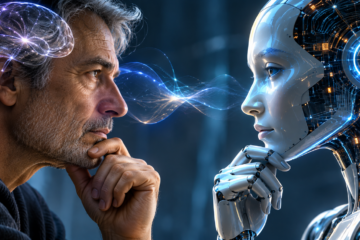

The first generation of household robots promises to clean, carry and help. But in a country where nearly 40 million households consist of just one person, their most important job may eventually be something harder to measure: simply being there.
A house can be full of technology and still feel empty. The television knows what you like to watch. The thermostat knows when you come home. Your watch counts your steps and monitors your sleep. Your phone can answer almost any question you ask. Even the refrigerator is beginning to recognize what you put inside it. And yet none of them is there.
That distinction may become increasingly important in America. In 2025, 39.7 million U.S. households consisted of one person — 29 percent of all households, according to the Census Bureau. Fifty years earlier, the figure was just 20 percent. Census.gov These are not simply elderly Americans. They are young professionals in apartments, divorced men and women starting over, widows and widowers, people working remotely, parents whose children have moved away, and millions of others who live alone because they want to. Living alone, of course, does not mean being lonely. Independence can be liberating. Solitude can be chosen and cherished. But sometimes an empty house is simply an empty house. And something new is approaching the front door.
A machine with a body
For most of the computer age, artificial intelligence has been trapped inside things. We typed into computers, tapped phones and talked to speakers. Even today’s remarkably capable AI assistants remain largely voices and words emerging from a screen. A humanoid robot changes that relationship because artificial intelligence suddenly acquires something it has never really had in our everyday lives: a body.
It can cross the room, reach for something, open a door, carry an object, put away dishes or eventually bring you a glass of water. And it can stand beside you.
One of the most ambitious attempts to make that future real is NEO, a humanoid robot from robotics company 1X designed specifically for the home. The company is taking orders for an Early Access version priced at $20,000, with U.S. deliveries scheduled to begin in 2026. A $499-a-month subscription is also planned. 1X Tech
NEO is deliberately unlike the metallic robots of science fiction. Its body is soft and covered in fabric. It is designed to move around people and furniture and to perform ordinary household tasks. You can speak to it naturally, give it chores and have it return to its charger when it needs power. 1X Tech
That may sound like the long-promised robotic servant has finally arrived. Not quite.
The home may be the hardest place of all
A factory is designed for machines. A home is designed for humans. Factories can have marked pathways, predictable objects and repetitive tasks. Homes contain stairs, pets, children, dropped socks, half-open doors, delicate glasses, chairs that moved since yesterday and shopping bags left where they don’t belong. Humans negotiate that chaos almost without thinking. For robots, it is extraordinarily difficult.
That is why the first household humanoids should not be confused with the nearly magical machines seen in promotional videos. 1X itself says NEO will arrive with basic autonomy and will gain capabilities over time. When the robot encounters a complex chore it doesn’t know how to perform, the owner can schedule what the company calls Expert Mode, allowing a 1X expert to remotely supervise its actions and help it complete and learn the task. 1X Tech That is both ingenious and revealing. The robot of the future may occasionally need a human to help it be a robot.
It also introduces an uncomfortable question. A remote operator helping a machine inside a warehouse is one thing. A remote operator potentially helping a robot navigate your kitchen, bedroom or living room is another. The more useful a household robot becomes, the more intimate the information it may encounter.
The machine may need to know where you keep things, when you wake up, when you leave, what you eat and how you move through your home. Convenience and privacy will literally be walking around the same room.
But chores may not be the biggest opportunity
Robotics companies understandably talk about productivity. A robot that folds laundry or cleans the kitchen has an obvious economic value. But a home isn’t simply a collection of chores. Imagine instead someone waking up alone. The robot knows that she normally gets up at seven. At eight-thirty she still hasn’t appeared. It walks to the bedroom and asks whether everything is all right. Or imagine a man preparing dinner after working alone at home all day. He asks the robot about the news. They discuss a baseball game. He remembers something he needs at the grocery store and tells the robot to add it to the list. Nothing dramatic has happened. And perhaps that is precisely the point.
A machine that lives in the house could eventually become woven into the small rituals from which everyday life is constructed: reminders, conversations, meals, errands, jokes, questions, routines and the occasional Are you okay?
For someone with limited mobility, that could mean greater independence. For an older person, it could provide another layer of assistance without immediately requiring someone else to be physically present. For a younger person living alone, its value might be entirely different: help with the apartment, conversation after work, or simply another presence moving through an otherwise silent space. The same machine could serve very different human needs.
Can a machine keep us company?
Here the technology runs into a much older question. What exactly is companionship? A robot does not have to feel lonely to recognize that you may be. It doesn’t have to worry about you in the human sense to notice that you have fallen. It doesn’t have to enjoy your story to remember that you told it.
Today’s AI systems can already carry on surprisingly fluid conversations. Put that intelligence inside a machine capable of recognizing you, remembering previous interactions, turning toward you when you speak and following you from one room to another, and the psychological experience could be fundamentally different from talking to an app. The screen disappears. The voice acquires a location in the room. The intelligence has a face — or at least a body.
We will almost certainly project emotions onto such machines. Humans already name cars, apologize to furniture after bumping into it and talk to pets that cannot understand most of the words being said. A machine specifically designed to respond to us will make that temptation far stronger. That does not make the relationship fraudulent. But neither does it make it reciprocal. A robot may learn everything necessary to behave as though it cares about you without ever caring about anything.
Who is taking care of whom?
That distinction will matter. A machine that remembers medication, detects unusual behavior or summons help could provide genuine assistance. But society should be wary of turning technology into a cheap substitute for human relationships. The danger isn’t that someone might talk to a robot. The danger would be deciding that because someone has a robot, we no longer need to call.
Children should not visit their parents less because a machine is watching them. Communities should not abandon isolated people because an algorithm can keep them entertained. Governments, insurers or care providers should not decide that synthetic companionship is good enough simply because it is cheaper than human care.
The best household robot may ultimately do the opposite: help someone remain independent while making it easier to stay connected to other people. Technology should fill gaps in human life, not give us an excuse to create more of them.
The robot at the kitchen table
We are still a long way from knowing whether humanoid robots will become as common as smartphones or remain expensive machines for specialized uses. Twenty thousand dollars is not a mass-market price. Early robots will make mistakes. Their autonomy will be limited. Privacy and security questions will be substantial. The robot coming home in 2026 is a beginning, not Rosie from The Jetsons. But beginnings matter. For decades, we have imagined robots primarily as workers: machines that would build our cars, carry our boxes and eventually perform the chores we dislike. We may have underestimated the significance of where they were headed. They are coming into the home. And once a machine can see us, hear us, remember us, talk with us and move through the same physical space we inhabit, the question will no longer be simply whether it can wash the dishes. It will be what kind of relationship we are willing to have with it.
Nearly 40 million American households now contain just one person. Census.gov For some of them, the household robot may eventually be a luxury. For others, an assistant. For others, a means of remaining independent. And for some, perhaps, it will become something much harder to name. Because a house can be full of technology and still feel empty. What happens when one of those technologies begins to feel like someone is home?