

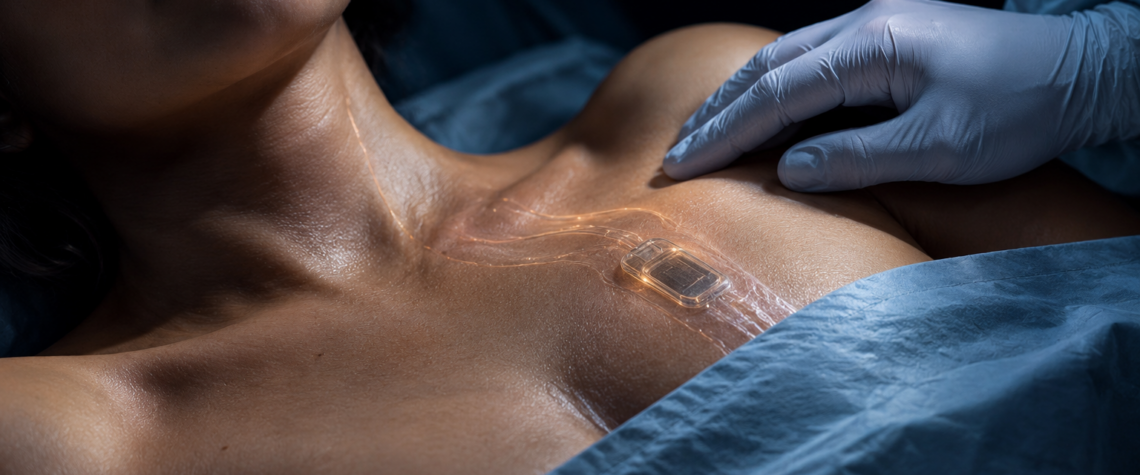
First we carried computers. Then we wore them. Now we are beginning to put them inside our bodies. For most of the digital age, there was a reassuringly simple boundary between humans and technology. We were here. The machine was over there. The computer sat on a desk. Then it moved into our pockets. Later we strapped technology to our wrists, put wireless devices in our ears and began sleeping beside watches that measure our heart rate, temperature and movement. Each step brought the machine closer. The next step crosses the skin.
That may sound like science fiction, but millions of people already live with electronic technology inside their bodies. Pacemakers regulate hearts. Cochlear implants convert sound into electrical signals that stimulate the auditory nerve. Other implanted devices stimulate parts of the nervous system or continuously monitor what is happening inside the body.
What is changing now is the sophistication of those machines — and the intelligence beginning to surround them. The implant of the future may not simply sit inside us and perform one predetermined function. It could sense, collect information, communicate with external systems and eventually use increasingly sophisticated algorithms to help decide when something needs to happen. The distinction between wearing technology and living with technology inside us is beginning to matter.
The computer under your skin
Consider glucose. Most people who monitor glucose continuously use a small sensor attached to the body. But an FDA-cleared system called Eversense 365 takes another approach. A healthcare professional places a tiny sensor beneath the skin, where it can remain for up to a year monitoring glucose. Access Data Think about what that represents.
For decades, learning what was happening inside the body usually required a moment of measurement: a blood sample, an X-ray, an electrocardiogram, a doctor’s examination. Increasingly, medicine can watch. Instead of asking what your glucose was when you pricked your finger at 8 a.m., a sensor can reveal what happened throughout the day. Instead of capturing only isolated snapshots, technology can begin assembling something closer to a continuous story. That shift — from occasional measurement to persistent observation — could become one of the foundations of personalized medicine. And artificial intelligence is particularly suited to finding patterns in enormous streams of information.
The FDA now says more than 1,600 AI-enabled medical devices have been authorized for marketing in the United States. They include systems that help analyze medical images, detect disease and automate insulin dosing using information from continuous glucose monitors. U.S. Food and Drug Administration The important change may therefore not be the implant itself. It may be what happens when the implant begins feeding an intelligent system capable of interpreting what it sees.
When the machine talks to the nervous system
We have already crossed another boundary. A cochlear implant doesn’t merely monitor the human body. It communicates with it. Sound captured outside the body is processed and converted into electrical signals. Electrodes implanted in the inner ear stimulate the auditory nerve. The brain learns to interpret those signals as sound. U.S. Food and Drug Administration Pause over that for a moment. A machine receives information from the world, translates it into electricity and delivers that information directly to the nervous system. For someone who can hear because of it, the distinction between technology and biology is no longer philosophical. It is functional. The machine has become part of the pathway through which the person experiences the world.
And now, the brain
The most dramatic frontier lies several inches higher. Brain-computer interfaces are attempting to create direct communication between neural activity and machines.
Neuralink currently lists active clinical trials investigating whether people with quadriplegia can control computers and robotic arms through thought, and whether neural signals can be decoded to help people with severe speech impairment communicate. These are clinical experiments, not consumer products. Neuralink
Synchron is pursuing the same broad frontier through a very different approach. Its Stentrode interface is delivered through a blood vessel rather than requiring open brain surgery. The company is studying whether people with severe paralysis can use the system to control digital devices. Synchron explicitly cautions that the device remains investigational and that its clinical benefit has not yet been established. Synchron
That distinction matters enormously. A demonstration of someone moving a cursor with neural signals does not mean healthy consumers will soon be lining up to have computer interfaces implanted in their brains.
The medical justification for undergoing an invasive procedure to restore a lost ability is very different from undergoing one simply to acquire a new ability. But history suggests that the boundary between restoration and enhancement will eventually become difficult to ignore. If a device can restore communication, could a future version make communication faster? If an implant can restore hearing, could another eventually extend what we hear? If a brain interface can control a computer for someone unable to move, what happens if someday a healthy person wants the same connection? We are not there. But we can already see the question approaching.
Your body is becoming data
There is another consequence that may arrive sooner. A device inside the body can potentially generate some of the most intimate information a person possesses. Heart rhythms. Glucose levels. Movement. Sleep. Neural signals. Perhaps eventually biochemical changes that reveal disease before symptoms appear. That information could transform medicine.
A doctor who sees you for fifteen minutes every six months has a limited window into your health. A system receiving physiological information continuously could potentially detect changes long before either you or your doctor noticed them. But continuous knowledge creates continuous questions. Who owns that information? Where is it stored? Can the company that made the implant see it? Can an insurer obtain it? What happens when the company stops supporting the device? Can its software be updated? Can it be hacked? And perhaps the strangest question of all: what happens when a piece of your body depends on a company whose product may someday become obsolete? We are accustomed to replacing phones. Replacing technology inside ourselves is a different proposition.
Repair first. Enhancement later?
The strongest case for implantable technology is also the least controversial: restoring something disease or injury has taken away. Help someone hear. Allow someone with paralysis to communicate. Monitor a dangerous medical condition. Restore movement or regulate an organ. Few technological achievements are more profoundly human than giving someone back an ability they have lost. Enhancement is more complicated.
If technology eventually becomes capable not merely of restoring ordinary human function but extending it, society will confront questions medicine has rarely had to answer. Who gets enhanced? Who pays? Does refusing enhancement eventually become a disadvantage? Could employers prefer workers capable of interacting more directly with machines? Would wealthy people acquire abilities unavailable to everyone else? And at what point does a medical device become an upgrade? Those questions remain largely hypothetical today. They should remain labeled as such. But the technologies forcing us to ask them are no longer hypothetical. They are being implanted.
The disappearing boundary
For years we imagined the relationship between humans and computers as a conversation between two separate things. We asked. The computer answered. Then computers began watching our movements through phones and wearables. Medical devices began monitoring our bodies. Implants began communicating directly with nerves. Experimental interfaces are now learning to interpret signals from the brain. The distance keeps shrinking. This does not mean humanity is about to merge with machines. The body is extraordinarily complicated, surgery carries risk, medical devices require rigorous testing, and many spectacular laboratory demonstrations never become practical products. But direction matters.
The computer moved from the room to the desk. From the desk to the pocket. From the pocket to the wrist. And now, cautiously and for compelling medical reasons, it is beginning to cross the final few millimeters. The skin. Perhaps the most important question will not be whether technology can enter the human body. It already has. The question will be what we allow it to become once it is there. When technology becomes part of the body, where does the machine end and the human begin?






