

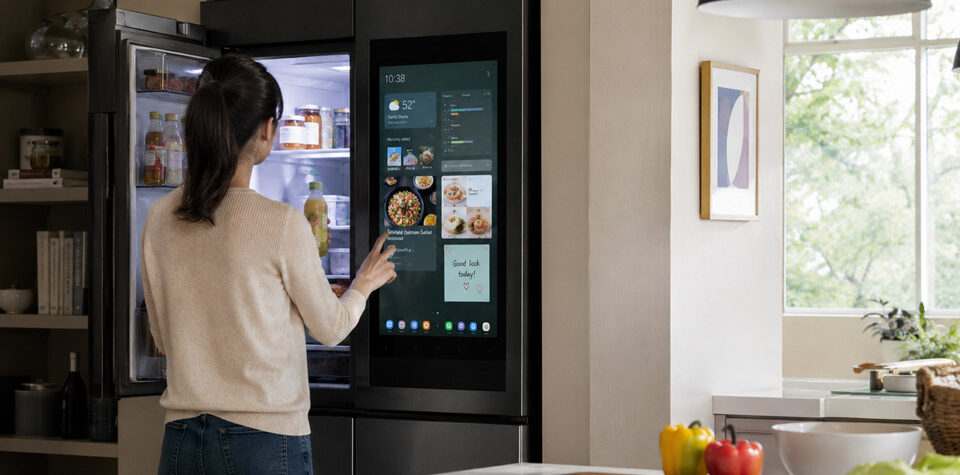
Samsung’s latest refrigerators can recognize food, suggest what to eat and gain new abilities through software updates. Then a faulty update caused some refrigerators in South Korea to stop cooling. Welcome to the strange new world of the computerized appliance.
A refrigerator has one job that matters more than all the others. It has to keep the food cold. For more than a century, manufacturers have improved the refrigerator by making it quieter, more efficient, more spacious and more reliable. But the basic bargain between the appliance and its owner remained remarkably simple: plug it in, put food inside and expect it to keep working. Samsung has a considerably more ambitious idea for what a refrigerator should be.
Its latest Bespoke AI refrigerators can include cameras, large touchscreens, voice control, internet connectivity and artificial intelligence capable of recognizing some of the food placed inside. Samsung’s AI Vision technology, now enhanced on compatible models with Google Gemini, is designed to identify a wider variety of fresh and packaged foods and help users manage what they have available. The refrigerator is becoming something else. Part appliance. Part computer. Part household assistant. And on September 22, some Samsung customers in South Korea discovered what happens when the computer part has a bad day.
The day the refrigerator got an update
Owners of some Samsung Bespoke AI refrigerators began reporting that their appliances had stopped functioning after receiving a software update through Samsung’s SmartThings platform.
Some refrigerators went offline. Displays became stuck on an update message. More seriously, some owners reported that refrigeration itself stopped working and food began to spoil. The timing was particularly unfortunate. The failure occurred immediately before Chuseok, one of South Korea’s major holidays, when households traditionally stock refrigerators with food for family gatherings. Samsung service centers received hundreds of cases, according to Korean reporting cited by Ars Technica.
Samsung acknowledged the problem and said it resulted from an error during internal testing related to a refrigerator software update. The company stopped the testing, activated an emergency response and dispatched service personnel. There is an important limitation to this story: Samsung said the incident was confined to South Korea and that it had identified no impact in overseas markets. This was not evidence that Samsung’s AI refrigerators everywhere suddenly became unreliable. But it demonstrated something much more interesting. A software problem could now interfere with one of the most basic functions of a household appliance.
Two weeks earlier, Samsung had told a very different story
The irony is difficult to miss. On September 7 — roughly two weeks before the incident — Samsung announced major AI-focused software updates for selected refrigerators and laundry appliances.
The company’s argument was compelling. We keep major appliances for years, so why should their capabilities remain frozen on the day we buy them? Samsung said selected Family Hub refrigerators produced between 2021 and 2025 would receive newer AI capabilities, including improved AI Vision powered by Google Gemini. Compatible refrigerators could become better at recognizing food, while software features such as Bixby and personalized information services could also improve over time.
Earlier in the year, Samsung executive Jeong Seung Moon had summarized the philosophy neatly: the value of a home appliance shouldn’t be fixed at the moment it is purchased; it should grow as technology evolves.There is a lot to like about that idea.
Your five-year-old refrigerator shouldn’t necessarily need to be replaced simply because this year’s model has better software. If an update can give an existing appliance new capabilities, extending its useful life instead of encouraging another purchase, that can be good for consumers and potentially good for the environment. But September demonstrated the other side of the proposition. If software can improve your refrigerator after you buy it, software can also break something that wasn’t broken before.
What does AI actually do in a refrigerator?
This is the question that matters for WORTH IT?. Forget the letters AI on the advertising for a moment. What does the intelligence actually do for you? Samsung’s Family Hub models provide some genuinely interesting answers.
Built-in cameras can help identify food entering and leaving the refrigerator. AI Vision can help maintain an inventory of what’s inside, while the system can assist with meal planning and recipes. Samsung has expanded the technology with Google Gemini so compatible refrigerators can recognize a broader range of fresh, packaged, branded and region-specific foods.
The large Family Hub screen can also function as a household information center, displaying calendars, reminders and personalized information. Bixby provides voice interaction, while Samsung’s SmartThings ecosystem connects the refrigerator to other compatible devices around the home.
None of those things is inherently frivolous. A family that regularly throws away forgotten food might find inventory assistance genuinely useful. Someone planning dinner could appreciate a refrigerator that knows roughly what’s available. Accessibility features and voice controls can make appliances easier to use. The mistake would be assuming that something becomes valuable merely because AI has been added to it.
The refrigerator now has an operating system
Here is where smart appliances differ fundamentally from the machines they replace. A traditional refrigerator contains sophisticated electronics, but the consumer generally doesn’t think about its software. A connected smart refrigerator increasingly resembles another computer on the home network.
It can have an operating system. An internet connection. User accounts. Apps. Cloud services. Software updates. Security patches. Compatibility requirements. And eventually, software that may no longer be supported. Samsung’s current update program illustrates both sides of that transformation. Its September rollout of Tizen 10.0 was specifically designed to bring newer capabilities to older compatible appliances. That’s impressive. But it introduces a question that rarely appeared when our parents bought refrigerators: How long will the software last? A smartphone might be replaced after several years. A refrigerator is different. Consumers reasonably expect an expensive kitchen appliance to remain useful for much longer. The compressor may be perfectly healthy ten years from now. Will its software be?
Reliability has a new meaning
For generations, appliance reliability was primarily mechanical. Does the compressor work? Does the door seal properly? Does the thermostat maintain the correct temperature? Those questions haven’t disappeared. We have simply added new ones.
Can the appliance connect to the network? Is its software secure? Will the manufacturer continue updating it? What happens if a cloud service disappears? Can the appliance still perform its essential functions when the internet is unavailable? And can a faulty update interfere with those functions? The Samsung incident makes the last question particularly important. A smart feature failing is annoying. Cooling failing is different. The smartest refrigerator in the world is a terrible refrigerator if the milk gets warm.
Then there is privacy
The more intelligence we put into appliances, the more information they may need in order to provide personalized services. A refrigerator that helps manage food needs information about what’s inside. A household assistant may connect to calendars or accounts. Voice features process commands. Smart-home platforms connect multiple devices and can create a detailed picture of how a household operates. That doesn’t automatically make smart appliances dangerous. Nor does it mean consumers should reject them. It means privacy belongs in the purchasing decision.
When evaluating a connected appliance, consumers should ask what information it collects, whether cloud services are required, which features can be disabled and whether the appliance’s basic functions continue working without those services. Those questions are becoming as legitimate as asking about capacity or energy consumption.
The smartest appliance may be the simpler one
There is a temptation in consumer technology to assume that more capability automatically means a better product. It doesn’t. The right question isn’t whether AI can be put into a refrigerator. Clearly, it can. The question is whether the additional intelligence solves a problem you actually have.
If you routinely forget what food you bought, enjoy connected-home automation, use meal-planning features and want a kitchen information center, an AI refrigerator may provide real value.
If what you want is a reliable box that keeps vegetables cold and ice cream frozen, paying for a giant screen, cameras, AI recognition and connected services may solve problems you never had. There is nothing technologically backward about choosing the simpler appliance. Sometimes simplicity is a feature.
So, is the AI refrigerator worth it?
For some households, absolutely. Samsung’s vision of an appliance that improves after purchase is genuinely appealing. The ability to add useful features to hardware people already own could be considerably better than forcing consumers to replace expensive appliances whenever technology advances. But the September incident exposed the bargain hidden inside that vision. When we allow software to become part of an appliance, we inherit the advantages of software and the problems of software. New features can arrive overnight. So can bugs.
The lesson isn’t that Samsung shouldn’t put AI into refrigerators or that consumers shouldn’t buy them. It is that we need a different standard for judging smart appliances. Before buying one, don’t merely ask: What can this refrigerator do? Ask another question: What happens when the smart part stops working? Because however intelligent our kitchens become, there are some things that should remain wonderfully, reassuringly dumb. The refrigerator still has to keep the food cold.






