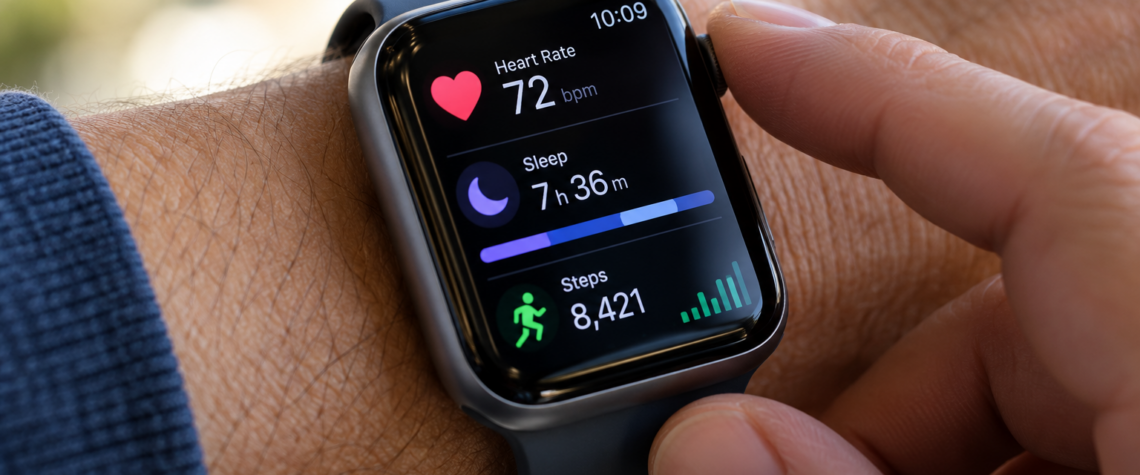
Smartwatches can track your heart rate, sleep, exercise and more. But knowing what those numbers mean—and what they don’t—is becoming an essential digital health skill.
A few years ago, a watch told you what time it was. Today, it may tell you how many steps you walked, how well you slept, how fast your heart is beating and whether you should stand up and move. Some devices can even alert users to unusual heart rhythms or changes in certain health measurements. That can make the small computer on your wrist feel remarkably close to a medical device. But there is an important distinction: Your smartwatch can collect information about your body. That doesn’t mean it understands your health.
A stream of information
Wearable devices have made something possible that once required specialized equipment: collecting information about our bodies throughout ordinary daily life. Instead of measuring your heart rate once during a doctor’s appointment, for example, a smartwatch may collect measurements while you are walking, sleeping, exercising or sitting at your desk. Over time, those measurements can reveal patterns, and patterns can be useful.
A person trying to become more active may discover how little they actually move during the day. Someone trying to improve their sleep may begin noticing connections between bedtime habits and sleep patterns. The value may not be any single number.It may be what changes over time.
The danger of the number
There is another side to having so much information. A number on a screen can look more authoritative than it really is. Consumer wearables operate under real-world conditions: the device may move on your wrist, fit imperfectly or encounter other factors that affect measurements. And some measurements or health features are more clinically meaningful than others. That means a surprising reading should not automatically become a diagnosis. Nor should a reassuring reading automatically mean that everything is fine. Data is not the same thing as diagnosis.
When the watch notices something
This may be where wearables become most interesting. A device that accompanies you every day may sometimes notice a change you hadn’t noticed yourself. That information can become useful when it leads to a better question: Is this normal for me? Has something changed? Should I discuss this with my doctor? The watch does not need to replace the doctor to be valuable. It may simply help start a conversation.
Your health data has value
There is another question that receives much less attention:
Where does all this information go?
Sleep schedules, exercise habits, heart-rate information and other measurements can create an unusually intimate picture of a person’s life. Before enabling every available health feature, consumers should understand what information is being collected, where it is stored, whether it is backed up to the cloud and what privacy controls are available. Digital health isn’t only about measuring ourselves. It is also about deciding who else gets to see the measurements.
The smartest health feature may be perspective
Wearable technology can encourage us to move more, pay attention to sleep and notice changes in our bodies. Those are meaningful benefits. But perhaps the healthiest relationship with a smartwatch begins by understanding what the device actually is.
It is a sensor.
It is a recorder.
It is increasingly an intelligent assistant.
But it is not a physician.
Your smartwatch can tell you a great deal about what your body is doing. Understanding what that information means is still a human responsibility.