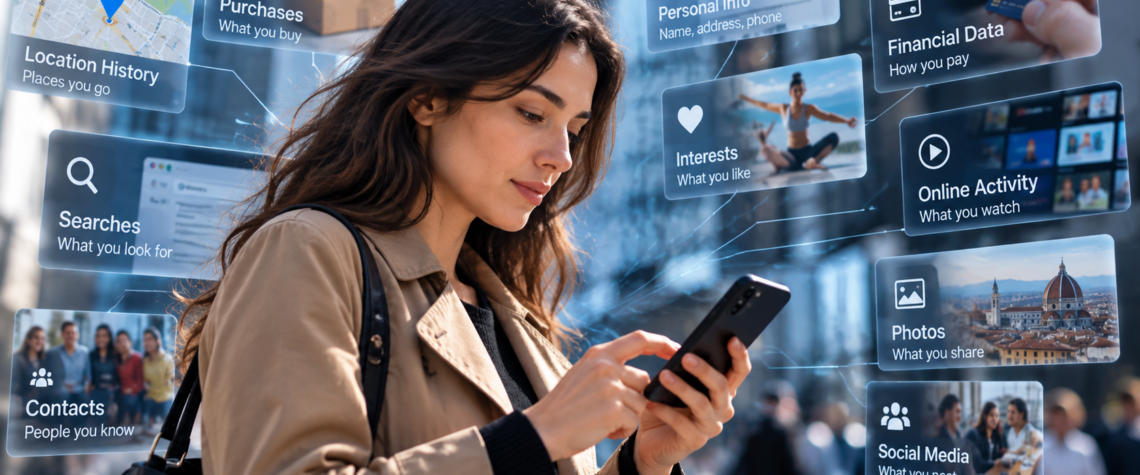
Your address. Your purchases. Your searches. Your location history. Your interests. Perhaps even the names of your relatives. After decades of living online, pieces of our personal lives are scattered across hundreds of companies and databases. Getting all of that information back may be impossible. Regaining some control over it is not.
You probably don’t remember giving away most of your personal information. There was no single moment when you sat down and decided that dozens—or perhaps hundreds—of companies should know pieces of your life. Instead, it happened gradually. You created an email account, downloaded an app, bought something online, joined a social network, signed up for a loyalty program, subscribed to a streaming service, searched for a house, booked a hotel and allowed a weather app to know where you were.
Each exchange seemed small. Taken together, they created something much larger: a digital portrait of you.
That portrait can include obvious information such as your name, address and telephone number, but also information you may rarely think about: what you buy, what websites you visit, which advertisements interest you, what device you use, where you go and what subjects repeatedly attract your attention. No single company necessarily knows everything. The problem is that your information doesn’t stay neatly in one place.
You Leave a Trail Without Thinking About It
Consider an ordinary Saturday. You check the weather on your phone. Search for a restaurant. Drive there using a navigation app. Pay with a credit card. Take a photograph. Post it on social media. Stop at a pharmacy on the way home and later browse online for a new television. To you, that was simply Saturday. To the digital world, it may have generated a series of data points. Some information is necessary for services to work. A navigation app obviously needs to know where you are if you want directions. A retailer needs an address if you ask it to deliver a package. But information collected for one purpose can sometimes acquire value for another. Data can be analyzed to infer interests, categorize consumers, personalize advertising, detect fraud or predict what someone may be likely to do next. The important distinction is between what you knowingly provide and what can be inferred from it. You may never tell a company, “I’m thinking about buying a house.” But your searches, visits to real-estate sites and mortgage calculations might tell a story anyway.
Then There Are the Companies You’ve Never Heard Of
The privacy problem becomes more difficult because some companies that handle information about consumers have no direct relationship with those consumers. The data-broker industry collects, combines and sells or shares information from numerous sources. Depending on the company and the data involved, those sources can include public records, commercial transactions, online activity and information obtained from other businesses. That means a company you have never visited may possess information about you. And you may have no idea what it has.
This is one of the fundamental asymmetries of the modern data economy. Consumers can often see the information they deliberately entered into an account. They have much less visibility into the profiles, categories and inferences that may have been constructed elsewhere. Artificial intelligence makes this issue even more important because its power lies partly in finding patterns among enormous quantities of information. Individual pieces of data that appear insignificant can become more revealing when they are combined. The danger isn’t always that someone possesses one extraordinary secret about you. It is that ordinary information, assembled together, can become extraordinary.
Data Breaches Changed the Equation
There is another reason to care about how much information exists about us: companies lose it. Large data breaches have exposed names, email addresses, passwords, Social Security numbers and other personal information belonging to millions of people. Once stolen information escapes into criminal marketplaces, consumers cannot simply change all of it. You can change a password. You cannot easily change your date of birth. And changing your Social Security number is nothing like replacing a compromised credit card.
This is why cybersecurity and privacy increasingly overlap. Information originally collected for legitimate purposes can become raw material for fraud after a breach. It can also make scams more convincing. A criminal who knows your name, address, bank or relatives does not necessarily know you personally. The information may simply have been purchased, stolen or assembled from several sources. As we saw with The New Scams That Know Your Name, an accurate personal detail can be the ingredient that makes the lie believable.
Can You Delete Yourself From the Internet?
Not completely. That may be the most useful place to begin because promises to make someone “disappear” from the internet should be treated skeptically. Public records exist. News archives exist. Companies have legitimate reasons—and sometimes legal obligations—to retain certain records. Information can also be copied from one database to another before you ever request its deletion. But “I can’t delete everything” does not mean “I can’t do anything.”
You can reduce the amount of unnecessary information you expose. You can close accounts you no longer use. You can review privacy permissions on the services you keep. You can remove applications that no longer need access to your information and restrict permissions that are unnecessary for an app’s purpose. Depending on where you live and the company involved, you may also have legal rights to request access to, deletion of or restrictions on certain uses of personal information. And some data brokers provide mechanisms for consumers to opt out of certain forms of collection or sale. None of these steps makes you invisible. The objective is not invisibility. It is reducing unnecessary exposure.
Start With Your Phone
If you want to understand how much information you are sharing, your smartphone is an excellent place to begin. Look at which applications have permission to access your location. Then your contacts. Then your photographs, microphone and camera. The results may surprise you. Some permissions make obvious sense. A video-call application needs your camera and microphone when you’re making a call. A mapping application needs your location when you’re asking for directions. But does every application need permanent access? Modern phones increasingly allow users to grant permissions only while an app is being used, provide an approximate rather than precise location, or deny access altogether. Those controls are valuable because privacy does not always require deleting an application. Sometimes it simply means giving that application only the information necessary to perform the job you want it to perform. That is a useful principle far beyond the smartphone.
Free Is Often an Exchange
We have become accustomed to receiving extraordinarily sophisticated digital services without paying money for them directly. Search. Email. Social networking. Maps. Video. Storage. News. Games. But “free” does not necessarily mean there is no exchange taking place. Advertising-supported services may derive value from understanding their audiences well enough to target advertising effectively. Other businesses may use data to personalize products, improve services, measure behavior or develop new features. That does not automatically make those services bad. Many provide enormous value. The important thing is understanding the bargain. If an application wants access to your contacts, location, photographs and microphone, ask why. If the answer is obvious and necessary, perhaps the exchange makes sense. If you cannot understand why the application needs the information, that is a reason to hesitate.
AI Raises the Stakes
Artificial intelligence changes privacy because it can make existing information more useful. A database containing thousands of disconnected facts is one thing. A system capable of analyzing those facts, finding relationships among them and generating predictions is another. AI can potentially infer preferences and patterns that a person never explicitly disclosed. It can summarize enormous collections of information quickly and make personalization far more sophisticated. That creates useful services. It can also create a world in which organizations know increasingly more about individuals while individuals know remarkably little about what organizations know about them. The question therefore isn’t simply, “What information did I give them?” It is increasingly: “What can they figure out from the information I gave them?”
Take Back What Control You Can
Privacy in 2026 is unlikely to mean keeping all personal information private. Modern life simply doesn’t work that way. A more realistic goal is control. Know which companies hold your most sensitive information. Use strong security on those accounts. Delete accounts you no longer need. Review app permissions periodically. Be cautious about questionnaires, quizzes and services asking for personal information without a clear reason. Think before posting information publicly that could help someone impersonate you. And when a company gives you meaningful privacy choices, use them. None of these actions will erase your digital footprint. But collectively they change your relationship with it. For years, the default behavior of the internet encouraged us to click Accept, create the account and continue. Perhaps the next stage of digital literacy begins with a different habit: Before you give away another piece of yourself, ask who wants it—and why.