Artificial intelligence can solve equations in seconds. But if machines can do the calculations, why should students still spend years learning mathematics? The answer goes far beyond numbers.
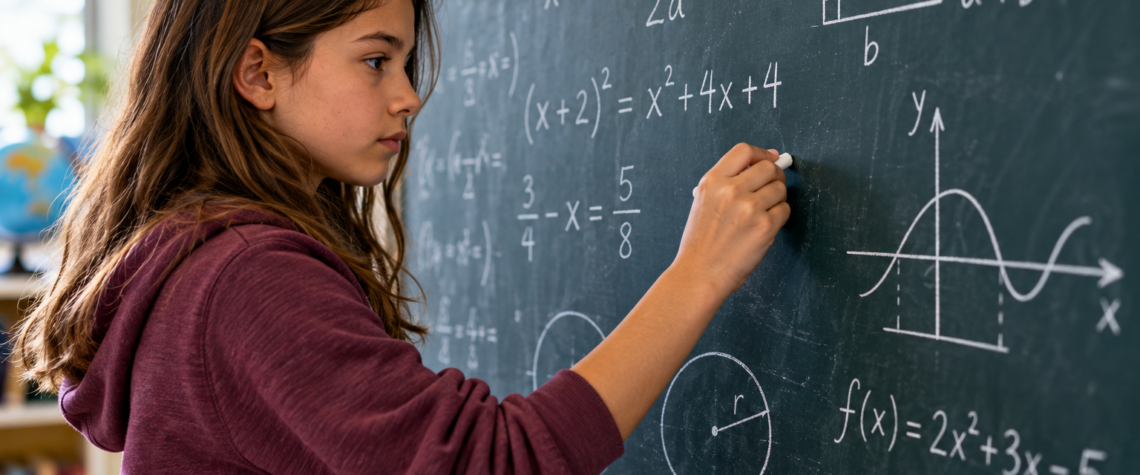
Imagine a high school student struggling with an algebra problem. Instead of spending twenty minutes working through the equation, she photographs it with her smartphone and asks an AI assistant for help. Within seconds, the screen displays an answer, complete with an explanation of the steps involved.
The assignment is finished. But has the student learned anything? That question is becoming increasingly important as artificial intelligence enters classrooms, homes, and workplaces. AI-powered tools can solve mathematical problems, generate graphs, explain formulas, and help analyze complex information. Some can perform calculations that would take a human hours or even days.
Yet the growing power of these systems raises a paradox: the more mathematics computers can do for us, the more important it may become to understand what they are doing. The reason is simple. Mathematics is not merely a collection of calculations. It is a way of thinking.
Mathematics Is More Than Getting the Right Answer
For many students, mathematics means memorizing formulas, performing calculations, and passing examinations. But beneath those activities lies a much broader intellectual discipline. Mathematics teaches people to recognize patterns, identify relationships, construct logical arguments, and evaluate whether a conclusion follows from the available evidence.
Consider a simple everyday situation. A store advertises a 30 percent discount, followed by an additional 20 percent reduction at checkout. Some shoppers might assume they are receiving a total discount of 50 percent. They are not. On a $100 item, the first discount reduces the price to $70. The second removes 20 percent of that remaining amount, bringing the final price to $56. The combined discount is 44 percent.
An AI assistant can calculate that instantly. But someone who understands percentages can recognize why adding the two discounts is misleading. That ability matters in shopping, borrowing money, evaluating investments, interpreting medical statistics, and making countless other decisions. Mathematics gives people the means to question an answer rather than simply accept it.
The Danger of Letting AI Do All the Thinking
The educational risk is not that students will use AI. It is that they may begin using it as a substitute for learning. A student who copies an AI-generated solution may receive a good grade without understanding the problem. Repeated often enough, this practice can create the appearance of academic progress while weakening the skills education is supposed to develop.
The OECD’s Digital Education Outlook 2026 warns that general-purpose AI tools can improve the quality of students’ completed assignments without necessarily producing lasting learning gains. In some studies examined by the organization, students who performed better with AI assistance lost that advantage when the technology was unavailable.
The distinction is critical. Completing an assignment and developing a skill are not the same thing. Learning requires mental effort. Students must attempt problems, make mistakes, examine their reasoning, and gradually become capable of working independently. AI can support that process, but it should not eliminate it.
Understanding a World Built on Algorithms
Mathematics is also becoming more important because algorithms increasingly influence everyday life. Banks use statistical models to evaluate credit applications. Insurance companies analyze risk. Hospitals rely on medical data to help guide decisions. Businesses use forecasting systems to anticipate demand and manage inventory. Artificial intelligence expands the reach of these mathematical methods.
A person does not need to become a software engineer to understand every technical detail. But a basic knowledge of probability, statistics, percentages, and data interpretation can help people recognize misleading claims and ask better questions. Suppose an AI-powered medical system reports that a particular treatment has an 80 percent success rate. Does that mean it will work for every patient? How was success defined? How many people participated in the study? Were the results similar across different age groups? Those questions require statistical understanding as much as technological knowledge. Without it, sophisticated numerical predictions can appear more certain than they really are.
Can AI Become a Better Math Tutor?
Used thoughtfully, artificial intelligence could make mathematics more accessible. Students who are reluctant to raise their hands in class can ask an AI tutor to explain a concept repeatedly, using different examples and levels of difficulty. A child struggling with fractions might benefit from visual demonstrations. A teenager studying algebra could ask for additional practice problems. An adult returning to education could review mathematical concepts forgotten years earlier.
AI tutoring systems can also be designed to guide students through questions instead of immediately supplying answers. That approach is promising, although the research is still developing. In a two-year experiment involving 18 middle schools in Tennessee, researchers studied the use of Khan Academy’s AI tutor, Khanmigo, during remedial mathematics sessions. They found modest improvements in achievement, but the gains were similar to those associated with Khan Academy practice without AI assistance.
One important obstacle was student engagement. Many students used the AI tutor only occasionally and did not regularly engage in substantial mathematical conversations. The lesson is that providing access to an AI tutor does not automatically improve education. How students use it matters.
Teachers Still Have a Central Role
A good mathematics teacher does much more than demonstrate how to solve equations. Teachers recognize when students are confused, adapt explanations, encourage persistence, and help children develop confidence in their own reasoning. They also understand that students learn differently. Some need visual examples, others benefit from practical applications, and many require individual encouragement before they feel comfortable attempting difficult problems.
AI can help teachers prepare exercises, identify common mistakes, and provide additional practice materials. But it cannot assume full responsibility for the educational and human relationship between a teacher and a student. UNESCO has called for a human-centered approach to generative AI in education, emphasizing appropriate safeguards, privacy, and meaningful pedagogical uses. The goal should be to give teachers better tools, not to make their judgment unnecessary.
What Should Schools Teach Differently?
The arrival of AI does not mean schools should abandon traditional mathematics. But it does create an opportunity to reconsider how the subject is taught. Students still need arithmetic, algebra, geometry, and mathematical reasoning. They also need stronger abilities to interpret data, evaluate statistical claims, and understand uncertainty.
Instead of concentrating exclusively on whether students can reproduce a procedure, schools can place greater emphasis on whether they understand why the procedure works. A student might be asked to solve a problem independently, compare the result with an AI-generated solution, and explain any differences. Another assignment could involve evaluating a graph produced by an AI tool and identifying misleading scales or unsupported conclusions. These activities would teach mathematics and AI literacy together. The objective is not to compete with machines at performing calculations. It is to develop the intellectual independence needed to use machines responsibly.
Parents Can Help Without Becoming Math Experts
Parents may feel intimidated by today’s mathematics curriculum, especially when their children encounter concepts they have not studied for decades. AI can help families overcome some of those difficulties.
A parent might ask an AI assistant to explain a mathematical concept in simple language, suggest everyday examples, or create practice questions appropriate for a child’s age. For instance: “Explain fractions to a 10-year-old using examples from cooking. Ask one question at a time and do not reveal the answer until the child has tried.” Another useful instruction might be: “My child is struggling with percentages. Help me understand the concept so I can explain it, but don’t complete the homework for us.”
Parents should still check the explanations, follow school policies on AI use, and avoid sharing unnecessary personal information about their children. The most valuable contribution a parent can make is encouraging curiosity and persistence rather than focusing only on correct answers.
Mathematics as a Form of Intellectual Independence
There is a larger issue beneath the debate about mathematics and artificial intelligence. As technology becomes capable of answering more questions, people may become less accustomed to examining how those answers were produced. That dependence carries risks. Someone who understands mathematical reasoning is better equipped to question a financial projection, challenge a misleading statistic, or recognize when an automated recommendation does not make sense.
Mathematics does not guarantee that a person will always make good decisions. But it provides essential tools for evaluating evidence and recognizing uncertainty. In an age when AI-generated answers can appear instantly and confidently, those abilities are increasingly valuable.
The future does not require every student to become a mathematician. It does require citizens who can think critically about the numerical information shaping their lives. Artificial intelligence may eventually solve almost every calculation we encounter. Understanding which calculations matter, whether their assumptions are reasonable, and what their answers actually mean will remain a profoundly human responsibility.
Sources: