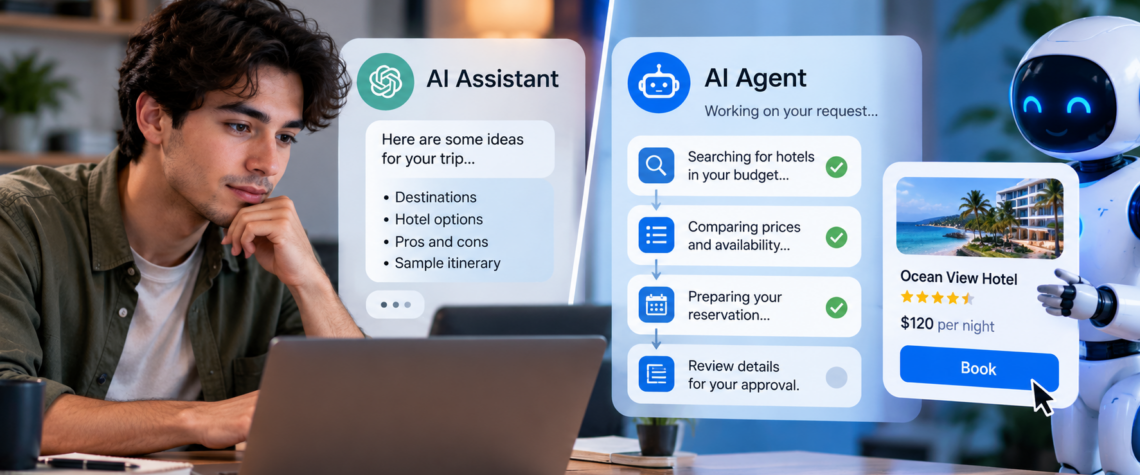
Both use artificial intelligence to make everyday tasks easier. But one primarily helps you do the work, while the other can take action on your behalf.
You have probably used an AI assistant without thinking much about what to call it. Ask ChatGPT to explain a medical term, summarize a document, translate a paragraph, or help write an email, and you are using artificial intelligence as an assistant. But a new category of technology is becoming increasingly important: AI agents.
The distinction may sound technical, but it is actually quite simple. An AI assistant generally responds to your requests and helps you complete tasks. An AI agent can go further, carrying out multiple steps toward a goal, sometimes with limited supervision.
An Assistant Helps. An Agent Acts.
Imagine you are planning a vacation. You ask an AI assistant to recommend destinations, compare hotel prices, and prepare a five-day itinerary. It gathers information, explains your options, and helps you make decisions. You still handle the reservations yourself.
Now imagine giving an AI agent a different instruction: find a suitable hotel within my budget, compare available rooms, and prepare a reservation for my approval. With access to the appropriate tools and permissions, the agent could search websites, evaluate alternatives, complete forms, and move the process forward without requiring instructions at every step. The assistant helps you plan. The agent can help execute the plan.
What Makes an AI Agent Different?
AI agents combine language understanding with the ability to use software tools, retrieve information, and make intermediate decisions. For example, an agent might organize incoming customer inquiries, identify those requiring urgent attention, draft responses, and update a company’s records. Another could monitor inventory, detect shortages, and prepare purchase orders.
These capabilities are especially promising for small businesses and individuals who spend considerable time on repetitive administrative tasks. But the distinction is not absolute. Modern AI assistants increasingly include agent-like capabilities, and some products combine both approaches.
More Independence, More Responsibility
Giving an AI system permission to act introduces new risks. An assistant that recommends the wrong hotel may inconvenience you. An agent that books the wrong hotel could cost you money.
Agents can misunderstand instructions, encounter misleading information, or make mistakes while interacting with websites and applications. That is why important actions—especially those involving payments, sensitive information, or irreversible decisions—should require clear authorization and, when appropriate, human confirmation. The most useful AI agent is not necessarily the one with the greatest independence. It is the one that can perform useful work while remaining understandable, controllable, and accountable to its user.
The Future Is Both
AI assistants and AI agents are not competing technologies so much as different ways of using artificial intelligence. Sometimes you need a knowledgeable partner to explain something, explore an idea, or help you think. Other times, you need a system capable of completing a task. The simplest distinction is this: an AI assistant helps you decide what to do. An AI agent can help get it done.