

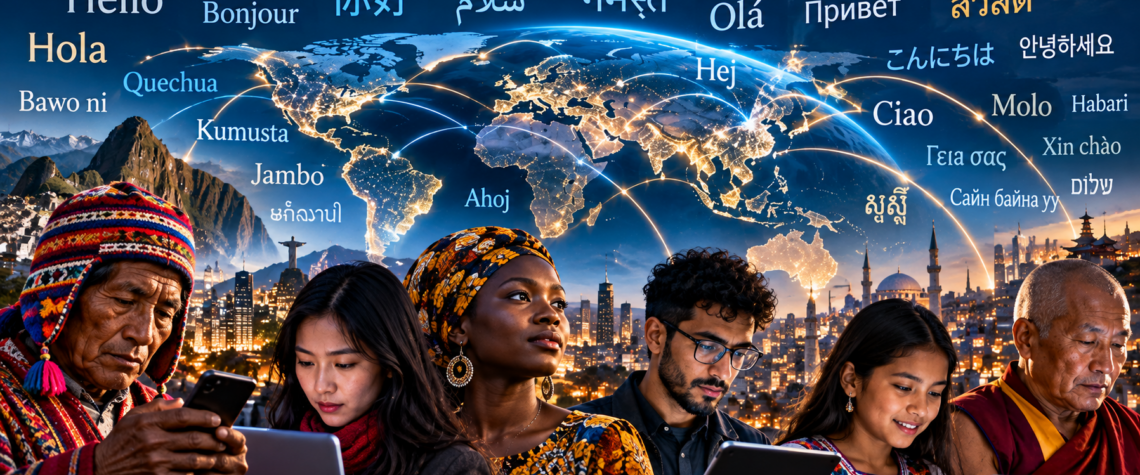
Artificial intelligence is becoming a universal tool for learning, communication, and opportunity. But its linguistic abilities remain profoundly unequal, raising a troubling question: whose knowledge, culture, and identity will be represented in the digital future?
Imagine a farmer in the Andes asking an artificial intelligence assistant about an unfamiliar disease affecting his crops. He speaks Quechua, the language of his family and community. The assistant responds confidently, but its explanation is incomplete, its terminology awkward, and its recommendations potentially misleading. Now imagine another farmer asking the same question in English. The answer is detailed, clearly organized, and supported by extensive information. The difference is not necessarily the intelligence of the farmers or the importance of their questions. It may be the language in which those questions are asked.
Artificial intelligence promises to make knowledge accessible to everyone. Yet the systems driving this revolution do not understand all languages equally. Some can produce sophisticated essays, explanations, and technical instructions in English while struggling to interpret a simple request in a language spoken by millions—or one preserved by only a small community. This imbalance exposes a fundamental contradiction in the AI revolution: a technology designed to expand access to knowledge may also deepen existing linguistic and cultural inequalities.
A World of Thousands of Languages
Humanity speaks more than 7,000 living languages, although the precise count depends on how languages and dialects are classified. Each carries its own history, traditions, expressions, and ways of understanding the world. Some have extensive written literatures and millions of digital documents. Others are transmitted primarily through conversation, storytelling, songs, and community practices.
Artificial intelligence, however, learns much of its linguistic knowledge from enormous collections of digital text. These collections include websites, books, academic publications, online discussions, and other materials. The languages most extensively represented in those sources often receive the greatest benefits from AI development.
English occupies a particularly privileged position. According to Common Crawl, an organization whose web archives are widely used in AI research, English accounted for approximately 42 percent of the HTML pages identified by language in one of its 2026 web crawls. Spanish represented less than 5 percent, while many languages accounted for only tiny fractions of the collection.
These figures describe a particular web archive, not the complete training data of every AI model. Nevertheless, they reveal the enormous imbalance in the digital information available to researchers. For languages with little online material, the challenge is not simply that artificial intelligence has not learned enough words. It may have encountered too little of the culture, history, scientific terminology, and everyday experience expressed through those languages.
Why AI Understands Some Languages Better Than Others
Large language models learn statistical relationships from enormous quantities of text and other data. Through training, they develop the ability to recognize patterns, interpret questions, and generate responses. The amount and quality of available training material can strongly influence performance. English benefits from a vast digital ecosystem of universities, scientific publications, government documents, journalism, literature, and technical resources. Languages with smaller digital footprints face a different situation.
A language may be spoken by millions of people but have relatively few digitized books, educational resources, or searchable websites. In other cases, written material exists but has never been collected or prepared for machine learning. Researchers describe many of these as low-resource languages, meaning that suitable digital datasets and computational tools are limited.
Low-resource does not mean linguistically simple, culturally insignificant, or spoken by few people. It describes the resources available to technology developers, not the value of the language itself. This distinction matters. A language can sustain a rich intellectual tradition for centuries and still be almost invisible to the databases used to train modern artificial intelligence.
When Translation Is Not Understanding
One possible solution appears straightforward: translate everything into a language the AI understands well. But translation is not always equivalent to comprehension. Languages contain idioms, cultural references, humor, metaphors, and concepts that do not transfer neatly from one linguistic system to another. A phrase that carries a particular social meaning in an Indigenous community may become vague or misleading when translated into English.
Traditional knowledge about agriculture, medicine, geography, or community relationships can be especially difficult to interpret without cultural context. AI translation systems may produce grammatically fluent sentences while losing the original meaning. The result can be particularly dangerous when information concerns healthcare, legal rights, education, or public services.
Even when an AI system can generate sentences in a language, that does not establish that it can reason, follow complex instructions, or provide reliable information in that language. These abilities must be evaluated separately.The distinction is essential because linguistic fluency can create an illusion of accuracy. An answer may sound convincing while being wrong.
The Languages of the Americas
Latin America offers a striking example of the challenge. Spanish and Portuguese dominate much of the region’s official administration, higher education, journalism, and digital communication. But the continent is also home to hundreds of Indigenous languages. Quechua and Aymara remain important languages in the Andean region. Guarani is widely spoken in Paraguay and has official status alongside Spanish. Nahuatl, Maya languages, Mapudungun, and many others preserve cultural traditions across the Americas.
Their digital representation varies considerably, as does the quality of available AI tools. Some multilingual translation systems already support languages such as Quechua, Aymara, and Guarani. That is meaningful progress, but inclusion in a language list does not guarantee reliable performance across every dialect, subject, or application.
Consider the consequences for education. A student who speaks an Indigenous language at home may encounter an AI tutor that works exceptionally well in Spanish but provides limited explanations in the student’s first language. The student is not necessarily excluded from using the technology. Instead, the student must adapt linguistically to the technology rather than receiving an equally capable service in the language most familiar to them. Over time, this could reinforce the dominance of already powerful languages in education and public life.
Africa and the Digital Language Divide
Africa presents another major challenge. The continent contains an extraordinary diversity of languages, including widely spoken languages such as Swahili, Hausa, Amharic, Yoruba, Igbo, and many others with smaller digital footprints. For decades, commercial translation technologies concentrated heavily on languages with large markets and extensive online content.
In 2022, Meta introduced its No Language Left Behind project, releasing a translation model designed to support 200 languages, including 55 African languages. The initiative demonstrated that advances in machine learning could expand translation capabilities for languages previously underserved by commercial systems. But translating text between languages is only one dimension of AI accessibility.
A useful AI assistant must also understand local questions, cultural context, regional terminology, and specialized subjects. A farmer asking about rainfall patterns, a teacher preparing classroom material, or a patient seeking health information may require knowledge that is not adequately represented in the underlying training material. The challenge is therefore both linguistic and informational. Teaching AI to recognize a language does not automatically give it an accurate understanding of the world described in that language.
Can AI Help Preserve Endangered Languages?
The relationship between artificial intelligence and linguistic diversity is not entirely negative. AI could become a powerful instrument for preserving languages threatened by declining numbers of speakers. Speech recognition systems can help transcribe oral histories. Digital archives can preserve stories, songs, and traditional expressions. Language-learning applications can assist younger generations in studying the languages of their families.
Researchers are also exploring how machine learning can support dictionaries, educational materials, and translation tools for communities with limited digital resources. These applications offer genuine possibilities, particularly when developed in partnership with native speakers and local institutions. But preservation requires more than collecting words.
Languages are living expressions of community identity. Their meaning depends on the people who speak them and the social relationships in which they are used. An AI project that extracts recordings or texts without meaningful community participation may reproduce the same inequalities it claims to address.
Who authorizes the collection of linguistic data? Who controls access to recordings of traditional knowledge? Can communities decide how their language is represented or whether certain cultural materials should be used for commercial purposes? These questions introduce an important principle: linguistic inclusion should not become another form of data extraction.
Who Owns a Language’s Digital Future?
The growing demand for multilingual AI data creates new economic and ethical questions. Technology companies need text, recordings, translations, and linguistic expertise to improve their systems. Communities possess knowledge that can make those systems more useful. But they may lack the financial resources or negotiating power of the organizations collecting their data. If a company uses recordings from an Indigenous community to develop a profitable language service, should the community receive compensation or continuing access to the technology? Should the community be able to restrict the use of sacred, private, or culturally sensitive material? And who decides whether the resulting system represents the language accurately?
There is no single answer that applies to every community or legal system. However, researchers and Indigenous data-governance advocates increasingly emphasize informed participation, appropriate consent, community oversight, and the ability to share in the benefits of technological development. The objective should be to build AI systems with communities rather than merely collecting information from them.
The Promise of Multilingual AI
Despite these difficulties, progress is accelerating. Researchers have developed techniques that allow AI systems to transfer some linguistic knowledge between languages. Multilingual models can use patterns learned from languages with abundant data to improve performance in languages with fewer resources. Openly available datasets, collaborative research projects, and community-led language initiatives can also reduce barriers.
The development of Meta’s No Language Left Behind system showed that translation coverage could expand substantially beyond the languages traditionally served by commercial technology. Other research has explored ways to extract overlooked linguistic material from existing web archives and adapt language models using comparatively modest computing resources.
These developments suggest that the linguistic imbalance in artificial intelligence is not inevitable. But technological progress alone will not resolve it. Developers must evaluate models in a wider range of languages, work with native speakers, and invest in resources that may not promise immediate commercial returns.
Governments and universities can support language digitization, public-interest research, and educational applications. International institutions can help communities gain access to the tools and expertise needed to participate. Most importantly, speakers of underrepresented languages must have a meaningful role in determining how their linguistic heritage enters the digital world.
The Risk of a New Linguistic Hierarchy
Throughout history, language has influenced access to education, political authority, commerce, and cultural recognition. Artificial intelligence could create a new version of that hierarchy. People who speak languages strongly represented in AI systems may gain faster access to knowledge, professional assistance, educational tools, and economic opportunities. Others may receive less reliable services, depend on translation into dominant languages, or remain excluded from important applications.
The danger is not necessarily that AI will cause smaller languages to disappear. Language survival depends on many social, political, and economic factors. The danger is that AI could strengthen existing pressures by making dominant languages more useful in an increasingly digital society. If the most advanced educational assistants, research tools, and public services work best in a few languages, the incentive to abandon less-supported languages may grow. That would represent more than a technological inconvenience. It would diminish the diversity of human experience reflected in the digital world.
Intelligence Should Not Have a Preferred Language
Artificial intelligence has already demonstrated remarkable linguistic capabilities. It can translate documents, support communication across borders, and make information available to people who might otherwise struggle to access it. These achievements deserve recognition. But the ability to communicate in many languages should not be confused with equal understanding of all of them.
The real measure of progress will not simply be how many languages appear on an AI company’s list of supported features. It will be whether people can use those systems accurately, safely, and meaningfully in the languages through which they understand their lives. A technology that claims to democratize knowledge must confront the inequalities embedded in the information from which it learns.
Every language carries knowledge. Every language represents a human community. And every language deserves consideration in the technological future. Artificial intelligence may eventually learn to speak thousands of languages. The greater challenge is ensuring that it learns to listen to the people who speak them.






