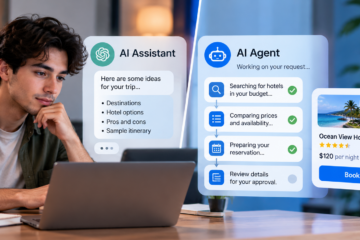
You don’t need to become an AI expert. But learning a few simple skills can make the difference between using artificial intelligence as a novelty and turning it into a genuinely useful tool.
For most people, the arrival of artificial intelligence has created a strange new pressure. Suddenly we’re told we should be using AI at work, at home, in school, to manage information, to write, to research and perhaps even to make decisions. Then comes the intimidating vocabulary: models, agents, tokens, neural networks, prompting, multimodal systems. Fortunately, you don’t need to understand most of that to become good at using AI. Think about the smartphone. Millions of people use one every day without knowing how a cellular network works or how a processor executes instructions. What matters is knowing what the device can do, what it cannot do and how to use it intelligently. AI is beginning to require a similar kind of literacy. Here are seven skills worth learning now.
1. Learn how to explain what you want
The most important AI skill may also be the simplest: learn to give clear instructions. People sometimes approach an AI chatbot as if it were a search engine. They type three or four words:
“Trip to Italy.”
“Help with résumé.”
“Explain Medicare.”
The AI will respond, but it has to guess what the user actually wants.
Instead, provide context.
You might say: “I’m planning a ten-day trip to Italy in October. It will be my first visit. I’m more interested in history and food than nightlife, and I’d rather spend time in three places than rush through six. Help me decide how to divide the trip. “Now the AI has something to work with. You don’t need elaborate formulas or a collection of supposedly magical prompts. You need to explain the problem as clearly as you would explain it to an intelligent assistant who knows nothing about your situation. What are you trying to accomplish? What matters to you? What constraints do you have? What kind of answer would be useful? Better context usually produces a better answer.
2. Learn to continue the conversation
Your first prompt does not have to be perfect. This is one of the biggest differences between conversational AI and traditional search. With a search engine, we often abandon one query and try another. With AI, you can work on the answer. Suppose you ask AI to draft an email and the result sounds too formal. Don’t start over. Say, “Make it warmer and less formal.” Still too long? “Cut it by about a third.” Now something important is missing? “Put the second point back, but explain it in one sentence.” This back-and-forth is one of AI’s most useful capabilities. You can question an answer, challenge it, ask for alternatives and gradually move toward what you need. Learning to use AI well therefore means learning something slightly counterintuitive: don’t expect perfection from the first answer. Treat the first response as the beginning of the work, not the end.
3. Learn to give AI material to work with
AI becomes considerably more useful when it can work with information you provide. Instead of asking, “How can I improve my résumé?” you can give it the résumé and ask it to identify unclear passages. Instead of asking it to explain insurance in general, you can provide the relevant section of a policy and ask what it means in plain English. You can give AI a draft, a photograph, a chart, meeting notes, a spreadsheet or a complicated document and ask it to help you understand or transform the material. But this skill comes with a companion skill: knowing what not to upload. Passwords, financial credentials, confidential company information, private information about other people and unnecessarily identifying medical or legal records deserve particular caution. Before uploading something, consider whether the AI really needs the entire document—or whether a smaller, anonymized portion will do. Using AI intelligently includes deciding what information it needs and what information it doesn’t.
4. Learn to ask for alternatives
AI is often more valuable as a source of possibilities than as a source of a single answer. Imagine that you’re trying to solve a problem at work. Instead of asking: “What should I do?” try: “Give me three possible approaches. Explain the advantages and disadvantages of each.” Or perhaps: “What am I overlooking?” “What would someone who disagrees with this idea say?”“Give me a cheaper alternative.”“What assumptions am I making?”These questions turn AI from an answer machine into a thinking partner.
This can be particularly useful when writing. Ask for five possible headlines rather than one. Ask for three ways to organize an article. Ask for arguments against your own conclusion. You remain the editor. The machine generates possibilities. You decide which ones deserve your attention.
5. Learn to recognize when AI might be wrong
This may be the most important defensive skill. AI can produce a beautifully written answer that is completely incorrect. The danger is not simply that it makes mistakes. Humans make mistakes too. The unusual problem with generative AI is that an incorrect answer can sound just as confident, polished and authoritative as a correct one. That means style cannot be your test for truth. Be particularly careful with specific facts: names, quotations, dates, statistics, medical information, legal requirements, financial rules and current events. Ask for sources, then check those sources yourself when the information matters. If an AI tells you that a government agency has changed a rule, go to the agency’s website. If it attributes a quotation to Mark Twain, verify the quotation. If it summarizes a medical study, find the study or a reliable medical source. The higher the consequences of being wrong, the more important verification becomes. Fluency is not evidence.
6. Learn when AI is the wrong tool
Becoming skilled with AI doesn’t mean using it for everything. Sometimes ordinary search is better because you want the original source. A calculator is better when you simply need arithmetic. A map is better when you need current directions. Your bank’s website is better when you need your actual account balance. And some decisions should remain firmly human.
AI can help you organize questions before visiting a doctor, but it cannot examine you. It can help explain a contract, but important legal decisions may require a lawyer. It can help compare financial options, but it does not know your life well enough to assume responsibility for your money.The smartest AI users will not necessarily be the people who use AI most often.They may be the people who know when not to use it.
7. Learn to keep your own judgment in the loop
There is a subtle danger in using a tool that can produce answers almost instantly: it becomes tempting to stop thinking. Why struggle with a paragraph when AI can write one? Why compare alternatives when AI can recommend one? Why read a long document when AI can summarize it? Convenience is useful. Intellectual passivity isn’t. If you use AI to summarize something important, read the parts that matter. If AI writes something in your name, make sure it actually represents what you believe. If it recommends a course of action, ask why—and consider what information the machine might not have. AI should extend your abilities, not gradually replace them. The final skill, therefore, isn’t really about artificial intelligence at all. It is about maintaining your own curiosity, skepticism and judgment while using a remarkably powerful machine.
You don’t need to master AI
The technology will continue changing. Today’s most popular AI service may not be tomorrow’s. Interfaces will become easier, models will become more capable, and many AI functions will simply disappear into the products we already use. Specific tricks will come and go. These seven skills are more durable because they’re really habits of mind: explain clearly, converse, provide useful context, explore alternatives, verify important claims, choose the right tool and preserve your own judgment. You don’t need to become an AI expert. You need to become an intelligent user. And that may turn out to be the more important skill.