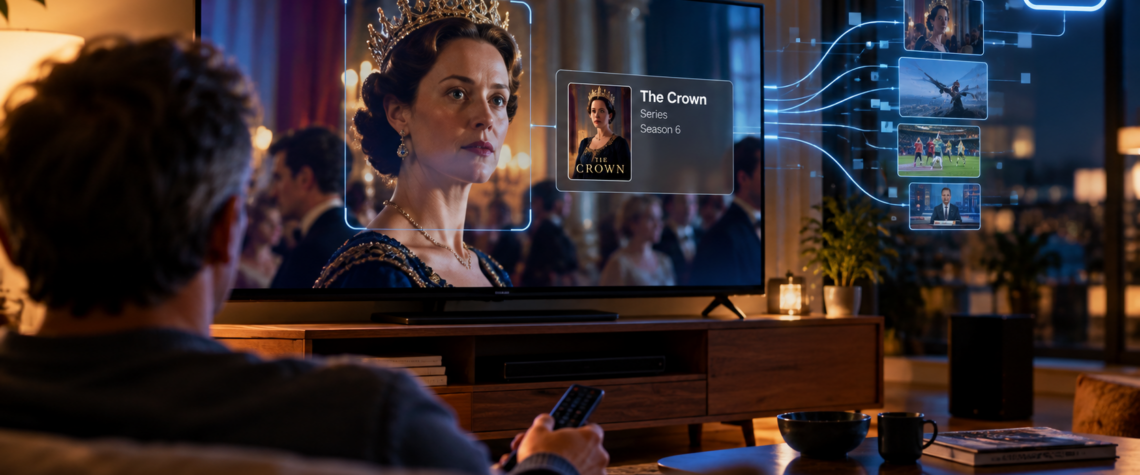
Smart TVs can recommend what to watch, respond to your voice and increasingly use AI to personalize what appears on the screen. But some can also identify what you’re watching. Before buying your next television, there’s a privacy setting you should know about.
For most of television’s history, the relationship between the viewer and the television was remarkably simple. You turned it on. You chose a channel. You watched. The television knew nothing about you. That relationship has changed. Today’s smart TVs connect to the internet, run apps, recommend programs, respond to voice commands and increasingly incorporate artificial intelligence. They can remember what you watched, suggest what you might like next and connect with other devices around your home. Much of that is genuinely useful. But behind some of those conveniences is a technology most television owners have probably never heard of. It is called Automatic Content Recognition, or ACR. And depending on your television and the settings you’ve accepted, it can identify what you’re watching.
Your television can recognize what’s on the screen
ACR is essentially a content-recognition system. Different implementations work differently, but the basic idea is straightforward: the television creates a digital fingerprint from the content being played and compares it with a database to determine what program or other material is being watched. This can provide useful features. A television that understands what you’re watching can offer recommendations, audience information or other personalized services. But the same information has obvious commercial value. Knowing that a household owns a television is one thing. Knowing what that household watches — and potentially when and how often — creates a much more revealing portrait of its interests. That is why ACR has attracted the attention of privacy advocates and regulators.
We have been here before
The privacy issue isn’t hypothetical. In 2017, the Federal Trade Commission and the New Jersey Attorney General reached a $2.2 million settlement with television manufacturer Vizio. Regulators alleged that software installed on approximately 11 million televisions collected detailed viewing information without adequately informing consumers or obtaining proper consent.
According to the FTC, the televisions captured second-by-second information about video displayed on the screen. And it wasn’t limited to programming delivered through the television itself. The system could recognize content arriving from cable and set-top boxes, over-the-air broadcasts, DVDs and streaming devices.
The information could also be combined with demographic data such as age, income, marital status, education and home ownership for advertising and analytics purposes, according to the government’s complaint. Vizio agreed to prominently disclose its practices and obtain affirmative consent before collecting and sharing viewing information. The case established an important principle for the smart-TV era: What you watch can be personal information.
What about LG?
This brings us to a much more recent controversy. LG issued a detailed statement in September 2026 after what the company described as misconceptions in recent media coverage about the privacy practices of its smart TVs.
LG confirms that some of its televisions support ACR. But there is an important distinction between saying that an LG television can recognize viewing activity and saying that LG secretly watches everything its customers watch. According to LG, ACR is optional and turned off by default. A user must accept the company’s Viewing Information Agreement to enable it. Personalized interest-based advertising requires a separate consent.
LG also says its ACR implementation doesn’t take screenshots or make video recordings of what’s appearing on the television. Instead, it uses audio fingerprinting through the television’s internal audio processor to identify supported content. When enabled, the system can recognize content from sources including live television, LG Channels and devices connected through HDMI. LG says its ACR doesn’t operate inside third-party apps such as Netflix or YouTube running directly on the television.
That’s an important distinction. Your television isn’t necessarily making a movie of everything you watch and sending it somewhere. But it may be capable of identifying what you’re watching. For privacy purposes, that can be considerably more important than it sounds.
Where does that information go?
LG says ACR-related information can be used for audience segmentation and analysis of viewing trends. Depending on the market, the agreements accepted by the user and the applicable privacy rules, viewing information may also be shared with LG Ad Solutions, a majority-owned affiliate.
LG goes further in its current disclosure: in some markets and under applicable agreements, ACR-related information may be shared in ways that legally qualify as the “sale” or “sharing” of personal information. That doesn’t mean someone at LG is sitting in an office watching what you’re watching. The reality is more automated — and perhaps more consequential. Your viewing habits can become data. And data can become a product.
Is your television listening to you?
This is where the story can easily become exaggerated. Many smart televisions now contain microphones or work with remotes that contain them. Voice control obviously requires the device to detect speech at some point. But LG says its televisions don’t continuously record or transmit conversations in the home. On televisions supporting hands-free voice commands, wake-word detection occurs locally. According to LG, speech processing begins when the wake word is detected or when the user presses the voice button on the remote. Some supported models also provide a physical switch to disable the television’s built-in microphone. So the more accurate question isn’t: “Is my television secretly recording everything I say?” There is no evidence in LG’s current system that it does. The better question is: “What information have I agreed to let my television collect?” That question is much harder to answer.
The problem with “I Agree”
When you buy a television, you probably want to watch television. You probably don’t want to spend Saturday afternoon studying privacy agreements. During setup, however, smart TVs can present users with multiple terms, permissions and agreements. Faced with a new device they simply want to start using, many people do what we’ve been trained to do throughout the digital world. They click Agree.
LG’s current documentation illustrates why paying attention matters. Its Terms of Use and Privacy Policy are required for smart services such as Netflix and YouTube, but LG says its other agreements are optional and can later be changed in the television’s settings. The distinction between required and optional deserves more attention than it usually receives. You don’t necessarily have to surrender every piece of data a television requests simply because you want to watch The Bear.
Check your television tonight
If you own a smart TV, spend a few minutes exploring its privacy settings. The terminology varies by manufacturer and model, but look for settings or agreements involving Viewing Information, Automatic Content Recognition, viewing data, personalized advertising, interest-based advertising, voice recognition or similar language.
On LG televisions supporting these features, LG says users can review or withdraw optional agreements through the TV settings and can disable ACR. Declining optional agreements does not, according to LG, prevent basic functions such as streaming apps, live television, HDMI devices and software updates from working. Don’t automatically disable everything, either. Some people may genuinely want personalization and recommendations based on viewing habits. Others may decide that the convenience isn’t worth exchanging their viewing information. The important thing is that the decision should be yours.
So, is a smart TV worth it?
For most consumers, yes. Streaming apps, high-quality displays, voice controls, software updates and increasingly sophisticated recommendation systems have made today’s televisions far more capable than the passive screens they replaced. It would be silly to abandon all of those advantages merely because the television connects to the internet. But there is a larger lesson here. We have spent years worrying about what our phones know about us. Now intelligence is spreading into televisions, cars, refrigerators, watches, speakers and other objects around the home.
Every time an ordinary object becomes “smart,” we should ask what intelligence requires in return. What information does it collect? Where does that information go? Who benefits from it? Can we turn the collection off? And will the product still work if we do? Those questions belong on the shopping list alongside screen size, picture quality and price. Because the smartest television isn’t necessarily the one that knows the most about you. It may be the one that lets you decide how much it needs to know.