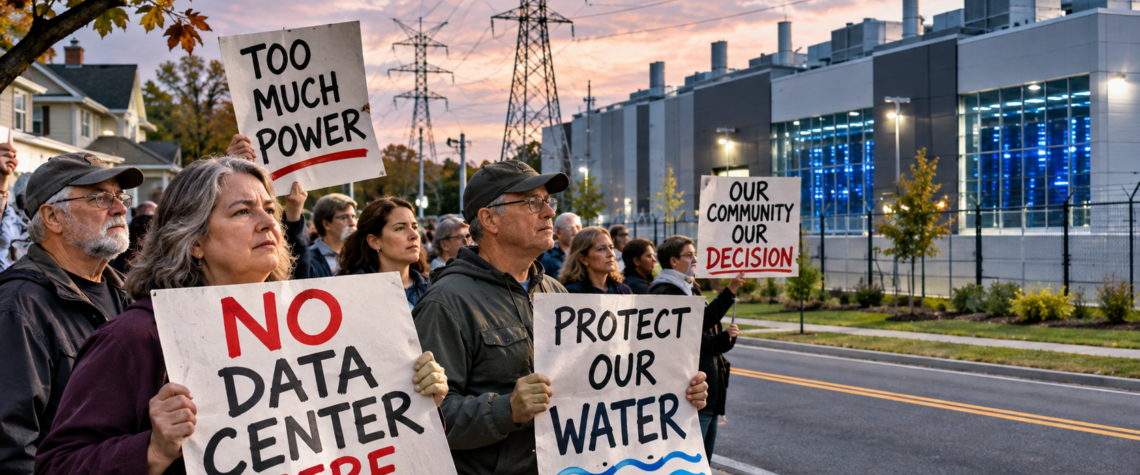
Across the United States, communities are pushing back against the enormous facilities powering artificial intelligence. But can we live without data centers—and who should pay the environmental and economic costs of keeping them running?
Americans are increasingly embracing artificial intelligence in their daily lives. They use it to answer questions, write documents, conduct research, manage businesses, and solve problems. But when the enormous facilities required to power that technology are proposed in their own communities, many voters are delivering a different message: Not here.
In the November 3 elections, communities across the United States voted overwhelmingly to restrict or reject new data center development. The results represented a significant setback for technology companies investing billions of dollars in the infrastructure needed to expand artificial intelligence.
According to Ballotpedia’s November 4 tally, 46 of 47 decided local ballot measures related to data centers during 2026 produced outcomes favoring greater restrictions. The measures included construction bans, temporary moratoriums, additional approval requirements, and advisory votes opposing development.
In Alhambra, California, voters supported a prohibition on data centers by approximately 82 percent. In Edgewater, Florida, roughly 77 percent approved restrictions on new facilities. In Bloomington, Illinois, nearly 78 percent supported an advisory proposal calling for a moratorium on large data centers.
Not every measure was legally binding, and the results do not mean Americans voted to eliminate existing data centers. But they reveal growing public resistance to the rapid expansion of facilities that have become essential to the digital economy.
The question is no longer simply whether artificial intelligence will transform society. It is whether the communities hosting the infrastructure that makes AI possible are willing to accept its costs.
What Do Data Centers Actually Do?
A data center is a building or complex containing large numbers of computers called servers. These machines store information, process calculations, and deliver digital services through the internet.
When someone watches Netflix, accesses a bank account, retrieves photographs from cloud storage, or asks ChatGPT a question, computers operating in data centers may be doing much of the work behind the scenes.
Data centers also support hospitals, universities, government agencies, transportation systems, and countless businesses.
Not all data centers serve the same purpose. Some primarily store information or operate websites. Others handle financial transactions or provide computing services to businesses. The newest facilities designed for artificial intelligence may contain thousands of specialized processors capable of performing the enormous calculations required to train and operate advanced AI models.
These machines consume electricity and generate heat. To prevent overheating, data centers require cooling systems, which may use substantial quantities of water, electricity, or both, depending on their design.
The larger and more powerful the facility, the greater its potential demands on local infrastructure. That is where the conflict begins.
Why Are Communities Saying No?
For residents living near proposed data centers, the debate is not necessarily about whether artificial intelligence is useful. It is about what happens when a massive industrial facility arrives in their community.
Electricity is among the biggest concerns. Large data centers can require substantial power supplies, sometimes demanding new transmission lines, substations, and generating capacity.
Residents worry that the expense of expanding electrical infrastructure could eventually be reflected in higher utility bills.
Water is another concern. Some cooling systems consume significant amounts of water, raising questions about their impact on local supplies, particularly in areas experiencing drought or increasing water demand.
Communities have also raised concerns about noise from cooling equipment and backup generators, the conversion of farmland into industrial developments, construction traffic, and the environmental consequences of additional electricity generation.
Supporters of data center construction argue that these facilities can generate tax revenue, construction employment, and investment in local infrastructure. They also point to the economic importance of keeping the United States competitive in artificial intelligence.
But residents question whether those benefits are distributed fairly.
A large facility may generate substantial economic value for a technology company while creating relatively few permanent jobs compared with its physical size and electricity consumption. The result is a debate over who receives the benefits and who bears the costs.
Can We Eliminate Data Centers?
The short answer is no—not without profoundly disrupting modern life. Eliminating all data centers would affect far more than artificial intelligence.
Many websites would become unavailable. Cloud-based banking services could be interrupted. Hospitals could lose access to remotely hosted records and applications. Businesses and government agencies would struggle to operate systems that depend on remote computing infrastructure.
Email, streaming services, online collaboration tools, and many smartphone applications would also be affected.
Computers and software operating entirely on local devices could continue functioning. But much of today’s interconnected digital economy depends on data centers.
There is, however, an important distinction between eliminating existing facilities and limiting the construction of new ones.
Communities voting against data center development are generally not proposing to shut down the internet. They are challenging the assumption that every proposed facility should be approved simply because demand for computing power is increasing.
And that raises another question: Does the continued development of artificial intelligence necessarily require building more and larger data centers?
Does AI Really Need So Much Computing Power?
Training sophisticated AI models can require enormous computational resources. Operating those models for millions of users also creates substantial demand.
As companies develop more capable systems and incorporate AI into search engines, office software, smartphones, and business applications, demand for computing capacity may continue to grow. But increased demand does not automatically mean that computing infrastructure must expand at the same rate.
Researchers and engineers are developing more efficient AI models that can perform useful tasks with fewer calculations and less energy.
Smaller language models can already run on some personal computers and smartphones, reducing the need to send every request to remote servers.
Other approaches include improving processor efficiency, optimizing software, reusing existing facilities, and scheduling certain computational tasks when electricity is more readily available.
Advanced cooling technologies can also reduce water consumption, although the trade-offs depend on local climate, electricity sources, and system design.
These improvements cannot eliminate the need for large data centers. But they could change how quickly new facilities must be constructed and how much energy they consume.
There is another complication: making AI cheaper and more efficient may encourage more people and businesses to use it, potentially offsetting some of the energy savings. Efficiency alone, therefore, may not resolve the conflict.
Who Should Pay for the AI Revolution?
Perhaps the most consequential issue is financial. When a technology company proposes a large data center, the project may require substantial investment in electrical infrastructure.
New substations, transmission equipment, and generating capacity can be expensive. Depending on local regulations and utility agreements, some costs may be paid directly by the developer, while others may be distributed among electricity customers.
That raises a fundamental question of fairness. Should households and small businesses help finance infrastructure primarily needed by some of the world’s wealthiest technology corporations?
The answer depends on how utilities allocate costs, what benefits a project provides, and whether regulators require developers to pay for the additional capacity they demand.
Communities also need reliable information about projected water consumption, electricity demand, pollution, noise, and employment.
Without that information, residents may be asked to accept long-term consequences without understanding the full economic and environmental implications.
The election results suggest that many voters want a greater role in those decisions.
Is There a Better Way?
The choice does not have to be between unrestricted construction and abandoning the digital economy. Governments can establish clearer standards for energy and water consumption, require more transparent environmental assessments, and ensure that large customers pay an appropriate share of infrastructure costs.
Communities can also negotiate development agreements that address local concerns and provide measurable benefits. Technology companies, meanwhile, can invest in more efficient hardware, improved cooling systems, and AI models designed to use fewer computing resources.
Developers can prioritize suitable industrial locations and existing infrastructure rather than assuming that every available parcel of land is appropriate for a new data center. None of these measures offers a perfect solution.
But together they suggest that the growth of artificial intelligence can be managed rather than treated as an unavoidable process beyond public control.
A Vote About More Than Data Centers
The November election results may represent an important turning point in the relationship between American communities and the technology industry. For years, the expansion of digital infrastructure has largely been presented as an unquestionable economic benefit.
Artificial intelligence is now forcing a more complicated conversation. Its benefits are widely distributed. Its physical infrastructure, however, is concentrated in particular communities that must contend with electricity demand, water use, construction, and changes to their surroundings.
The voters who rejected data center development were not necessarily rejecting technology itself. Many were demanding a greater voice in deciding how that technology should be built, where it should operate, and who should pay for it.
The challenge for technology companies is to demonstrate that the benefits of their investments justify the costs—and that those costs will not simply be transferred to communities with limited power to resist them.
Artificial intelligence may be transforming the world, but its infrastructure remains firmly rooted in the physical one.
And the people who live in that physical world are beginning to demand a say in how the AI revolution is built.
Sources
- Ballotpedia, 2026 Ballot Measure Election Results, updated November 4, 2026.
- The Guardian, Datacenters Were on the Ballot. US Voters Rejected Them, November 4, 2026.
- The Washington Post, Voters Reject Data Centers Across the Country as the AI Backlash Grows, November 4, 2026.
- Stateline, Voters Across the Country Reject Data Centers, November 4, 2026.
- International Energy Agency, Energy and AI, 2025.
- U.S. Department of Energy, research on U.S. data center energy consumption.