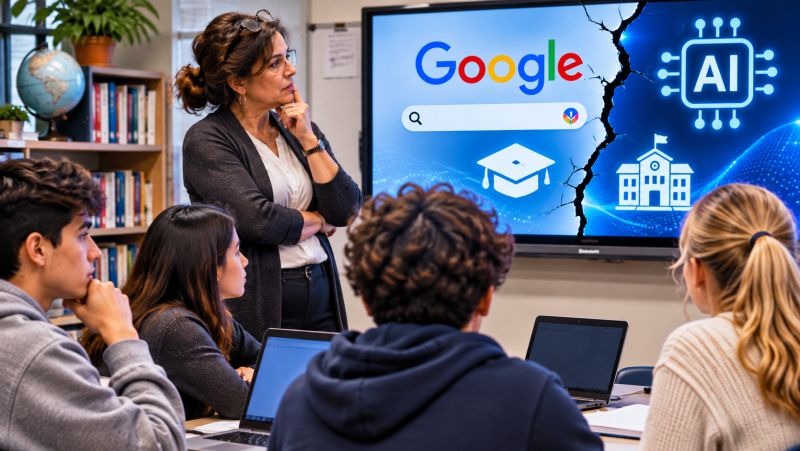
Starting in 2027, schools that reject AI-powered search may lose Google Search access on student accounts. The decision raises questions about corporate influence over education and who gets to decide how children learn.
Google is giving schools a choice about artificial intelligence in the classroom. But that choice comes with a significant condition: schools that reject AI entirely will also lose access to Google Search on their students’ school-managed accounts.
The technology giant announced November 3 that Google Search and its educational AI products will be turned off by default for K–12 student accounts beginning in early 2027. School administrators will have to explicitly enable the services.
The change follows growing concerns among educators, parents, and policymakers about the introduction of generative AI into classrooms.
But the announcement has sparked a new controversy. While schools can enable Search without necessarily activating Google’s separate Gemini chatbot products, they cannot choose a conventional version of Google Search without its integrated AI features.
Chris Phillips, Google’s vice president and general manager of education, explained that Search and AI have become deeply integrated.
For schools that want to prohibit AI altogether, the consequence is straightforward: students will not be able to use Google Search through the affected school accounts.
The policy places school administrators in an uncomfortable position. They must decide whether to accept AI-powered search or give up a widely used educational research tool.
Google Says It Is Giving Schools More Control
The company presents its announcement as an effort to make artificial intelligence safer and more useful for students. In an official statement, Google said it had listened to educators, researchers, and policymakers who wanted greater control over the technologies available in classrooms.
The new policy covers Google Search, Gemini, Gemini Notebook, and Gemini in Classroom. Access will remain disabled for K–12 student accounts until school administrators activate the services. Schools will be able to establish different levels of access for different student age groups.
Google is also introducing Guided Learning features designed to encourage students to work through academic problems rather than simply receive answers generated by AI. For example, a student seeking help with a physics problem may be guided through the reasoning process instead of immediately receiving the solution.
The company says this approach can promote critical thinking and meaningful learning. But critics question why schools cannot retain access to traditional web searches without accepting Google’s AI-powered features.
A Search Engine Becomes an Educational Bargaining Chip
Google Search has become an important part of how students conduct research, find information, and complete assignments. Google also has an extensive presence in education through Chromebooks, Google Workspace, and Google Classroom. According to the company, approximately 150 million students and educators worldwide use Google Classroom.That widespread adoption makes Google’s decisions particularly consequential.
A school district that wants to restrict generative AI may now have to reconsider how students conduct online research. The controversy is not simply about whether AI belongs in education. It concerns whether a technology company should be able to determine which combinations of services schools must accept.
Former Federal Trade Commission Chair Lina Khan accused Google of using its dominance in search to pressure schools into adopting artificial intelligence. Other critics argue that educational institutions should retain the authority to determine when students are developmentally and academically ready to use AI tools.
Google maintains that its changes are intended to provide schools with more control and better learning experiences. The disagreement highlights a growing tension between technology companies developing AI products and educators responsible for deciding how those products should be used.
Schools Are Already Questioning AI in the Classroom
Google’s announcement comes amid a broader debate over the educational consequences of generative AI. Teachers have raised concerns that students may use chatbots to complete assignments without developing the underlying knowledge or skills.
Others see considerable potential in AI-powered tutoring, personalized instruction, and assistance for students who need additional academic support. Some large school districts have already introduced restrictions while they evaluate the technology.
New York City has restricted student-facing AI for younger grades, while Los Angeles Unified has imposed a temporary moratorium on generative AI on district devices. Google’s new policy could complicate these decisions by linking access to its search engine with the acceptance of AI-enhanced search.
For schools with substantial technology resources, switching to alternative search engines or developing different research systems may be possible. Smaller districts, however, may face greater difficulties. They may lack the technical personnel, budgets, or training resources necessary to reorganize classroom technology around new restrictions. The result could be another source of inequality between well-funded schools and those operating with limited resources.
Who Should Decide How Children Learn?
The controversy raises a question that extends beyond Google. Artificial intelligence is rapidly becoming embedded in software that students and teachers already use. As those technologies become increasingly integrated, avoiding AI may become more difficult even for institutions that have legitimate educational reasons to limit it.
Google argues that its Guided Learning approach will help students develop understanding rather than bypass the learning process. That objective deserves serious consideration. But educational decisions involve more than the capabilities of a particular product.
Teachers must consider students’ ages, academic development, learning difficulties, classroom objectives, and the potential effects of technology on independent thinking. A school may reasonably conclude that some students should learn to evaluate sources, construct arguments, and solve problems before relying extensively on AI-generated assistance. Others may decide that carefully supervised AI tools can strengthen those same abilities. The essential issue is whether schools retain meaningful freedom to make those decisions.
What Happens Next?
Google says the new controls will begin rolling out in early 2027, with additional details to be provided to educational institutions beforehand. Schools will need to review their technology policies, determine which AI services to enable, and communicate those decisions to teachers, students, and parents.
The company may also face continued pressure to explain why it cannot provide a version of Google Search without generative AI features for educational accounts. For now, the announcement illustrates a broader transformation in the relationship between schools and technology providers.
AI is no longer merely an optional chatbot that students can choose to open. It is becoming part of the infrastructure through which they access information.And that creates a question with consequences far beyond the classroom:
When technology companies control the tools students use to learn, how much control do educators really have?
Sources
- Google, Designing Responsible AI for Learning, November 3, 2026.
- Associated Press, Google Will Cut Off Search Access for Students at Schools That Reject AI Tools, November 3, 2026.
- Education Week, Google’s New Rules Hand Schools Hard Choices About AI and Search, November 3, 2026.
- The Guardian, Google Says There’s No Way to Use Search Without Using Artificial Intelligence, November 3, 2026.