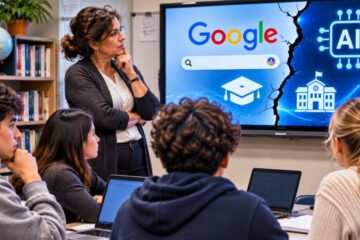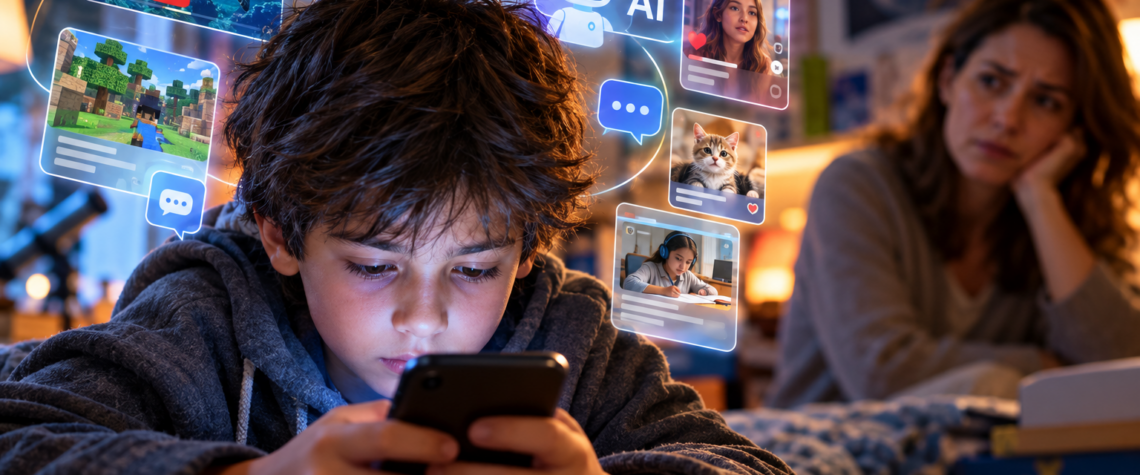
Smartphones already give children access to an enormous digital world. Artificial intelligence adds something new: a technology that can teach, create, advise and converse. That brings remarkable possibilities—and new responsibilities for parents.
For years, parents have worried about what children do on their phones. How much time are they spending on them? What are they watching? Who are they talking to? Are they using the phone when they should be sleeping, studying or interacting with other people? Now another question has arrived: What happens when artificial intelligence becomes part of the phone?
AI can help a child understand fractions, practice Spanish, explore the solar system or learn why dinosaurs disappeared. It can also write homework, produce convincing false information, generate images and carry on conversations that can feel surprisingly human. The smartphone was already a powerful doorway to the world. AI makes that doorway considerably more complicated.
Not all screen time is the same
It is tempting to measure children’s technology use simply in hours. Two hours. Four hours. Six hours. But what a child is doing during those hours matters. Video-chatting with grandparents isn’t the same as endlessly scrolling through short videos. Reading isn’t the same as gaming. Creating music isn’t the same as watching content selected automatically by an algorithm. Using AI to understand a difficult math problem isn’t the same as asking AI to complete the homework. Parents therefore need to look beyond one number called screen time. A better question is: What is the child doing on the screen?
The phone competes with other parts of childhood
Smartphones are unusually effective at filling empty moments.
Waiting for dinner? … Phone.
Riding in the car? … Phone.
Bored? … Phone.
Going to bed?… Phone.
That convenience has benefits. But children also need activities that don’t involve screens: physical activity, sleep, reading, conversation, play and sometimes simply being bored. Boredom isn’t necessarily a problem that technology must solve. It can be the moment when a child invents a game, draws something, explores outside or begins asking questions. The objective doesn’t have to be eliminating smartphones. It can be ensuring that the phone doesn’t gradually displace everything else.
AI can be an extraordinary tutor
This is the other side of the story. Imagine a child who doesn’t understand a math lesson.Instead of asking AI: “Give me the answer.”
the child can say: “Don’t solve this for me. Explain how I can solve it myself.” AI can provide another example. Then another. It can create practice questions. It can adjust an explanation when the first one doesn’t work. A child learning a language can practice conversation without being embarrassed by mistakes. A curious student can ask: “Why is the ocean salty?” and immediately continue:“But where did the salt come from?” Used this way, AI can encourage something education has always valued: curiosity.
But an answer isn’t necessarily the truth
Children also need to understand one of AI’s most important limitations. It can be wrong. And sometimes it can be wrong while sounding completely confident. That makes AI literacy different from simply knowing how to operate an application. Children need to learn to ask: Where did this information come from? Can I verify it? Does another reliable source say the same thing? Is this fact—or something the AI generated because it seemed like a plausible answer? The lesson isn’t “Never trust AI.” Nor should it be “AI knows the answer.” The healthier lesson is: “Check important information.”
AI can do the homework without doing the learning
This may be one of the most immediate problems for families and schools. A student can now ask AI to write an essay, solve an equation or answer a worksheet. The result may even be excellent. But the purpose of homework is usually not the production of a document. It is the thinking required to produce it. Researching. Reading. Making mistakes. Developing an argument. Trying again. AI can support that process—or bypass it entirely. Parents therefore may need to replace the traditional question: “Did you finish your homework?” with another: “How did you do your homework?”. A chatbot can sound more human than it is
There is another difference between AI and previous technologies.
A search engine gives results. A calculator gives answers. An AI chatbot can converse. It may respond sympathetically, remember context within a conversation and use language that feels personal. Adults can sometimes forget that there isn’t another human being behind those words. Children may find that distinction even more difficult. That doesn’t mean conversations with AI are inherently harmful. But children should understand what they are interacting with. An AI assistant can simulate conversation. It doesn’t have human friendship, judgment, responsibility or concern for the child in the way a parent, teacher or friend does. For important personal problems, children still need people.
Privacy becomes part of the conversation
Children may tell an AI things they would never type into a search engine. Their name. Their school. Where they live. Family problems. Photographs. Personal worries. Parents have spent years teaching children not to share personal information with strangers online. AI requires an updated version of that lesson. Before entering information, children should learn to ask:
Do I really need to tell the AI this?
Passwords, addresses, financial information, private photographs and other sensitive information should not casually become part of an AI conversation.
Parents don’t have to become AI experts
This may be reassuring. Parents don’t need to understand how large language models work. They do need to understand how their children use them. Try the technology yourself. Ask your child to show you what they do with AI. Instead of beginning with: “You’re not allowed to use this.” try: “Show me how you’re using it.”
That conversation may reveal considerably more. You may discover a child using AI to cheat. You may also discover a child using it to understand something that nobody had been able to explain clearly before.
Some boundaries still make sense
Every family will make different decisions depending on a child’s age, maturity and circumstances. But technology doesn’t have to be available every minute simply because it can be. Families can establish phone-free meals. Phones can stay outside the bedroom at night. Parents can review privacy and notification settings with younger children. Schools and teachers can establish when AI is permitted for assignments and when students are expected to work independently. The objective isn’t surveillance for its own sake. It is gradually teaching children to manage technology themselves. Because eventually parents won’t be standing beside them.
Children need something more valuable than restrictions
Every generation of parents has encountered technologies that seemed capable of changing childhood. Television. Video games. The internet. Social media. Smartphones. Artificial intelligence is the latest—and in some ways one of the most powerful. It deserves neither panic nor blind enthusiasm. AI can help children learn, create and explore. It can also distract them, mislead them and make it remarkably easy to avoid difficult intellectual work. The technology itself cannot decide which of those experiences a child will have.
Parents, teachers and children will have to learn that together. Perhaps the most useful thing we can teach a child isn’t simply how to use AI. It is knowing when to use it. When to question it. When to put the phone down. And when to think for themselves.